Refreshing an Oracle database is a routine yet critical task for many administrators. Whether you need to update your test environment with production data or recover from an error, this process must be handled with care. Mistakes can lead to downtime or data loss. RMAN (Recovery Manager) is Oracle’s built-in tool for backup and recovery tasks like these—it helps automate complex steps and reduces risk when refreshing databases.
What Is Oracle Database Refresh?
An Oracle database refresh means replacing the data in a target database with data from another source—most often a recent production backup. This keeps test or development environments current with real-world data or helps restore systems after corruption or mistakes. You can perform a refresh at either the full database level or just for specific tablespaces based on your needs.
A full refresh overwrites everything in the target system with new data files from backup sets. A partial refresh targets only selected tablespaces—useful if only certain business units need updated information.
Why Use RMAN Backup for Refresh?
RMAN is tightly integrated into Oracle databases and automates many manual steps that are prone to error if done by hand. It supports both full and incremental backups while maintaining block-level consistency across all files involved in a restore operation. Using RMAN ensures that your refreshed environment matches your source exactly—even down to transaction timing if you use point-in-time recovery features.
With RMAN’s automation capabilities, you reduce human error during restores—a key concern when working with mission-critical systems where even small mistakes can have big consequences.
How to Perform a Full Database Refresh Using RMAN?
A full database refresh replaces every file in your target system with those from an RMAN backup set taken from another instance—usually production copied over to test or development servers.
Critical Pre-Restore Checks and Preparation
Before starting any restore operation using RMAN backups, take time for careful preparation:
Version Compatibility: Make sure your target server runs an Oracle version equal to or newer than the source backup.
Backup Validation: Always validate backups before use by running VALIDATE BACKUPSET within RMAN.
Archived Logs: Confirm that all needed archived redo logs are available; missing logs will prevent complete recovery.
Password Files: If SYSDBA authentication uses password files on the source system, copy them over or recreate them on the target.
Parameter File Review: Adjust parameters such as db_name, db_unique_name, memory settings (memory_target), process limits (processes), file destinations (DB_CREATE_FILE_DEST), control file locations (CONTROL_FILES), archive log paths (LOG_ARCHIVE_DEST_1), diagnostic destinations (DIAGNOSTIC_DEST), and cluster settings if applicable.
Step-by-Step Process
First, ensure you have a valid RMAN backup from your source database along with its parameter file (PFILE or SPFILE). Transfer these files securely to your target server using tools like SCP or Rsync for reliability.
1. Prepare the Environment:
On the target server, create directories needed for data files, control files, redo logs, archive logs, diagnostics output—matching what’s specified in your parameter file.
2. Start Database in NOMOUNT Mode:
Set up environment variables so that SQLPlus points at your new SID (system identifier). Then start SQLPlus:
STARTUP NOMOUNT PFILE='/path/to/init.ora'
3. Restore Control File:
Connect through RMAN:
RESTORE CONTROLFILE FROM '/path/to/controlfile_backup';
If you used automatic backups cataloged by RMAN previously:
RESTORE CONTROLFILE FROM AUTOBACKUP;
4. Mount Database:
In SQL*Plus:
ALTER DATABASE MOUNT;
5. Catalog Backups:
If you moved backup pieces onto this server manually:
CATALOG START WITH '/path/to/backup/';
6. Managing File Location Changes During Restore
If directory structures differ between source and target servers—or if restoring multiple times—you may need persistent mappings using SET NEWNAME FOR DATABASE TO '/new/datafile/location/%b';. For repeated operations consider configuring AUXNAMEs within RMAN scripts.
Preview planned actions before execution:
RESTORE DATABASE PREVIEW;
7. Restore Database Files:
Run inside an RMAN script block:
    RUN {
      SET NEWNAME FOR DATABASE TO '/new/datafile/location/%b';
      RESTORE DATABASE;
      SWITCH DATAFILE ALL;
    }
8. Recover Database:
Apply archived redo logs as needed:
RECOVER DATABASE;
To roll forward only up until a certain time—for example during testing—use:
RECOVER DATABASE UNTIL TIME "TO_DATE('2024-06-01 12:00:00', 'YYYY-MM-DD HH24:MI:SS')";9. Open Database With RESETLOGS
After successful recovery:
ALTER DATABASE OPEN RESETLOGS;
This step creates a new incarnation of your database; previous backups become unusable for future restores here.
How to Perform a Tablespace-Level Refresh Using RMAN?
Sometimes only part of your environment needs updating—a single business unit’s schema perhaps—or maybe just one application’s tablespace has become corrupted while others remain healthy.
Tablespace-level refreshes are less disruptive than full restores but require attention to dependencies between objects stored across different tablespaces.
Before proceeding make sure that:
Use PL/SQL procedure DBMS_TTS.TRANSPORT_SET_CHECK beforehand:
  EXEC DBMS_TTS.TRANSPORT_SET_CHECK('tablespace_name', TRUE);
  SELECT * FROM TRANSPORT_SET_VIOLATIONS;
If violations exist address them first; otherwise proceed:
1. Take affected tablespace offline in SQL*Plus:
ALTER TABLESPACE your_tablespace OFFLINE IMMEDIATE;
While offline any applications relying on objects within it will be unavailable until completion of restore/recovery steps below.
2–3–4 follow similar logic as above but focus only on named tablespaces rather than entire DB:
2.Restore via RMAN command line interface—
RESTORE TABLESPACE your_tablespace;
3.Recover same way—
RECOVER TABLESPACE your_tablespace;
4.Bring back online once satisfied no errors occurred—
ALTER TABLESPACE your_tablespace ONLINE;
This targeted approach saves time/resources especially useful when large databases contain isolated workloads needing frequent updates.
Vinchin Backup & Recovery: Enterprise-Level Solution for Oracle Backup & Migration
For organizations seeking streamlined automation beyond native tools, Vinchin Backup & Recovery delivers robust enterprise-grade protection tailored for modern environments—including comprehensive support for Oracle databases alongside MySQL, SQL Server, MariaDB, PostgreSQL, PostgresPro, and TiDB platforms. As an advanced solution designed specifically for today's mixed-database infrastructures, Vinchin Backup & Recovery offers essential features such as batch database backup management, flexible retention policies including GFS retention policy options, cloud backup and tape archiving integration, integrity checks with automated verification routines via SQL scripts, and secure storage protection against ransomware threats—all contributing to reliable compliance-ready operations while minimizing administrative overhead through centralized management.
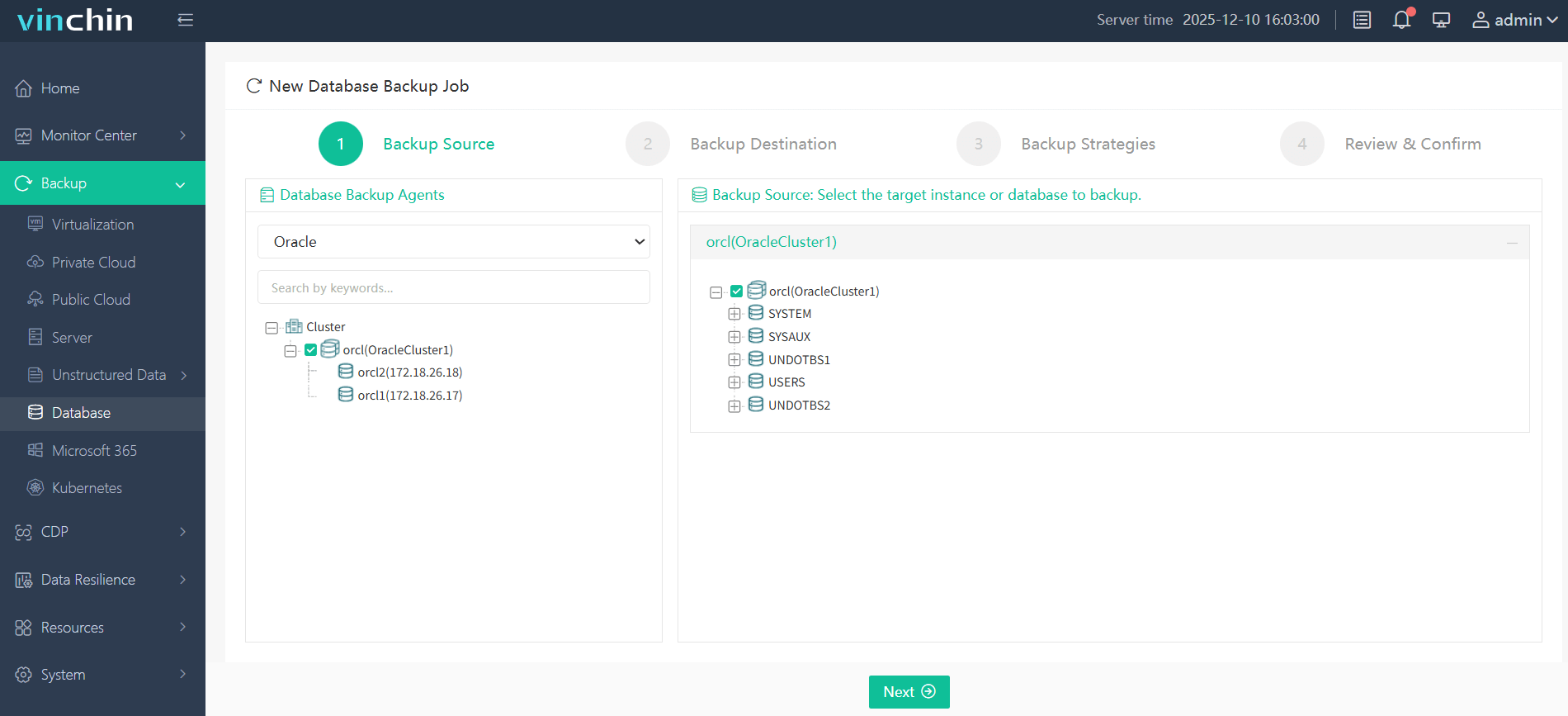
The intuitive web console makes safeguarding Oracle databases remarkably straightforward:
Step 1. Select the Oracle database to back up
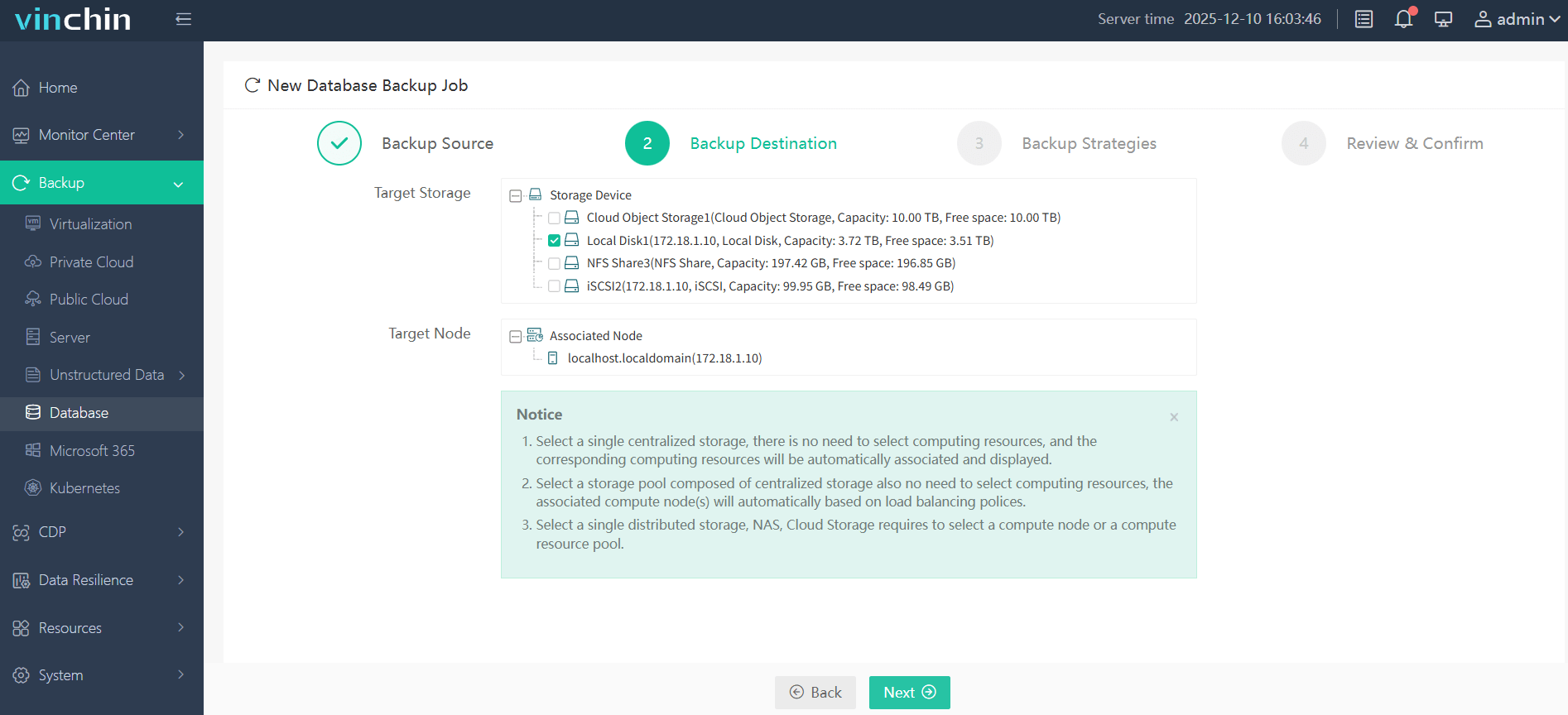
Step 2. Choose the backup storage
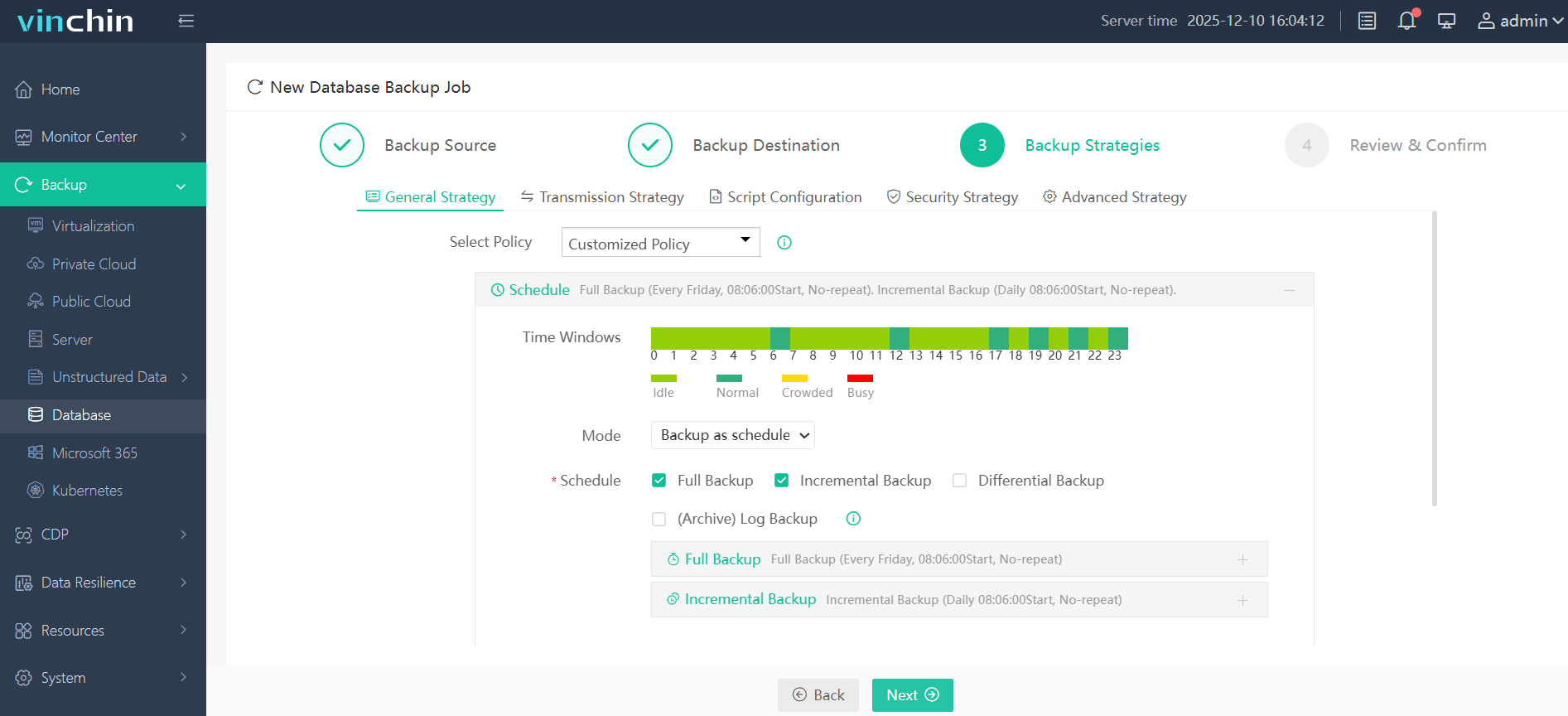
Step 3. Define the backup strategy
Step 4. Submit the job
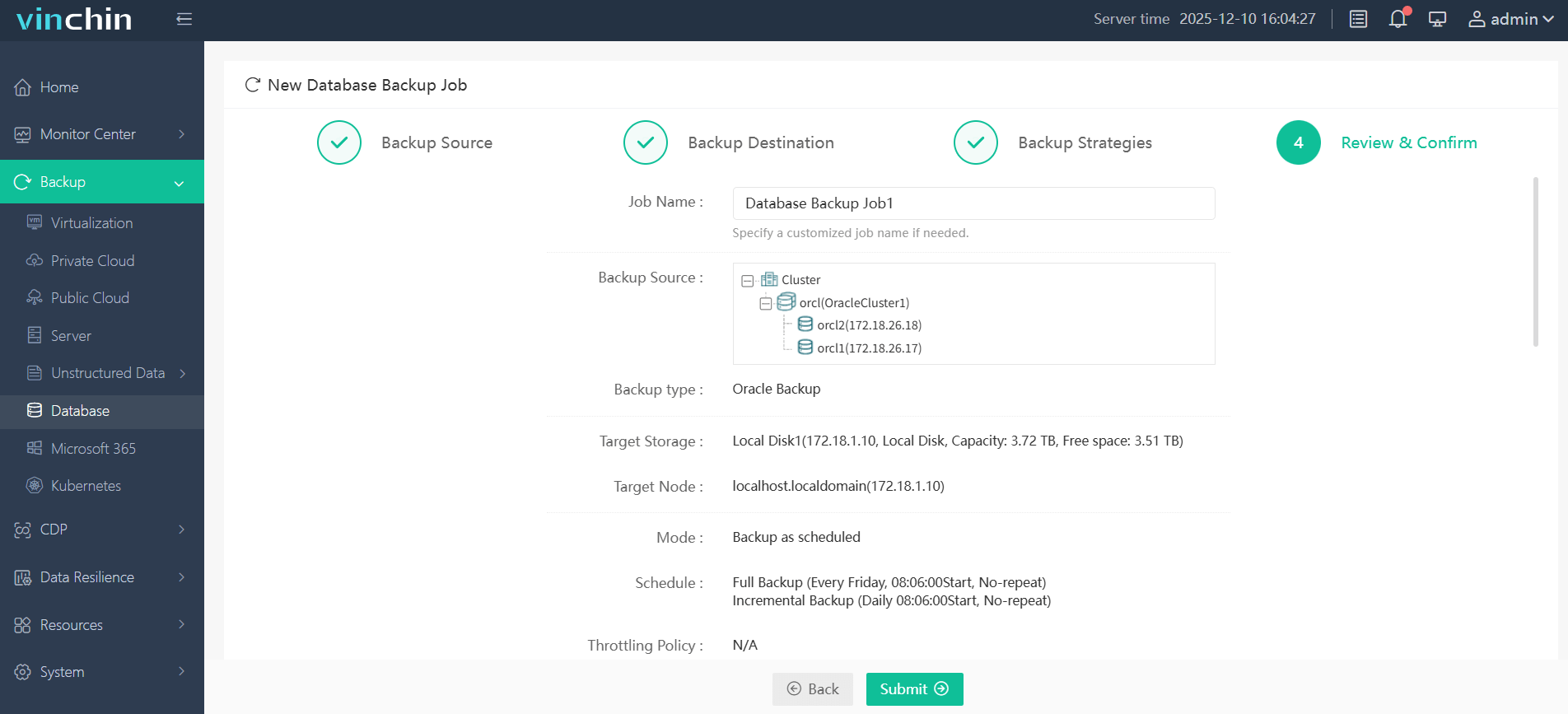
Recognized globally among leading enterprise data-protection solutions—with thousands of customers worldwide and top industry ratings—Vinchin Backup & Recovery offers a fully functional free trial lasting 60 days so you can experience its benefits firsthand; click below to get started!
Oracle Database Refresh Using RMAN Backup FAQs
Q1: Can I perform an online refresh of my test database using an active production RMAN backup?
A1: No—you must shut down the target before restoring from backup since open files cannot be safely overwritten during this process.
Q2: What should I do if my restored environment reports missing archived logs?
A2: Manually register missing log files using CATALOG ARCHIVELOG command then rerun RECOVER commands until complete.
Q3: How do I check whether my chosen tablespaces are self-contained before attempting partial restore?
A3: Run EXEC DBMS_TTS.TRANSPORT_SET_CHECK('tablespace_name', TRUE); then review TRANSPORT_SET_VIOLATIONS table output.
Conclusion
Refreshing an Oracle database using RMAN backup keeps environments synchronized while reducing risk through automation.RMAN handles both full-system clones partial updates reliably.For even greater simplicity consider Vinchin's automated solutions—they streamline protection so IT teams stay focused on business priorities instead of manual maintenance tasks!