Oracle Recovery Manager (RMAN) is essential for backup and recovery in Oracle databases. In Oracle 12c, RMAN offers many configuration parameters that help you automate, optimize, and secure your backup strategy. Knowing how to manage these settings is vital for every database administrator. But what do these parameters really control? How can you set them up to build a reliable backup environment? Let’s break down the key parameters and how to configure them for a resilient, production-ready environment.
What Are RMAN Configuration Parameters?
RMAN configuration parameters are persistent settings that guide how RMAN handles backup and recovery tasks. These options define where backups go, how long they are kept, whether they’re compressed or encrypted, how many copies exist—and much more. Once you set these values using CONFIGURE, they stay active until changed again. This means you don’t need to specify them every time you run an operation; automation becomes simpler.
For busy operations teams managing multiple databases or complex environments, this persistence saves time and reduces human error. You can focus on higher-level planning instead of repeating manual steps.
Key RMAN Configuration Parameters in Oracle 12c
Oracle 12c provides many RMAN configuration parameters—each serving a specific role in your backup plan. Understanding their purpose helps you avoid mistakes that could put data at risk or waste resources.
Let’s look at some of the most important ones:
Retention Policy: Controls when backups become obsolete based on either redundancy (number of copies) or recovery window (days). For example, setting it to “recovery window of 7 days” ensures backups needed for point-in-time recovery within seven days are retained.
Backup Optimization: When enabled with CONFIGURE BACKUP OPTIMIZATION ON, RMAN skips files already backed up according to retention policy—unless you use FORCE during backup commands. This saves storage space but requires careful policy management.
Default Device Type: Specifies if backups go by default to disk (DISK) or tape (SBT_TAPE). Setting this correctly streamlines routine jobs.
Controlfile Autobackup: With CONTROLFILE AUTOBACKUP ON, Oracle automatically backs up both the control file and server parameter file after structural changes or regular backups—critical for disaster recovery scenarios.
Backup Format and Location: Use format strings like '/backup/rman/db_%U' to define naming conventions and storage paths for backup files; this keeps files organized by date or type.
Parallelism: Sets how many channels (streams) RMAN uses during operations via PARALLELISM n; higher values can speed up jobs but may stress system resources if set too high.
Compression & Encryption: Enable compression (COMPRESSED BACKUPSET) to save space; enable encryption (ENCRYPTION FOR DATABASE ON) for security—but remember encryption needs wallet setup first.
Archivelog Deletion Policy: Controls when archived redo logs can be deleted (for example, only after being backed up at least once); prevents accidental loss of logs needed for recovery.
Snapshot Controlfile Name: Sets location/name of snapshot control file—a temporary copy used during backup jobs so that ongoing database activity doesn’t cause errors like “snapshot too old.” Place it on fast local storage outside your main data area whenever possible.
You set these using the CONFIGURE command inside an RMAN session. To see all current settings—including defaults—use SHOW ALL;. Regularly reviewing these helps ensure compliance with company policies or audit requirements.
How to Set and View RMAN Parameters in Oracle 12c?
Configuring RMAN parameters in Oracle 12c is straightforward but demands attention to detail—mistakes here can have big consequences later! Here’s how you view current settings, make changes safely, clear unwanted values back to defaults—and why each step matters.
First connect as usual:
$ rman target /
To review all current parameter settings:
RMAN> SHOW ALL;
This lists every configurable option along with its user-defined value (if any) or default value otherwise—for example:
CONFIGURE RETENTION POLICY TO RECOVERY WINDOW OF 4 DAYS;
CONFIGURE BACKUP OPTIMIZATION ON;
CONFIGURE DEFAULT DEVICE TYPE TO DISK;
...
CONFIGURE SNAPSHOT CONTROLFILE NAME TO '/u01/app/oracle/product/12.2.0/dbhome_1/dbs/snapcf_prodserver.f';
Tip: Script this output regularly as part of your documentation process—it’s invaluable during audits or troubleshooting!
To change any parameter:
RMAN> CONFIGURE RETENTION POLICY TO RECOVERY WINDOW OF 7 DAYS;
RMAN> CONFIGURE BACKUP OPTIMIZATION ON;
RMAN> CONFIGURE DEFAULT DEVICE TYPE TO DISK;
RMAN> CONFIGURE CONTROLFILE AUTOBACKUP ON;
RMAN> CONFIGURE CONTROLFILE AUTOBACKUP FORMAT FOR DEVICE TYPE DISK TO '/backup/rman/cf_%F';
RMAN> CONFIGURE DEVICE TYPE DISK PARALLELISM 2;
RMAN> CONFIGURE DEVICE TYPE DISK BACKUP TYPE TO COMPRESSED BACKUPSET;
Want custom locations? Use format strings:
RMAN> CONFIGURE CHANNEL DEVICE TYPE DISK FORMAT '/backup/rman/datafile_%U.bkp';
Need smaller pieces due to filesystem limits?
RMAN> CONFIGURE CHANNEL DEVICE TYPE DISK MAXPIECESIZE 2G;
This helps when copying files offsite or working around size restrictions imposed by external storage systems.
To reset any parameter back to its default:
RMAN> CONFIGURE RETENTION POLICY CLEAR;
Note there is no single command that resets all parameters at once—you must clear each individually if needed.
For snapshot controlfile placement:
RMAN> CONFIGURE SNAPSHOT CONTROLFILE NAME TO '/backup/rman/snapcf_prodserver.f';
Best practice is placing this file on fast local storage not shared with main database files—to reduce risk from hardware failures affecting both primary datafiles and critical metadata snapshots.
Remember—every change persists across sessions until explicitly changed again!
How to Protect Oracle Databases with Vinchin Backup & Recovery?
After establishing robust RMAN configuration parameters in Oracle 12c, organizations seeking streamlined enterprise-grade protection should consider Vinchin Backup & Recovery. As a professional solution supporting leading platforms such as Oracle, MySQL, SQL Server, MariaDB, PostgreSQL, PostgresPro, and TiDB databases—with special emphasis on comprehensive support for Oracle environments—it delivers advanced features tailored for modern IT needs.
Vinchin Backup & Recovery empowers users with incremental backup capabilities for rapid protection cycles; advanced source-side compression reduces network load and optimizes storage usage; batch database backup simplifies scheduling across multiple instances; flexible multi-level retention policies align with diverse compliance requirements; while integrity check ensures recoverability confidence at all times. Together these features maximize efficiency while minimizing operational risk throughout the entire lifecycle of your database assets.
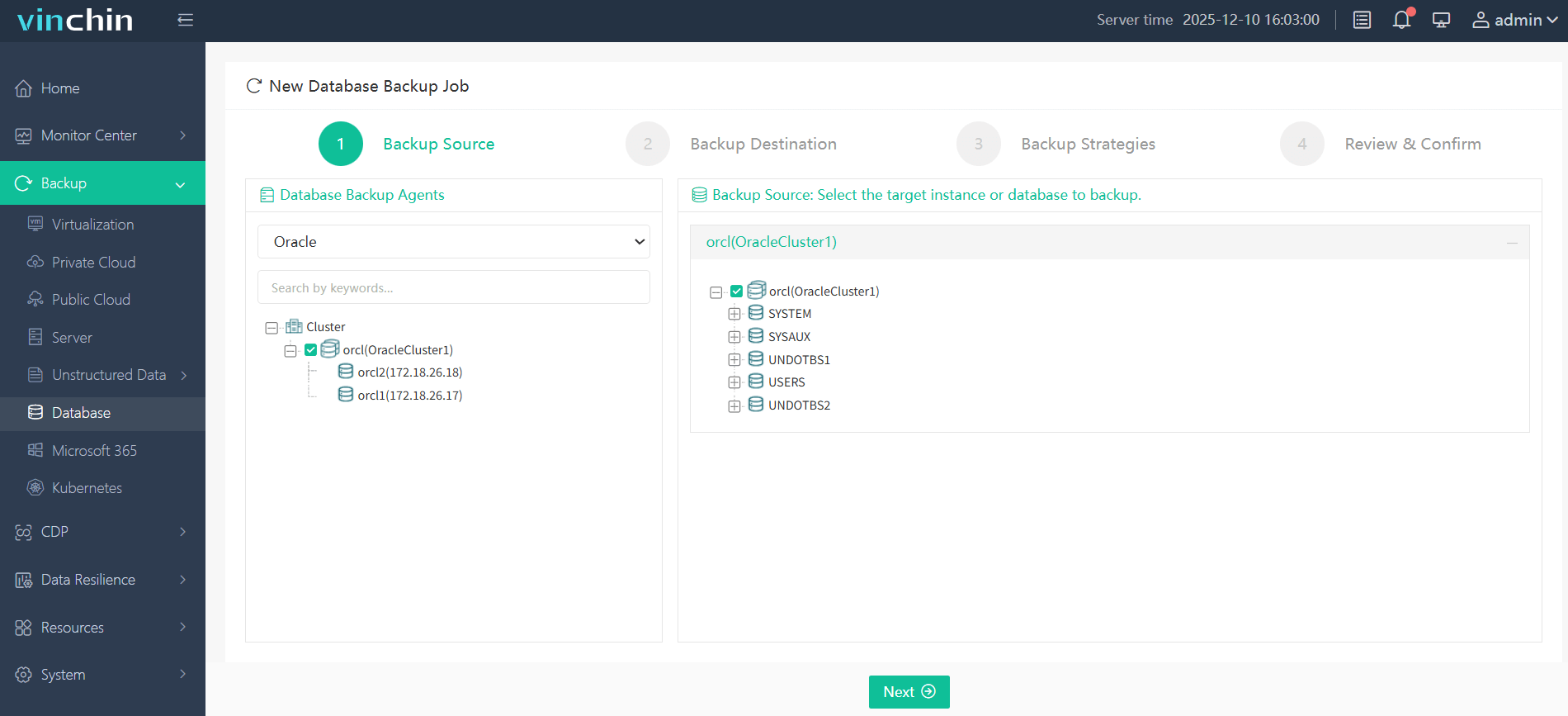
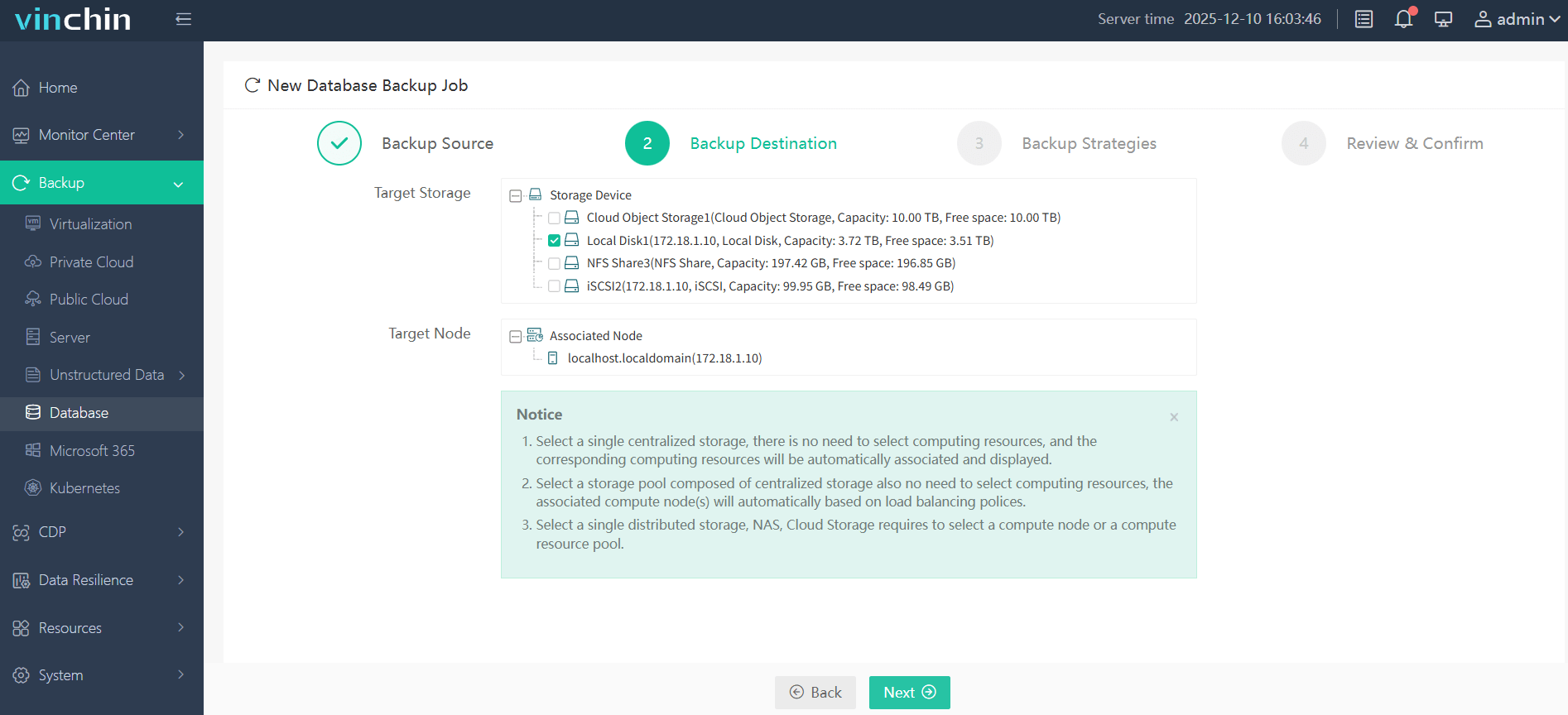
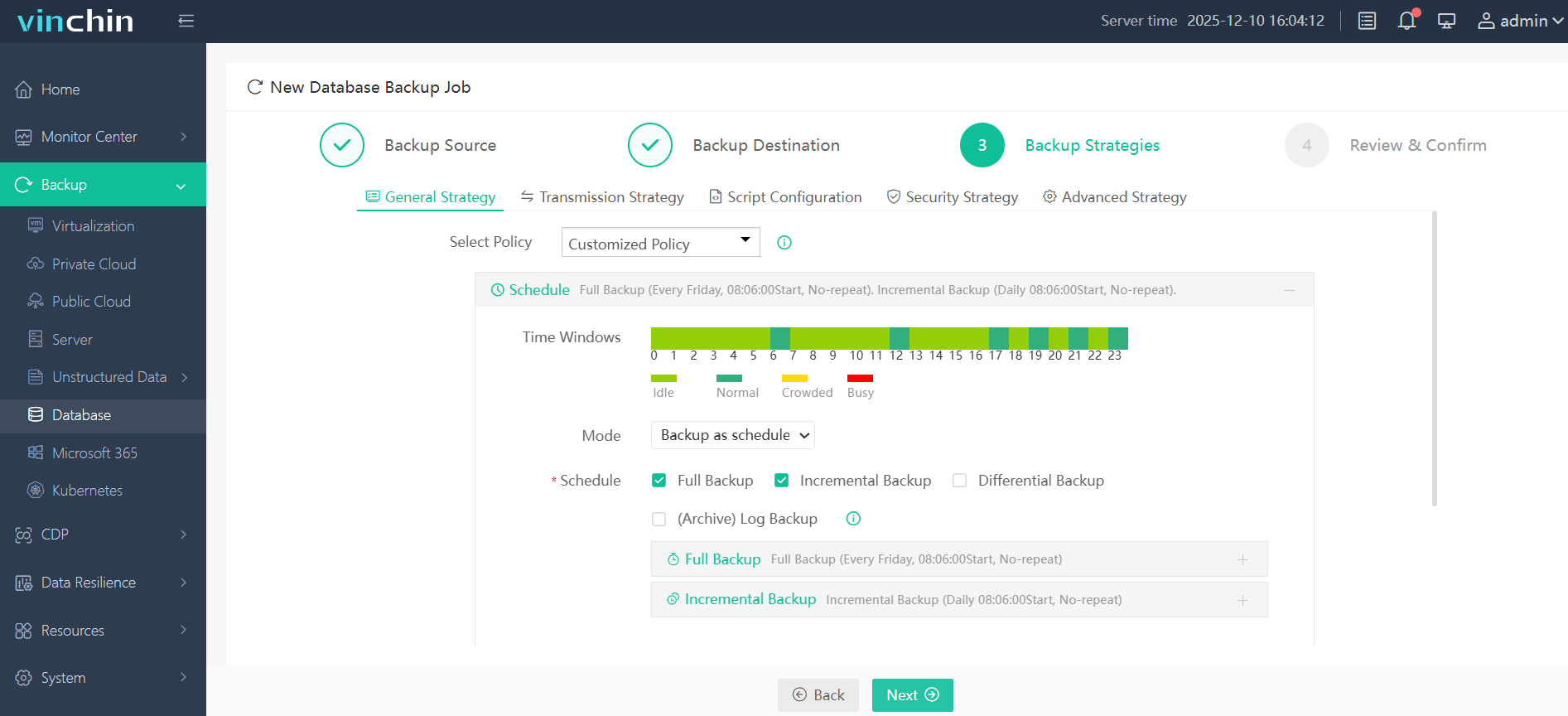
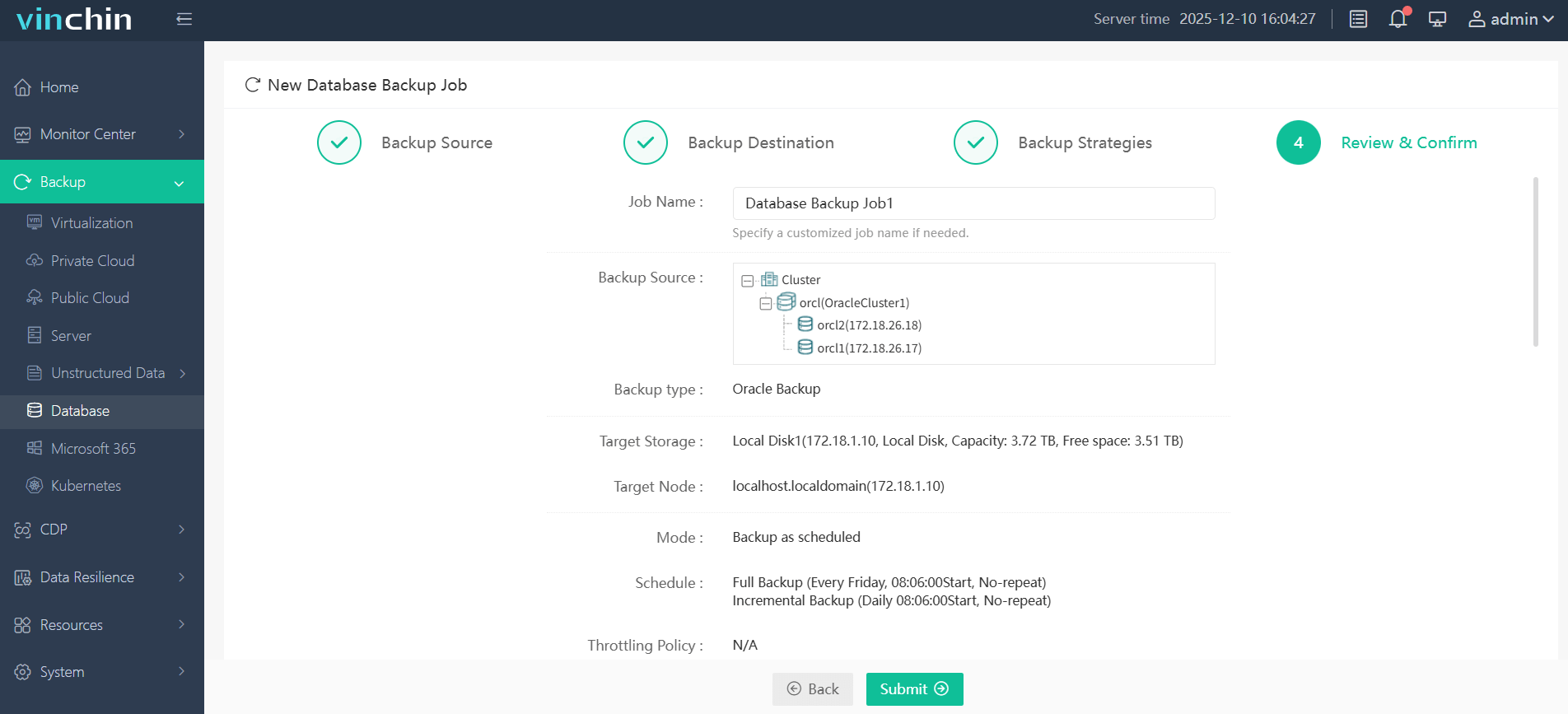
The intuitive web console makes safeguarding your Oracle database exceptionally simple—just follow four steps:
Step 1. Select the Oracle database to back up
Step 2. Choose the backup storage
Step 3. Define the backup strategy
Step 4. Submit the job
Recognized globally among enterprises for reliability and innovation—with thousands of satisfied customers worldwide—Vinchin Backup & Recovery offers a fully functional free trial valid for sixty days. Click below now to experience top-rated enterprise data protection firsthand!
RMAN Configuration Parameters in Oracle 12c FAQs
Q1: How do I reset all RMAN configuration parameters back to their defaults?
A1: There isn’t one command; connect via RMAN then run SHOW ALL, then issue CONFIGURE <parameter> CLEAR individually for each non-default setting until all are reset.
Q2: Can I store different types of backups in separate directories using channels?
A2: Yes; configure channels separately using CONFIGURE CHANNEL DEVICE TYPE <type> FORMAT 'your_path' per desired location/type combination before running relevant jobs.
Q3: How do I check if compression is active on my current disk-based backups?
A3: Run SHOW ALL inside an open RMAN session then look specifically for line stating DEVICE TYPE DISK BACKUP TYPE TO COMPRESSED BACKUPSET.
Q4: What happens if I set parallelism very high relative to my hardware capacity?
A4: Excessive parallelism may cause slowdowns due excessive CPU/I/O contention—instead start low then increase gradually while monitoring system load/performance metrics closely!
Q5: How do I send my Oracle backups directly onto tape devices instead of disk?
A5: Install/configure media manager software first then use ALLOCATE CHANNEL/CONFIGURE CHANNEL specifying device type SBT plus correct PARMS string per vendor documentation before launching tape-based jobs.
Conclusion
Mastering RMAN configuration parameters in Oracle 12c lets you fine-tune every aspect of your backup environment—from speed through safety right down granular retention controls! By understanding these options deeply—and applying best practices—you’ll keep critical business data protected against almost any threat imaginable! For even greater simplicity plus peace-of-mind try Vinchin’s robust solution free today—it brings enterprise-grade protection within everyone’s reach!