When you work with Oracle RMAN (Recovery Manager), you often see the command ALLOCATE CHANNEL DEVICE TYPE DISK. But what does it really do, and why is it important? For database administrators, channel allocation is a key lever for backup performance tuning and resource management. If you want to speed up backups, control where your data goes, or troubleshoot performance bottlenecks, understanding RMAN channels is essential. Let’s break down the concept, the reasons for allocating disk channels, and the exact steps to do it—both manually and automatically.
What Is an RMAN Channel?
An RMAN channel is a link between RMAN and your Oracle database instance. Each channel represents a single stream of data to a storage device, such as disk or tape. When you run backup or restore commands, RMAN uses these channels to move data between your database and storage.
Think of a channel as a dedicated worker: it starts a server session on the database and handles the actual backup or restore work. Each worker can operate independently. You can have one or more channels active at once, depending on your Oracle edition and hardware resources.
More channels mean more parallelism. This can speed up operations if your system has enough CPU power and I/O bandwidth. However, using too many channels may overload your disks or CPUs instead of helping.
Why Allocate Channel Disk in RMAN
Allocating a disk channel in RMAN enables fine-grained management of backup resources and performance. By default, RMAN uses a single preconfigured disk channel for backups. But what if you want to:
Run backups in parallel for faster throughput?
Direct backup files to specific disk locations?
Set limits on backup piece size or bandwidth usage?
Use different settings for different devices?
Allocating channels—either manually or automatically—lets you do all this. It’s especially useful for large databases or when you need to fine-tune backup jobs to match your hardware setup.
If you don’t allocate channels yourself, RMAN falls back on its defaults—which may not be optimal for every environment. Manual allocation gives you full control over how many streams are used and where each writes its output.
How to Allocate a Disk Channel in RMAN?
Manual channel allocation gives you maximum control over how backups are performed. You use the ALLOCATE CHANNEL command inside a RUN block within an RMAN session.
This method is best when you want to specify exactly how many channels to use, direct output files to certain disks, set special options like file size limits, or throttle I/O rates.
Here’s how manual allocation works step by step:
1. Start RMAN and connect to your target database.
2. Enter a RUN block using the keyword RUN { ... }.
3. Allocate one or more channels with ALLOCATE CHANNEL, specifying DEVICE TYPE DISK.
4. Optionally set parameters like file format paths using FORMAT, which supports variables like %U for unique filenames—a best practice that prevents overwrites.
5. Run your desired backup command (such as BACKUP DATABASE) inside the same block.
6. Channels are released automatically at the end of the block; no extra action needed unless you want explicit release.
For example, here’s how to allocate two disk channels so each writes backups to separate disks:
RUN {
  ALLOCATE CHANNEL ch1 DEVICE TYPE DISK FORMAT '/disk1/backup/%U';
  ALLOCATE CHANNEL ch2 DEVICE TYPE DISK FORMAT '/disk2/backup/%U';
  BACKUP DATABASE;
}
In this script:
Each channel writes its own stream of data
The %U variable ensures each file name is unique
Spreading I/O across multiple disks improves performance
You can also set options like MAXPIECESIZE if needed:
RUN {
  ALLOCATE CHANNEL ch1 DEVICE TYPE DISK FORMAT '/disk1/backup/%U' MAXPIECESIZE 5G;
  BACKUP DATABASE;
}
Remember: Oracle supports up to 255 concurrent channels per job, but practical limits depend on hardware capacity and licensing level (Enterprise Edition required for high parallelism). For best results, match the number of allocated channels with available physical disks or CPU cores—but always test before scaling up further.
How to Use Automatic Channel Allocation in RMAN?
Automatic channel allocation lets RMAN handle most configuration details itself via persistent settings defined by the DBA using CONFIGURE commands. This approach simplifies routine backups while ensuring consistent behavior across jobs—even those scheduled by scripts or third-party tools.
To enable automatic allocation:
1. Configure parallelism with CONFIGURE DEVICE TYPE DISK PARALLELISM n;, where n equals desired number of concurrent streams.
2. Optionally set default device type using CONFIGURE DEFAULT DEVICE TYPE TO DISK;
3. Optionally define output locations per-channel via statements such as:
4. Run any standard backup command (like BACKUP DATABASE;) directly at the prompt—no need for manual RUN blocks unless overriding defaults temporarily.
Example configuration:
CONFIGURE DEVICE TYPE DISK PARALLELISM 3;
CONFIGURE CHANNEL 1 DEVICE TYPE DISK FORMAT '/disk1/backup/%U';
CONFIGURE CHANNEL 2 DEVICE TYPE DISK FORMAT '/disk2/backup/%U';
CONFIGURE CHANNEL 3 DEVICE TYPE DISK FORMAT '/disk3/backup/%U';
Now whenever you execute:
BACKUP DATABASE;
RMAN will launch three parallel disk streams writing uniquely named pieces across three separate destinations—automatically balancing load without further intervention from operators.
You can review current settings anytime with:
SHOW DEVICE TYPE;
SHOW CHANNEL;
To reset any configuration back to factory defaults use CLEAR commands such as:
CONFIGURE DEVICE TYPE DISK CLEAR;
CONFIGURE CHANNEL DEVICE TYPE DISK CLEAR;
Automatic allocation works well for regular jobs but remains flexible: manual allocations inside RUN blocks always take precedence over automatic settings—perfect when special requirements arise unexpectedly!
When Should You Use Manual vs Automatic Channel Allocation?
Choosing between manual and automatic methods depends on both workload complexity and operational preferences.
Manual allocation shines when:
You need precise control over every aspect of resource usage (e.g., during migrations)
Different jobs require distinct configurations due either hardware layout changes or business priorities
Troubleshooting specific issues related directly backtraceable sessions/channels
Automatic allocation fits best when:
Most jobs follow similar patterns day-to-day
Consistency matters more than micro-level tuning
Staff turnover means ease-of-use outweighs deep customization needs
Many organizations start with automatic settings then override them only occasionally—for example during quarterly full backups versus daily incrementals—or when troubleshooting unexpected slowdowns revealed by monitoring tools mentioned above!
Enterprise-Level Oracle Backup Made Simple With Vinchin Backup & Recovery
While mastering native tools like RMAN provides granular control over Oracle database protection strategies, organizations seeking streamlined enterprise-grade solutions should consider Vinchin Backup & Recovery—a professional platform supporting today’s leading databases including Oracle, MySQL, SQL Server, MariaDB, PostgreSQL, PostgresPro, and TiDB. Vinchin Backup & Recovery delivers essential features such as batch database backup management; incremental backup capabilities; advanced source-side compression; comprehensive cloud/tape archiving integration; plus strong integrity check mechanisms—all designed for efficiency at scale while minimizing administrative overhead through automation and policy-driven retention controls.
The intuitive web console makes safeguarding Oracle databases straightforward:
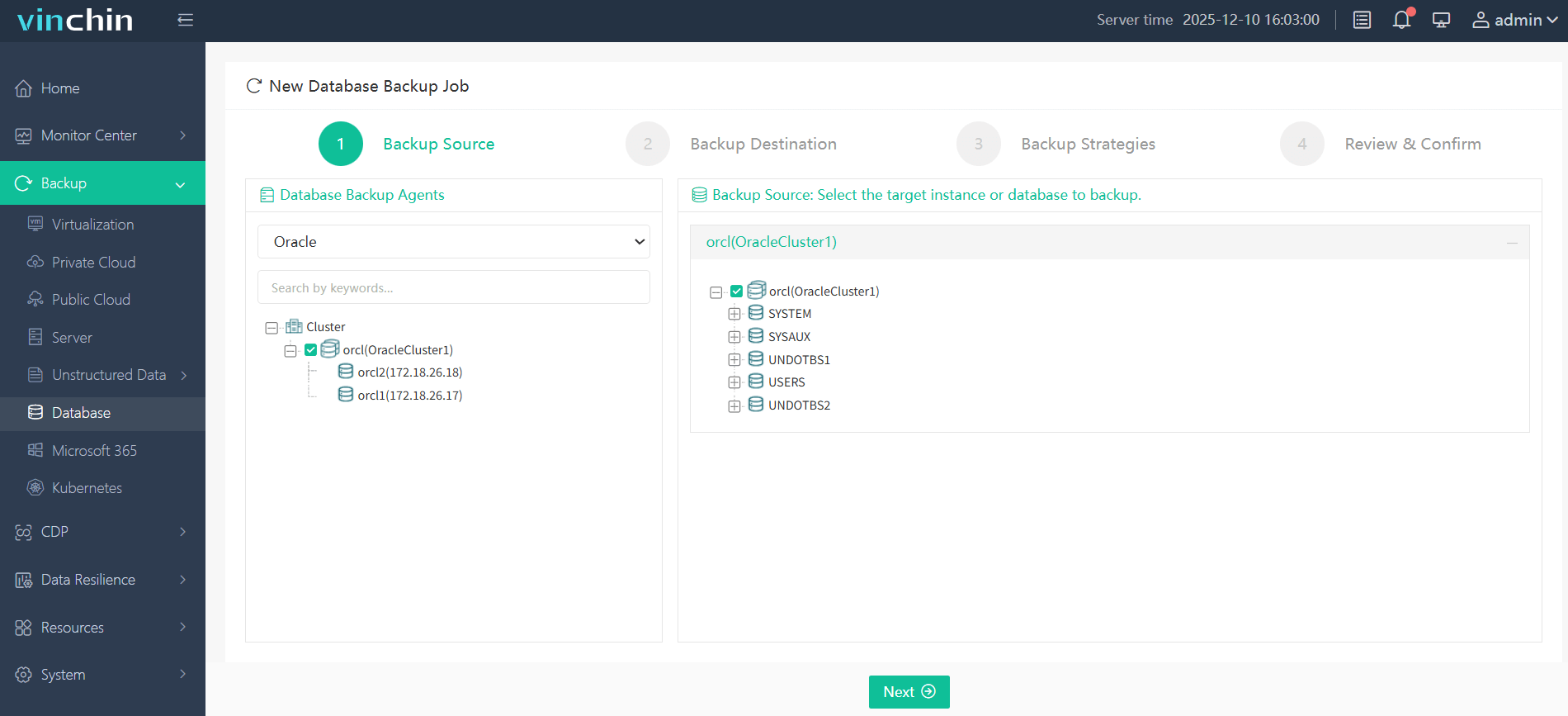
Step 1. Select the Oracle database to back up
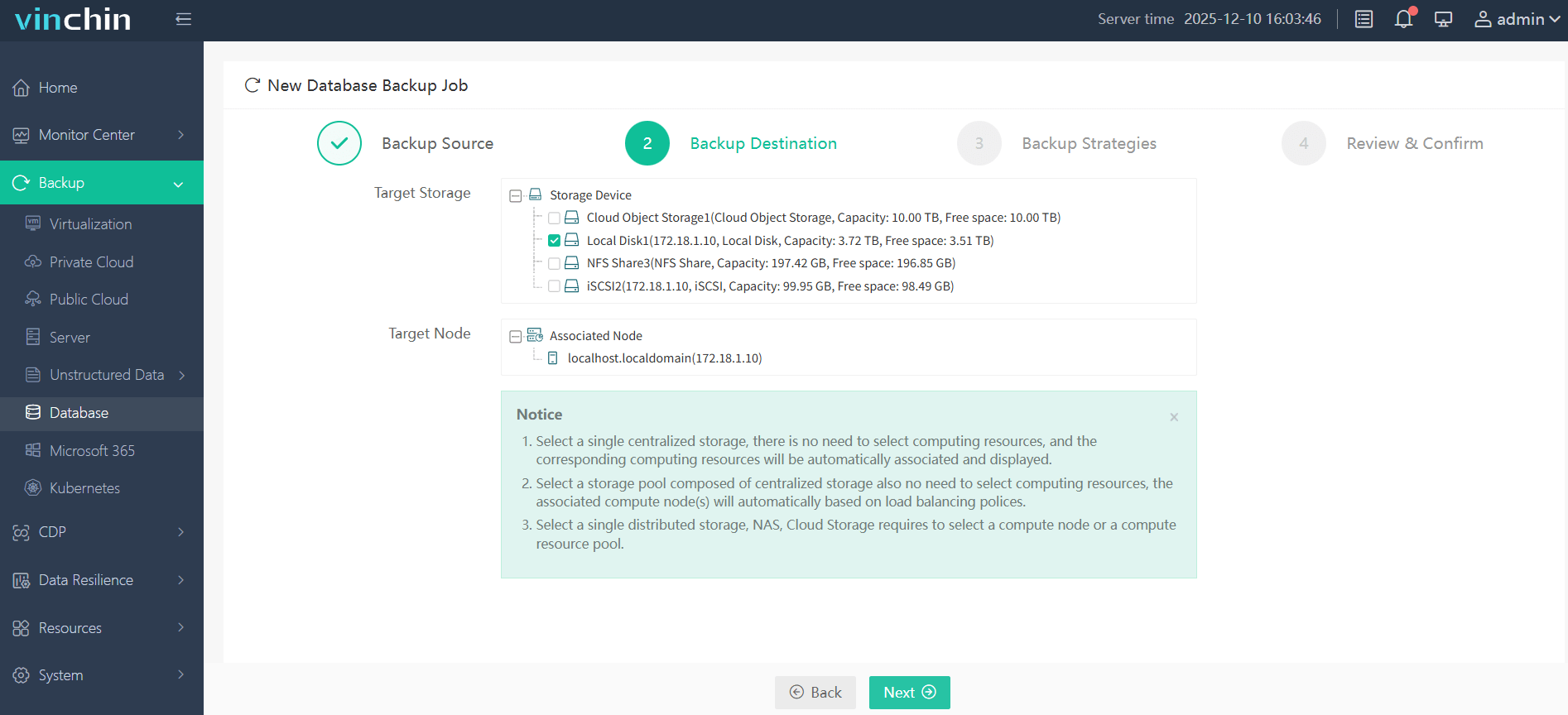
Step 2. Choose the backup storage
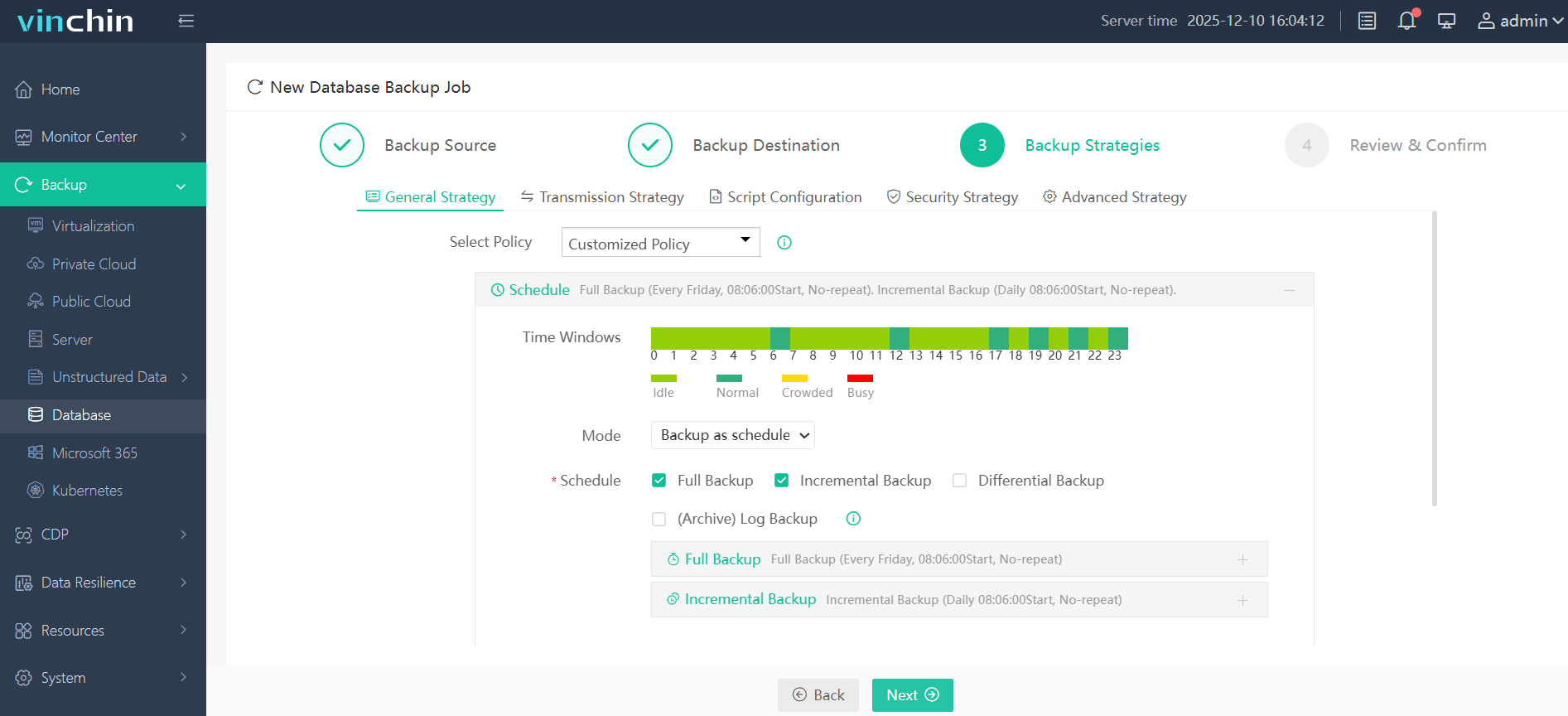
Step 3. Define the backup strategy
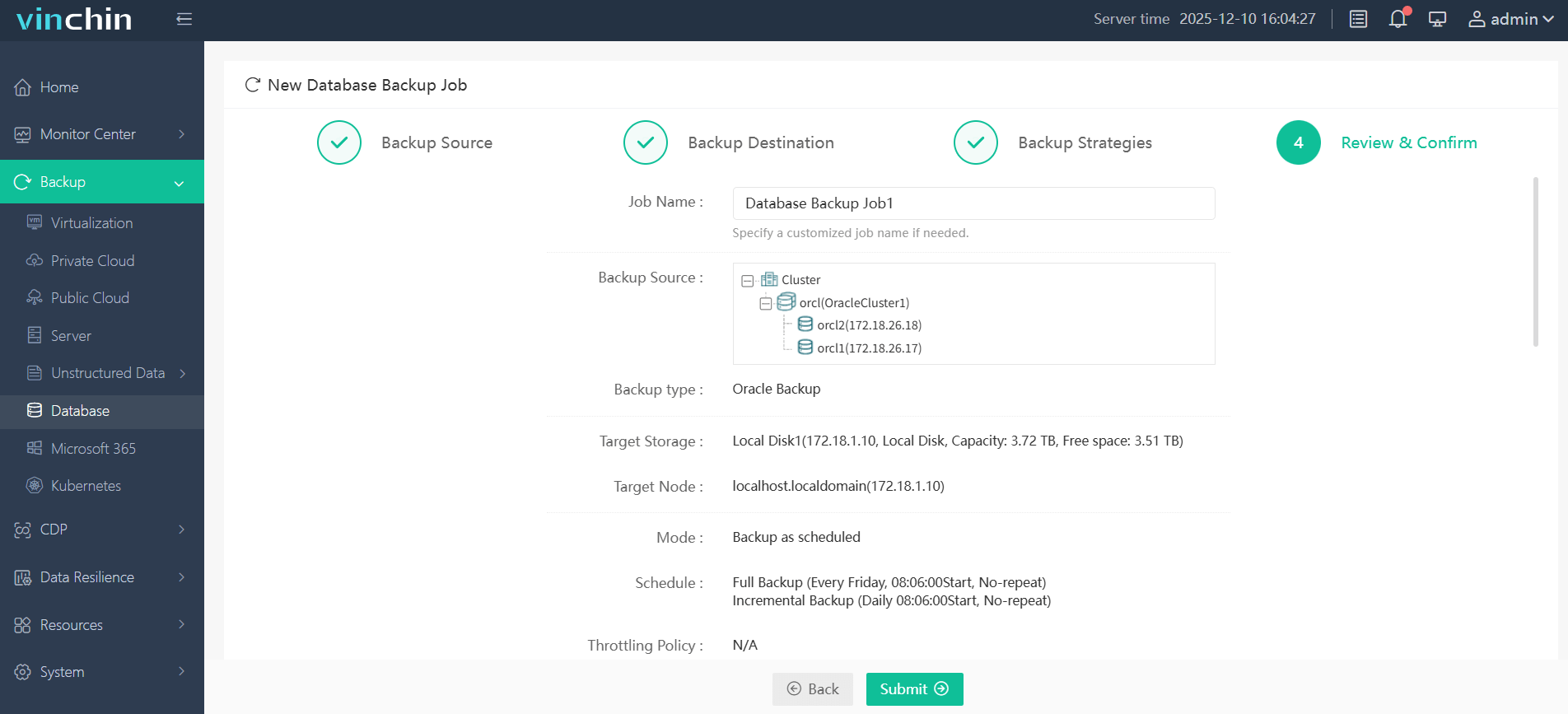
Step 4. Submit the job
Recognized globally among enterprise IT teams—with thousands relying on its reliability—Vinchin Backup & Recovery offers top-rated protection backed by industry-leading customer satisfaction scores. Try out all features free for 60 days—click below now!
Rman Allocate Channel Disk FAQs
Q1: How should I decide how many disk channels my system needs?
A1: Start with one channel per physical destination drive or CPU core; monitor I/O wait events using V$SESSION_WAIT; adjust based on observed throughput until optimal performance is reached without causing contention.
Q2: Can I mix both disk and tape devices within one job?
A2: Yes—you must manually allocate each type within one RUN block so they operate together under coordinated control from within that script section only.
Q3: How do I change where my disk-based backups go?
A3: Specify new paths using ALLOCATE CHANNEL chX DEVICE TYPE DISK FORMAT 'your/new/path/%U' inside any relevant RUN block before issuing BACKUP commands there.
Conclusion
Allocating disk channels in RMAN puts powerful control into administrators’ hands—enabling faster Oracle backups tailored precisely around available hardware resources whether managed manually or through automated policies tuned over time! Vinchin makes protecting critical databases even easier; try it free today!