Protecting your Oracle database is essential for every operations administrator. A full backup forms the backbone of any disaster recovery plan. But how do you perform an Oracle RMAN backup of a full database? What steps should you follow to ensure best practices? In this guide, I’ll walk you through everything from basics to advanced tips so you can back up your Oracle database with confidence.
Prerequisites for Oracle RMAN Full Database Backup
Before starting a full backup using RMAN, make sure you meet some key requirements. You need access to the server where Oracle runs. Your user account must have either SYSDBA or SYSBACKUP privileges; using SYSBACKUP is safer because it limits permissions. Check that there is enough free disk space on both your backup destination and Fast Recovery Area (FRA). Also confirm that your operating system user has permission to read/write in those directories. If automating backups with scripts, secure those files by setting strict file permissions.
What Is Oracle RMAN Full Database Backup?
An Oracle RMAN full database backup creates a complete copy of all data files at one point in time. This includes every used data block in your database, plus the control file and—if selected—archived redo logs. With this type of backup, you can restore your entire database exactly as it was when backed up. It serves as the baseline for other backups like incremental or differential ones.
Why Perform Full Database Backups?
Full database backups are critical for disaster recovery plans. They give you everything needed to restore systems after hardware failure or accidental data loss. With regular full backups made by RMAN, meeting regulatory rules becomes easier too. Having recent copies reduces downtime if something goes wrong—and lets you start incremental backups later on for faster daily protection.
How to Use RMAN Command Line for Full Database Backup?
Let’s break down how to run a full database backup using RMAN from beginner steps through advanced options.
First things first: always connect as a user with proper privileges—preferably SYSBACKUP instead of SYSDBA, unless required otherwise.
1. Connect to RMAN
Open your terminal on the server running Oracle Database. To connect locally with OS authentication:
rman target /
For remote connections or explicit role use:
rman target "username@tns_alias AS SYSBACKUP"
2. Check Database Mode
The mode determines if online (hot) or offline (cold) backups are possible. Online backups require ARCHIVELOG mode so changes during backup are saved safely; NOARCHIVELOG allows only cold backups when no users are connected.
To check mode in SQL*Plus:
   sqlplus / as sysdba
   SQL> ARCHIVE LOG LIST;
Or within RMAN:
RMAN> SQL 'ARCHIVE LOG LIST';
If not enabled and online backups are needed:
   SHUTDOWN IMMEDIATE;
   STARTUP MOUNT;
   ALTER DATABASE ARCHIVELOG;
   ALTER DATABASE OPEN;
3. Configure Key RMAN Settings
Set important parameters before backing up:
    SHOW ALL;
    CONFIGURE RETENTION POLICY TO RECOVERY WINDOW OF 7 DAYS;
    CONFIGURE DEFAULT DEVICE TYPE TO DISK;
    -- Optional: Increase performance
    CONFIGURE CHANNEL DEVICE TYPE DISK PARALLELISM 2;
The retention policy defines which old backups become obsolete so they can be deleted automatically later.
4. Run the Full Backup Command
To back up everything—including archived redo logs—for point-in-time recovery:
BACKUP DATABASE PLUS ARCHIVELOG;
This command creates a proprietary format called BACKUPSET by default (good for storage efficiency). For compressed output or custom filenames:
BACKUP AS COMPRESSED BACKUPSET DATABASE PLUS ARCHIVELOG FORMAT '/backup/ora_full_%U.bkp';
Want direct image copies usable without restore?
BACKUP AS COPY DATABASE FORMAT '/backup/imagecopy_%U.dbf';
If saving space matters and logs aren’t needed elsewhere after backup succeeds:
BACKUP DATABASE PLUS ARCHIVELOG DELETE INPUT;
The DELETE INPUT clause removes archived redo logs only after successful copy—use this only if another copy isn’t required elsewhere.
5. Verify Your Backup
Always check that your backup completed correctly! List summaries like this:
     LIST BACKUP OF DATABASE SUMMARY;
     LIST BACKUP OF ARCHIVELOG ALL SUMMARY;
For deeper checks against corruption or missing pieces:
     VALIDATE BACKUPSET <backupset_key>;
     RESTORE DATABASE VALIDATE; -- Ensures all pieces readable
     VALIDATE DATABASE;         -- Checks physical corruption
     VALIDATE ARCHIVELOG ALL;
6. Tag Your Backup (Optional)
Tags help track specific jobs over time—a lifesaver during audits or restores!
      BACKUP DATABASE TAG='FULL_BACKUP_JUNE2024' PLUS ARCHIVELOG;
      LIST BACKUP TAG='FULL_BACKUP_JUNE2024' SUMMARY;
7. Back Up When Database Is Closed (NOARCHIVELOG Mode)
If running in NOARCHIVELOG mode (no online log archiving), shut down users first then mount before backing up—all done inside one session:
        SHUTDOWN IMMEDIATE
        STARTUP MOUNT
        BACKUP DATABASE
        ALTER DATABASE OPEN
With these steps complete, you now have a reliable full Oracle database backup using native tools!
How to Automate Oracle RMAN Backups with Scripts?
Manual work is fine at first—but production environments demand automation! Automating keeps schedules tight and reduces human mistakes.
Here’s how you can automate regular full database backups using shell scripts on Linux/Unix:
1. Create your script file (rman_full_backup.sh) containing:
#!/bin/bash
export ORACLE_SID=yourdb
export ORACLE_HOME=/path/to/oracle
export PATH=$ORACLE_HOME/bin:$PATH

echo "Backup started at $(date)"
rman target / <<EOF > /path/to/logs/rman_full_backup.log 2>&1
RUN {
  CROSSCHECK BACKUP;
  BACKUP AS COMPRESSED BACKUPSET DATABASE PLUS ARCHIVELOG DELETE INPUT;
  DELETE NOPROMPT OBSOLETE;
}
EXIT
EOF

status=$?
if [ $status -ne 0 ]; then
  echo "RMAN backup failed at $(date)" | mailx -s "RMAN Backup Failure" dba_team@example.com
fi

echo "Backup ended at $(date)"
Set strict permissions on this script (chmod 700 rman_full_backup.sh) so only trusted users can edit or run it.
2. Make it executable:
chmod +x rman_full_backup.sh
3. Schedule it via cron:
Edit crontab (crontab -e) then add this line for daily runs at 2 AM:
0 2 * * * /path/to/rman_full_backup.sh
Logs will be written out per script above—review them regularly!
4. Monitor & Validate Regularly:
After each run—or weekly—validate that recent backups work by running inside rman target /:
VALIDATE DATABASE;
RESTORE DATABASE VALIDATE;
This ensures not just completion but actual recoverability!
For even greater security in automated jobs consider storing credentials securely using Oracle Wallet rather than plain text scripts whenever possible.
The retention policy set earlier controls what gets deleted by DELETE OBSOLETE, keeping storage tidy without manual cleanup.
Enterprise-Level Protection: Vinchin Backup & Recovery for Oracle Databases
Beyond native tools, organizations often seek streamlined solutions that enhance reliability and efficiency across large-scale deployments such as Oracle databases—the focus here—or other mainstream platforms including MySQL, SQL Server, MariaDB, PostgreSQL, PostgresPro, and TiDB. Vinchin Backup & Recovery delivers enterprise-grade protection with support for features like advanced source-side compression, incremental backup capabilities, batch processing of multiple databases simultaneously, flexible multi-level data compression options, and customizable retention policies tailored specifically for complex environments like yours—all designed to optimize storage use while ensuring compliance and rapid recovery readiness.
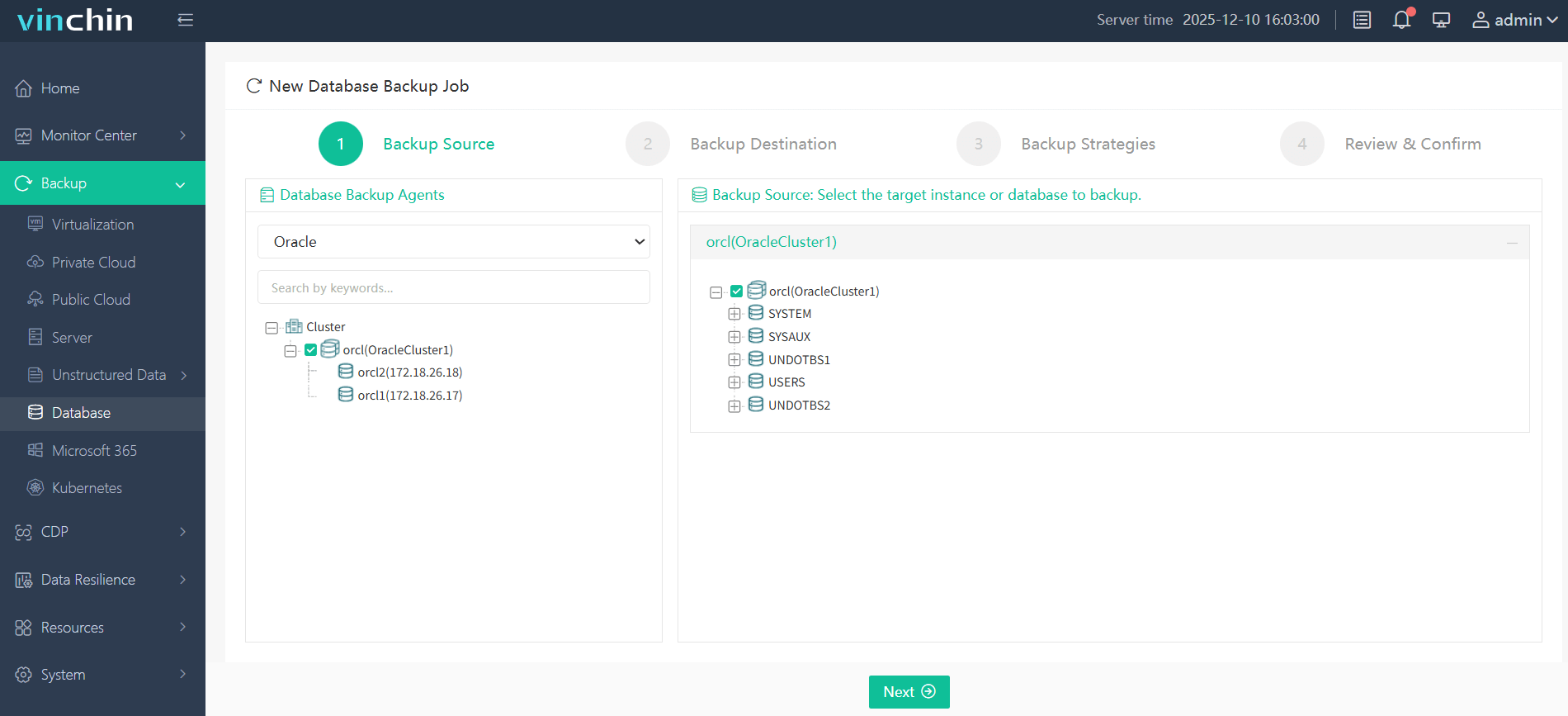
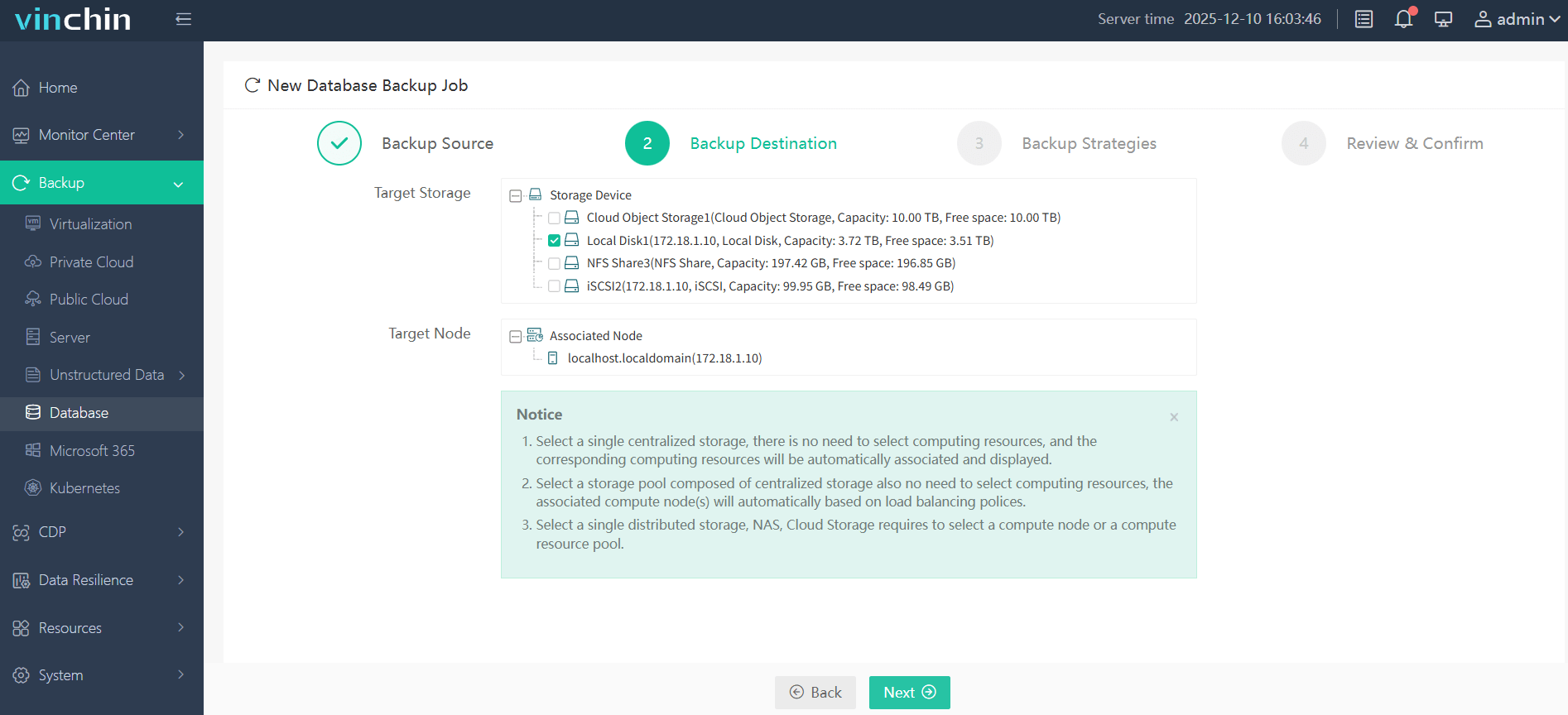
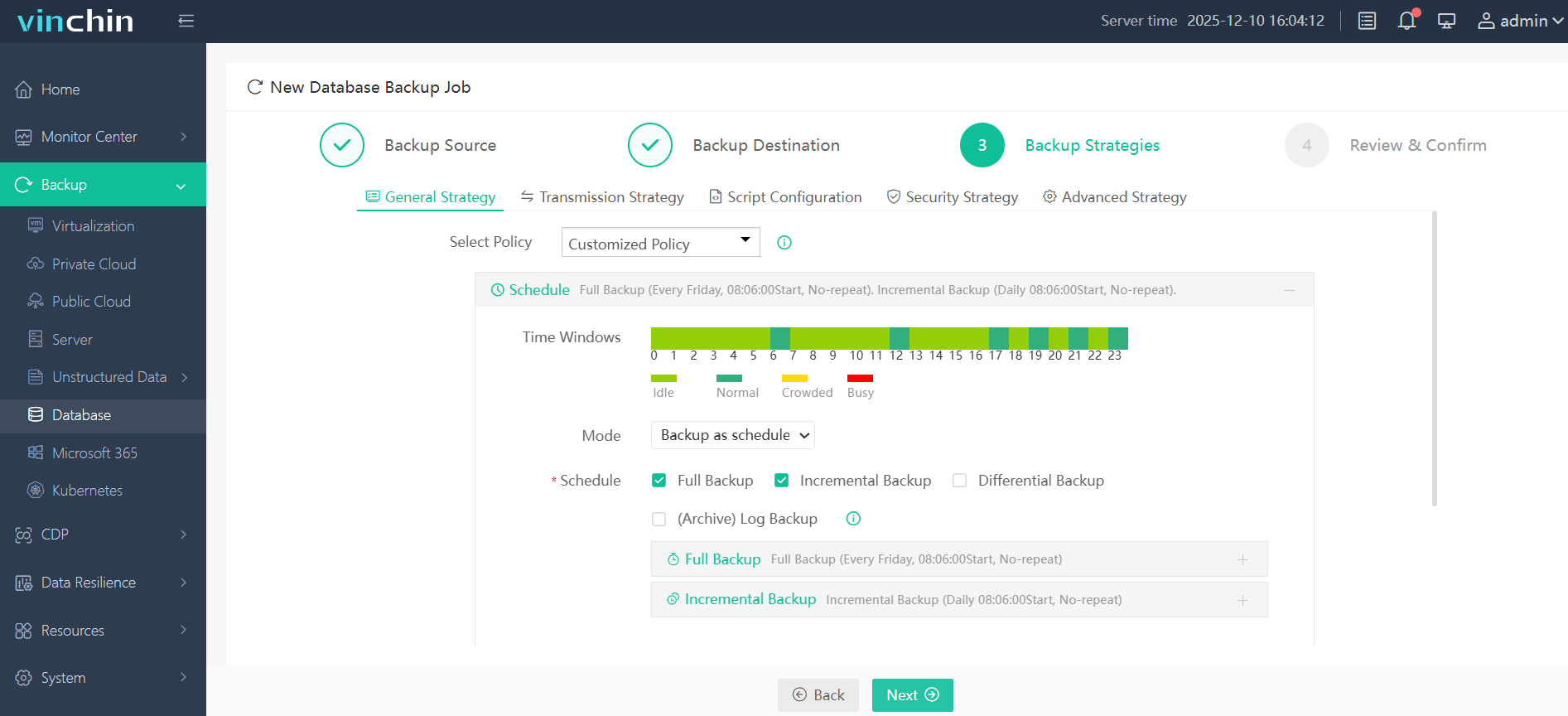
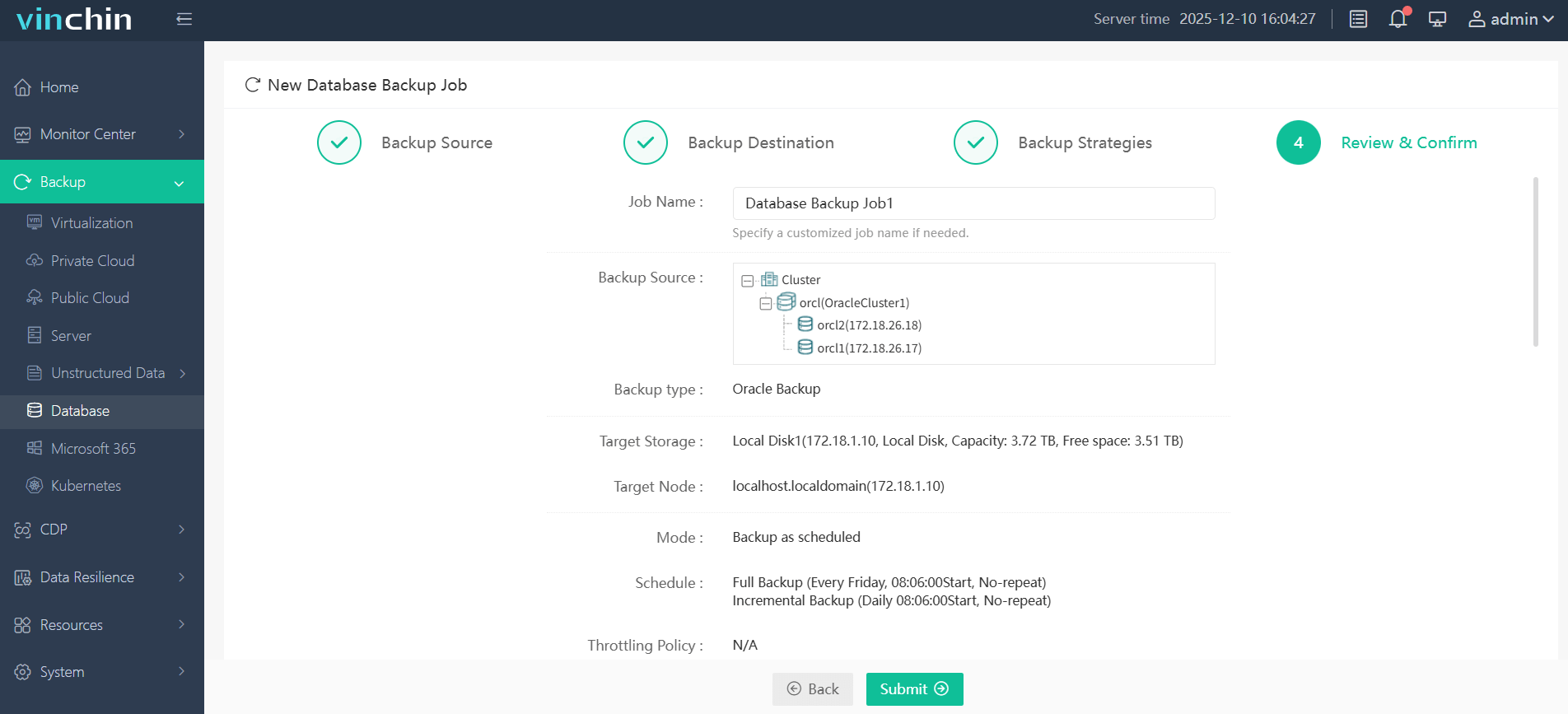
With its intuitive web console interface, performing an Oracle database backup typically involves four straightforward steps:
Step 1: Select the Oracle database to back up
Step 2: Choose the backup storage
Step 3: Define the backup strategy
Step 4: Submit the job
Vinchin Backup & Recovery enjoys global recognition among enterprises thanks to its robust feature set and high customer satisfaction ratings—explore all capabilities risk-free with their fully featured 60-day free trial by clicking download below.
Oracle RMAN Backup Full Database FAQs
Q1: Can I schedule an automatic email alert if my nightly full RMAN job fails?
A1: Yes—add logic in your script using tools like mailx or sendmail triggered when non-zero exit codes occur after running rman commands.
Q2: What should I do if my FRA fills up during an ongoing full database backup?
A2: Pause new jobs immediately; delete obsolete/backed-up archive logs using DELETE OBSOLETE after checking policies; increase FRA size if needed before retrying jobs safely.
Q3: How do I handle reported block corruption found during validation?
A3: Restore affected blocks from previous good backups using BLOCKRECOVER command within rman prompt.
Conclusion
Reliable full database backups are vital defense against downtime or lost data—and mastering both manual steps plus automation builds true operational resilience over time! For even greater simplicity plus advanced features try Vinchin’s enterprise-grade solution today—you’ll see how easy robust protection really can be!