Keeping your Oracle database backup catalog accurate—and your backups verifiably healthy—is a top priority for any operations administrator. But how do you know if your backup records match the files that actually exist on disk or tape? This is where the Oracle CROSSCHECK command comes in. In this article, we’ll explain what Oracle Crosscheck is, why it matters, and how to use it—both from the command line and Oracle Enterprise Manager. We’ll also explore how Crosscheck interacts with storage media, ways to automate checks, common troubleshooting tips, and show how Vinchin can help you verify and manage Oracle database backups with ease.
What is Oracle Crosscheck?
Oracle Crosscheck is a command in Recovery Manager (RMAN) that synchronizes backup metadata in your repository with actual backup files on storage. The repository refers to metadata stored either in the control file of your target database or in a separate recovery catalog database. In simple terms, Crosscheck verifies whether backups listed in RMAN’s records still exist at their recorded locations.
When you run CROSSCHECK, RMAN reads each backup file header at its expected location. If it finds the file accessible as described in its metadata record—either on disk or through a media management layer—it marks it as AVAILABLE. If not found or unreadable, RMAN updates its status to EXPIRED. This process keeps your backup catalog honest by reflecting only what truly exists.
Why does this matter? Over time, files may be moved or deleted outside of RMAN’s control. Without regular crosschecks, you could trust backups that are no longer usable—a risk no admin wants to take.
Why Use Oracle Crosscheck?
Backup environments change constantly. Files might be deleted accidentally or moved during storage maintenance. Sometimes hardware fails or permissions change unexpectedly. When this happens without updating RMAN’s records, you end up with mismatches between reality and what’s shown in your backup catalog.
Running CROSSCHECK helps you:
1. Identify missing or deleted backup files quickly so there are no surprises during restore operations.
2. Update statuses: Mark missing files as EXPIRED, available ones as AVAILABLE, ensuring accuracy.
3. Prevent restore failures by making sure only valid backups are used when disaster strikes.
4. Clean up expired entries so your catalog stays tidy—no clutter from old references.
Without regular crosschecks, restores can fail just when you need them most because RMAN tries to use non-existent files.
How Crosscheck Interacts with Your Media Layer?
Understanding how CROSSCHECK works behind the scenes helps prevent confusion—especially if you use both disk-based storage and tape libraries.
For disk-based backups:
CROSSCHECK performs a straightforward check using operating system calls to see if each file exists at its recorded path on local or networked disks. If readable by the OS account running RMAN (usually ‘oracle’), it marks them as AVAILABLE; otherwise they become EXPIRED.
For tape-based (SBT) backups:
Things get more complex here because tapes are managed by third-party media management layers (MML). When you run CROSSCHECK against SBT devices, RMAN doesn’t physically load every tape—it queries the MML software instead. The MML responds whether each piece is still cataloged as present within its own tracking system; if not found there—or if communication fails—the piece becomes EXPIRED in RMAN’s view.
This distinction matters: A tape could be physically present but marked expired if removed from MML inventory; conversely an empty slot might still appear available until MML syncs up again! Always ensure both sides agree before deleting anything critical.
How to Run Oracle Crosscheck Using RMAN Command Line?
The most direct way to run CROSSCHECK is through the RMAN command line interface—a favorite among seasoned DBAs who want full control over their environment.
Before starting:
Connect to your target database using rman target /
If using a recovery catalog database for centralized metadata tracking (recommended for large shops), connect via rman target / catalog username/password@catalogdb
Now let’s look at some practical commands:
To check all backups:
CROSSCHECK BACKUP;
To check all image copies:
CROSSCHECK COPY;
To check all archived logs:
CROSSCHECK ARCHIVELOG ALL;
To limit checks by date range:
CROSSCHECK BACKUP COMPLETED BETWEEN 'SYSDATE-7' AND 'SYSDATE';
After running these commands:
RMAN displays status updates for each item checked—marking any missing pieces as EXPIRED right away so you know which ones need attention next.
If working without a recovery catalog (NOCATALOG mode):
You must connect directly to the same instance where original backups were made since only that control file knows exact paths/labels used during creation!
For tape/SBT devices:
If persistent channels aren’t configured already via CONFIGURE CHANNEL, allocate one manually before checking tapes:
ALLOCATE CHANNEL FOR MAINTENANCE DEVICE TYPE sbt PARMS='...';
CROSSCHECK BACKUP;
RELEASE CHANNEL;
Replace '...' with parameters specific to your site’s media manager configuration—for example device names or credentials required by your SBT library software.
Once expired items are identified:
Remove them cleanly from metadata using
DELETE EXPIRED BACKUP;
This keeps catalogs lean while reducing risk of failed restores down the road!
How to Run Oracle Crosscheck Using Oracle Enterprise Manager?
Prefer graphical tools? Many admins do! With Oracle Enterprise Manager (OEM), performing crosschecks becomes point-and-click easy—even across multiple databases from one dashboard view.
Here’s how:
First log into OEM then navigate toward your target database object within Cloud Control console (UI layout varies between OEM 12c/13c versions). Look under sections labeled Availability, then select Backup & Recovery features menu; inside here search options such as Manage Backups, Backup Sets, or sometimes directly labeled “Crosscheck.”
Typical workflow looks like this:
1. Go into either Backup Sets or Backup Pieces
2. Select one/more items needing verification
3. Click button labeled either Crosscheck or sometimes just Validate
4. Wait briefly while OEM runs background jobs; review updated statuses shown onscreen
Missing files will now show up clearly marked as EXPIRED—you can then delete these safely using further UI actions provided nearby (“Delete Expired” etc.).
Remember: Menu labels may differ slightly depending on OEM version—but keywords like “Manage Backups,” “Crosscheck,” “Validate,” always guide you close!
OEM also provides handy reports summarizing recent crosschecks plus alerts about potential issues detected automatically—a big help when managing dozens of databases at once!
Automating and Scheduling Crosscheck Operations
Manual checks work fine occasionally—but busy IT teams rely on automation wherever possible! Regularly scheduled crosschecks catch problems early before they snowball into outages later on.
Here’s how most admins automate things:
First create a shell script containing basic steps needed:
#!/bin/bash
export ORACLE_SID=yourdbsid
export ORACLE_HOME=/path/to/oracle/home
$ORACLE_HOME/bin/rman <<EOF
CONNECT TARGET /
CROSSCHECK BACKUP;
CROSSCHECK ARCHIVELOG ALL;
DELETE EXPIRED BACKUP;
EXIT
EOF
Save this script somewhere secure—set executable permissions (chmod +x scriptname.sh). Now schedule it via cron job (Linux):
0 2 * /path/to/scriptname.sh > /var/log/rman_crosschk.log 2>&1
Or use Windows Task Scheduler similarly if running on Windows hosts!
Introducing Vinchin Backup & Recovery for Enterprise Database Protection
Beyond native tools like RMAN and OEM, organizations seeking streamlined enterprise-grade protection should consider Vinchin Backup & Recovery—a professional solution supporting mainstream platforms including Oracle, MySQL, SQL Server, MariaDB, PostgreSQL, PostgresPro, and TiDB (with special focus here on robust support for Oracle). Key features include batch database backup management, log backup capabilities enabling any-point-in-time recovery, advanced data compression/deduplication options for efficient storage usage, integrity check routines ensuring recoverability of every copy made, and strong storage protection mechanisms against ransomware threats—all designed to simplify compliance and operational resilience across diverse environments.
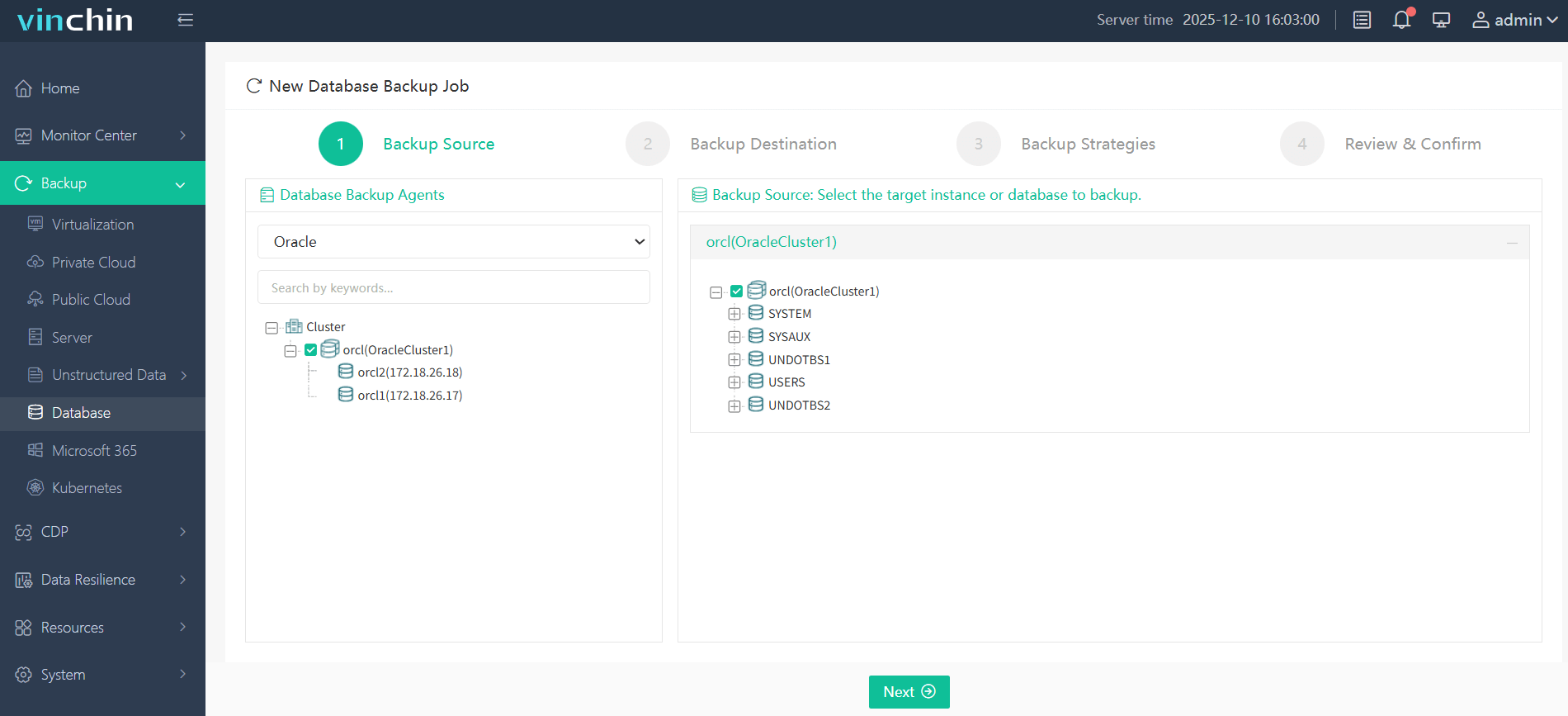
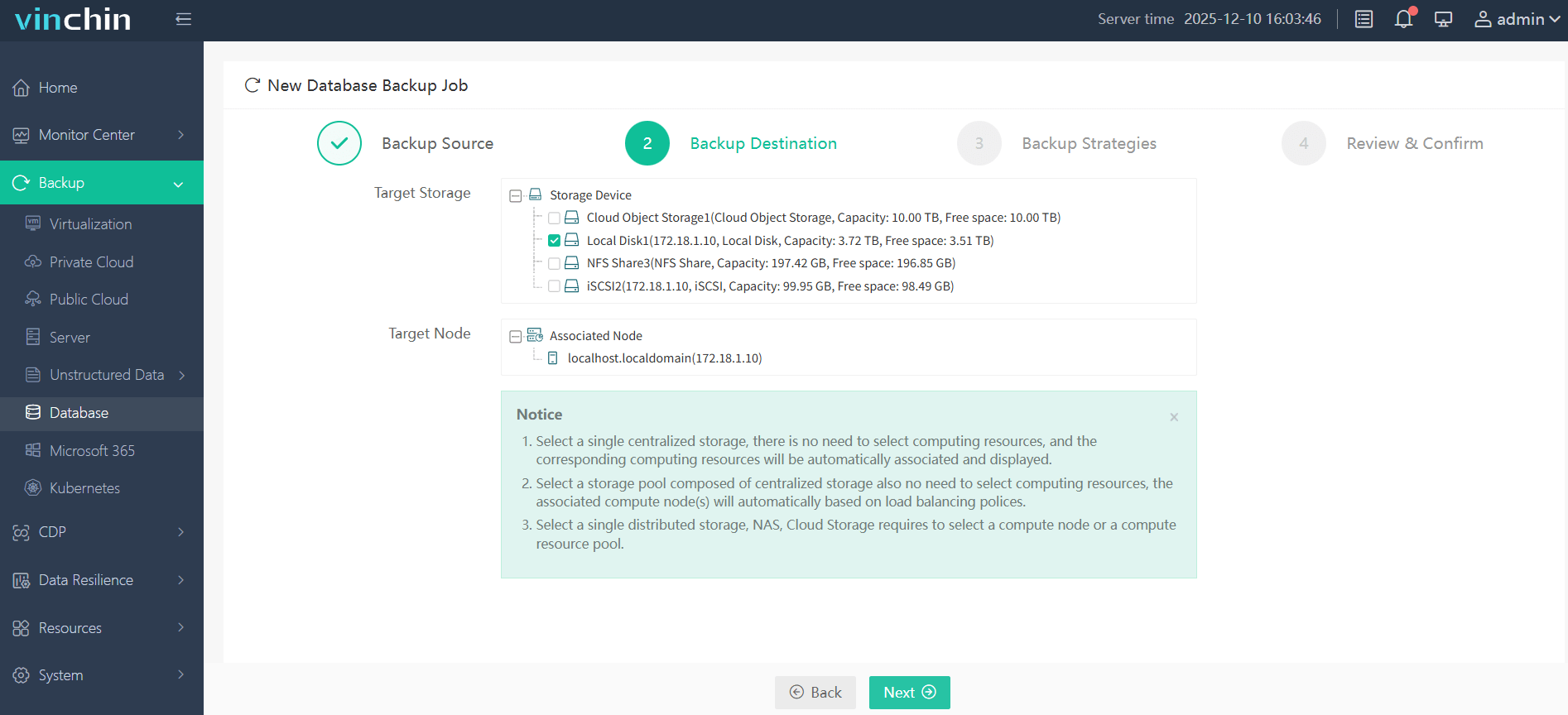
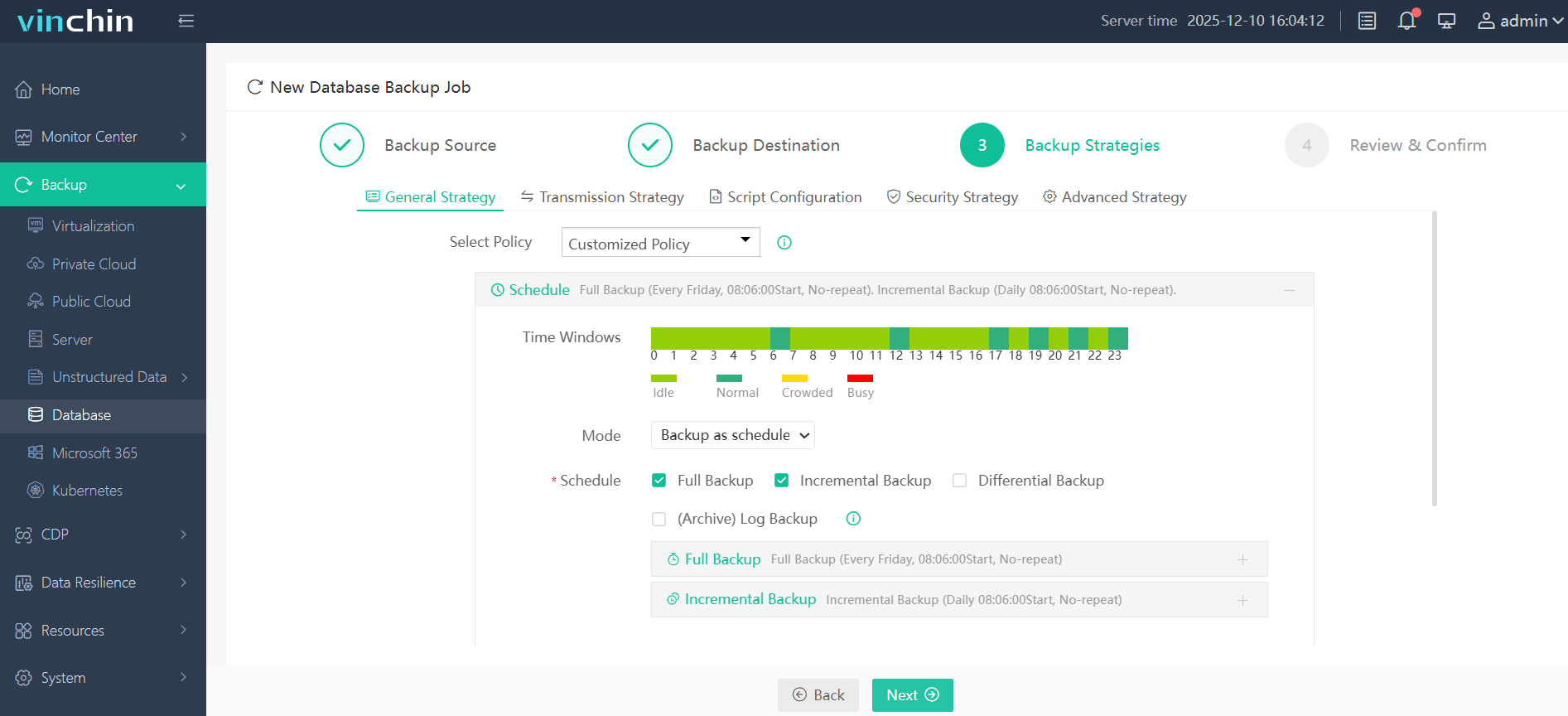
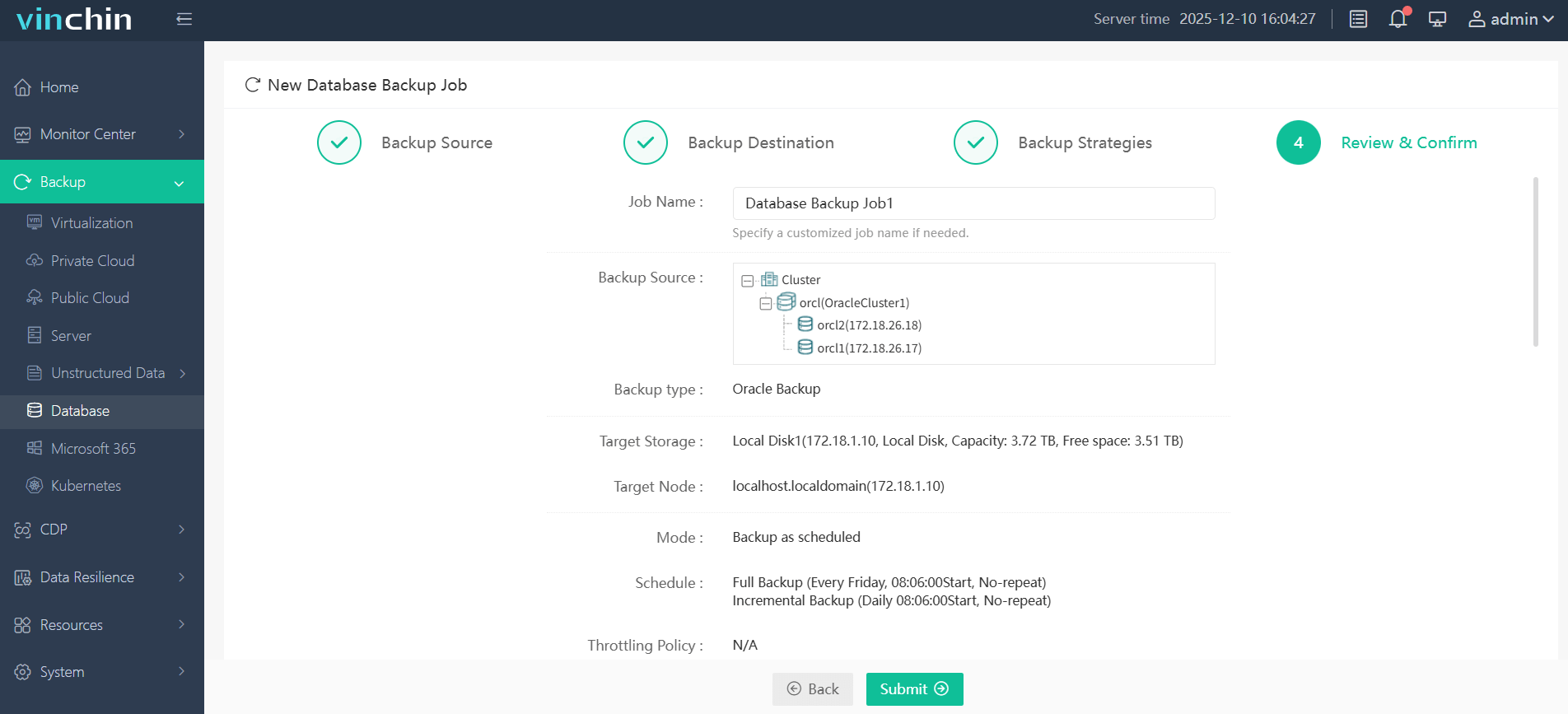
Vinchin Backup & Recovery offers an intuitive web console where backing up an Oracle database typically involves four clear steps:
Step 1. Select the Oracle database to back up
Step 2. Choose the backup storage
Step 3. Define the backup strategy
Step 4. Submit the job
Recognized globally with high customer satisfaction ratings among enterprise users worldwide,Vinchin Backup & Recovery delivers reliable data protection at scale.Try their fully featured 60-day free trial today—just click download below to experience effortless enterprise-grade backup firsthand.
Oracle Crosscheck FAQs
Q1: Can I run CROSSCHECK only against specific tablespaces?
A1: Yes; use CROSSCHECK BACKUP OF TABLESPACE tablespace_name in RMAN CLI for targeted validation.
Q2: Does running CROSSCHECK affect production performance?
A2: No; it operates only against metadata/catalog entries plus associated backup storage—not live datafiles themselves unless sharing infrastructure causes indirect I/O contention during heavy scans.
Q3: What should I do if my archive logs go missing but aren’t marked expired?
A3: Run CROSSCHECK ARCHIVELOG ALL then follow up with DELETE EXPIRED ARCHIVELOG afterward—to update status promptly within repository/catalog views.
Conclusion
Oracle Crosscheck keeps your recovery plans strong by ensuring only real backups remain trusted within catalogs.Whether automated via scripts,scheduled tasks—or enhanced through dedicated solutions like Vinchin—it forms an essential pillar of robust data protection strategies.Try Vinchin todayto simplifyand strengthenyour entirebackup lifecycle!