Every Oracle database administrator knows that backups are essential. But how do you know your backups are running as planned? How can you prove, for audits or peace of mind, that your Oracle backup history is complete and reliable? In this article, we’ll walk through what Oracle backup history is, why it matters, and how to check it using native Oracle tools.
What Is Oracle Backup History?
Oracle backup history is a record of all backup operations performed on your Oracle database. This includes full and incremental backups, archived log backups, and details about when each backup started, ended, and whether it succeeded or failed. These records form the backbone of any disaster recovery plan because they let you verify that critical data has been protected over time.
Oracle stores this information in its control file and optionally in a recovery catalog. The control file keeps recent backup metadata by default. If you use a recovery catalog database, historical records persist longer even after resets or re-creations of the control file. You can access this history using Recovery Manager (RMAN), SQL*Plus queries against dynamic performance views (V$ views), or by querying specific data dictionary tables.
Having an accurate record means you always know which backups exist for each part of your database like datafiles, tablespaces, and archived logs, and whether those backups are usable. This transparency is crucial not just for daily operations but also during audits or compliance checks.
Why Track Oracle Backup History Matters?
Tracking your Oracle backup history is not just a best practice, but a necessity. Without clear records of past backups and their status, you cannot guarantee recoverability if something goes wrong. Imagine facing an outage only to realize some critical data was never backed up, or worse yet, that recent backups silently failed due to storage issues.
Backup history helps you:
Verify that backups completed successfully and on time so there are no surprises during restores.
Identify failed or missed backups before they become a problem by reviewing job statuses regularly.
Meet compliance and audit requirements by providing proof of regular successful backups. It's a common demand in regulated industries like finance or healthcare.
Plan storage usage efficiently by knowing which older backups are obsolete or eligible for deletion according to retention policies.
Would you trust your recovery plan without knowing your backup history? Most experienced DBAs would say no because gaps in historical records often mean gaps in recoverability.
How to Check Oracle Backup History With RMAN?
RMAN is Oracle’s built-in tool for managing both routine backups and complex recoveries. It keeps detailed records of all jobs run through it whether scheduled via scripts or launched manually from the command line. Checking backup history with RMAN gives both summary overviews for quick checks as well as granular detail when troubleshooting issues.
1. Connect to RMAN as a user with SYSDBA or SYSBACKUP privilege:
rman target /
2. To see an overview of all recent backups, including type (full/incremental/archivelog), completion time, device type (disk/tape), size metrics, run:
RMAN> LIST BACKUP SUMMARY;
This command provides one-line summaries per job so you can quickly spot missing dates or unexpected failures at a glance.
3. For deeper inspection, such as viewing individual pieces within each set, use:
RMAN> LIST BACKUP;
This lists every component including which files were included in each set, start/end times, piece names, sizes, device types, encryption status; etc.
4. If you're interested in specific objects, such as only archived logs since last week, you might run:
RMAN> LIST BACKUP OF DATABASE;
RMAN> LIST BACKUP OF DATAFILE 1;
RMAN> LIST BACKUP OF TABLESPACE USERS;
RMAN> LIST BACKUP OF ARCHIVELOG ALL COMPLETED AFTER 'SYSDATE-7';
5. To distinguish between expired and obsolete backups:
Expired backups are recorded in RMAN but no longer accessible on storage (for example, due to NFS unmounts):
RMAN> LIST EXPIRED BACKUP;
Obsolete backups are those no longer needed according to the retention policy, even if the files still exist:
RMAN> REPORT OBSOLETE;
6. For performance monitoring and auditing durations/statuses across many jobs, the V$RMAN_BACKUP_JOB_DETAILS view holds valuable information accessible from either RMAN's SQL interface or SQL*Plus:
SELECT SESSION_KEY,
       INPUT_TYPE,
       STATUS,
       TO_CHAR(START_TIME,'mm/dd/yy hh24:mi') AS START_TIME,
       TO_CHAR(END_TIME,'mm/dd/yy hh24:mi') AS END_TIME,
       ELAPSED_SECONDS/3600 AS HOURS
FROM V$RMAN_BACKUP_JOB_DETAILS
ORDER BY SESSION_KEY;
This query shows when each job started/ended, what kind it was (full/incremental/log), its outcome (“COMPLETED”, “FAILED”, etc), and elapsed time which helps spot slowdowns due to network/storage bottlenecks.
Troubleshooting Common Issues With RMAN Backup History
Even experienced administrators encounter problems where expected jobs don’t appear or gets unexpected statuses like “FAILED” instead of “COMPLETED.”
When this happens, start by checking LIST FAILURE inside RMAN for unrecovered incidents related to missing files:
RMAN> LIST FAILURE;
If certain jobs seem absent from reports but should have run (for example via cron), check OS-level logs first then review V$RMAN_STATUS for evidence they started but did not finish cleanly:
SELECT OPERATION,
       STATUS,
       START_TIME,
       END_TIME
FROM V$RMAN_STATUS
WHERE START_TIME > SYSDATE - 7
ORDER BY START_TIME DESC;
When expired entries accumulate due to lost/moved media, even after hardware changes, run periodic crosschecks:
RMAN> CROSSCHECK BACKUP;
Then delete truly unreachable items:
RMAN> DELETE EXPIRED BACKUP;
Always compare results between control file-based queries versus those from any configured recovery catalog if discrepancies arise. They sometimes diverge after resets/cloning events unless resynchronized explicitly.
How to View Backup Records In SQL*Plus?
Sometimes DBAs prefer querying directly rather than relying solely on RMAN output, especially when building custom dashboards or integrating alerts into enterprise monitoring systems. SQL*Plus lets you access underlying dynamic performance views directly using standard SQL syntax.
The main view summarizing job-level results is V$RMAN_BACKUP_JOB_DETAILS, which tracks session keys (unique IDs per job), input types (“DB FULL”, “DB INCR”, “ARCHIVELOG”), statuses (“COMPLETED”, “FAILED”), start/end times/durations/sizes/compression ratios/output rates/etc.:
1. Connect as SYSDBA then run:
SELECT SESSION_KEY,
       INPUT_TYPE,
       STATUS,
       TO_CHAR(START_TIME,'mm/dd/yy hh24:mi') AS START_TIME,
       TO_CHAR(END_TIME,'mm/dd/yy hh24:mi') AS END_TIME,
       ELAPSED_SECONDS/3600 AS HOURS
FROM V$RMAN_BACKUP_JOB_DETAILS
ORDER BY SESSION_KEY DESC FETCH FIRST 20 ROWS ONLY;
This returns recent jobs sorted newest-first to confirm last night’s runs finished properly before business hours begin.
2. To analyze throughput/compression efficiency across multiple runs try:
SELECT SESSION_KEY,
       INPUT_TYPE,
       COMPRESSION_RATIO,
       INPUT_BYTES_DISPLAY AS IN_SIZE,
       OUTPUT_BYTES_DISPLAY AS OUT_SIZE
FROM V$RMAN_BACKUP_JOB_DETAILS
ORDER BY SESSION_KEY DESC FETCH FIRST 20 ROWS ONLY;
3. Filtering specifically for completed full-database jobs narrows focus further:
SELECT COMMAND_ID AS TAG,
        OUTPUT_BYTES_DISPLAY AS TOTAL_GB_BACKED_UP,
        STATUS,
        INPUT_TYPE,
        TIME_TAKEN_DISPLAY AS TIME_TAKEN_HOURS,
        INPUT_BYTES_PER_SEC_DISPLAY AS READ_MB_PER_SEC,
        OUTPUT_BYTES_PER_SEC_DISPLAY AS WRITE_MB_PER_SEC
FROM V$RMAN_BACKUP_JOB_DETAILS
WHERE INPUT_TYPE='DB FULL' AND STATUS LIKE '%COMPLETED%'
ORDER BY TAG DESC FETCH FIRST 10 ROWS ONLY;
For archived log-only runs adjust INPUT_TYPE accordingly ('ARCHIVELOG'). These filters help pinpoint exactly which protection points exist and their health/performance characteristics for different parts of your environment.
You can also join multiple views together for instance combining V$BACKUP_PIECE’s location/encryption info with V$BACKUP_SET’s logical grouping—to build richer reports tailored to audit needs:
Example advanced query showing piece name/location/encryption alongside parent set info:
SELECT bp.RECID      AS PIECE_ID,
         bp.HANDLE     AS FILE_NAME_PATH_ON_DISK_OR_TAPE_DEVICE ,
         bs.SET_STAMP  ,
         bs.BACKUP_TYPE ,
         bp.ENCRYPTED   ,
         bp.STATUS      ,
         bs.START_TIME  ,
         bs.COMPLETION_TIME
    FROM V$BACKUP_PIECE bp JOIN V$BACKUP_SET bs ON bp.SET_STAMP = bs.SET_STAMP
   WHERE bp.STATUS = 'A'
ORDER BY bs.COMPLETION_TIME DESC FETCH FIRST 15 ROWS ONLY ;
On large production databases these queries may impact performance slightly if run during peak hours because they scan internal metadata tables containing thousands—or millions—of rows over time. Schedule heavy reporting tasks off-hours whenever possible.
How to Properly Manage and Monitor Oracle Backup Lifecycle?
Beyond native tools alone, organizations seeking robust management turn to professional solutions to manage the whole lifecycle and ensure recoveribility.
Vinchin Backup & Recovery is a professional backup and disaster recovery solution supporting today’s mainstream databases including Oracle, MySQL, SQL Server, MariaDB, PostgreSQL, PostgresPro, and TiDB.
It delivers powerful features like batch database backup management across instances, flexible data retention policies including GFS support, cloud/tape archiving, and advanced source-side compression, helping streamline protection workflows while reducing risk exposure organization-wide.
The intuitive web console helps you easily manage all the jobs and view the backup history. The advanced features like integrity check and recovery verification ensure your Oracle database backups can be sucessfully recovered when needed.
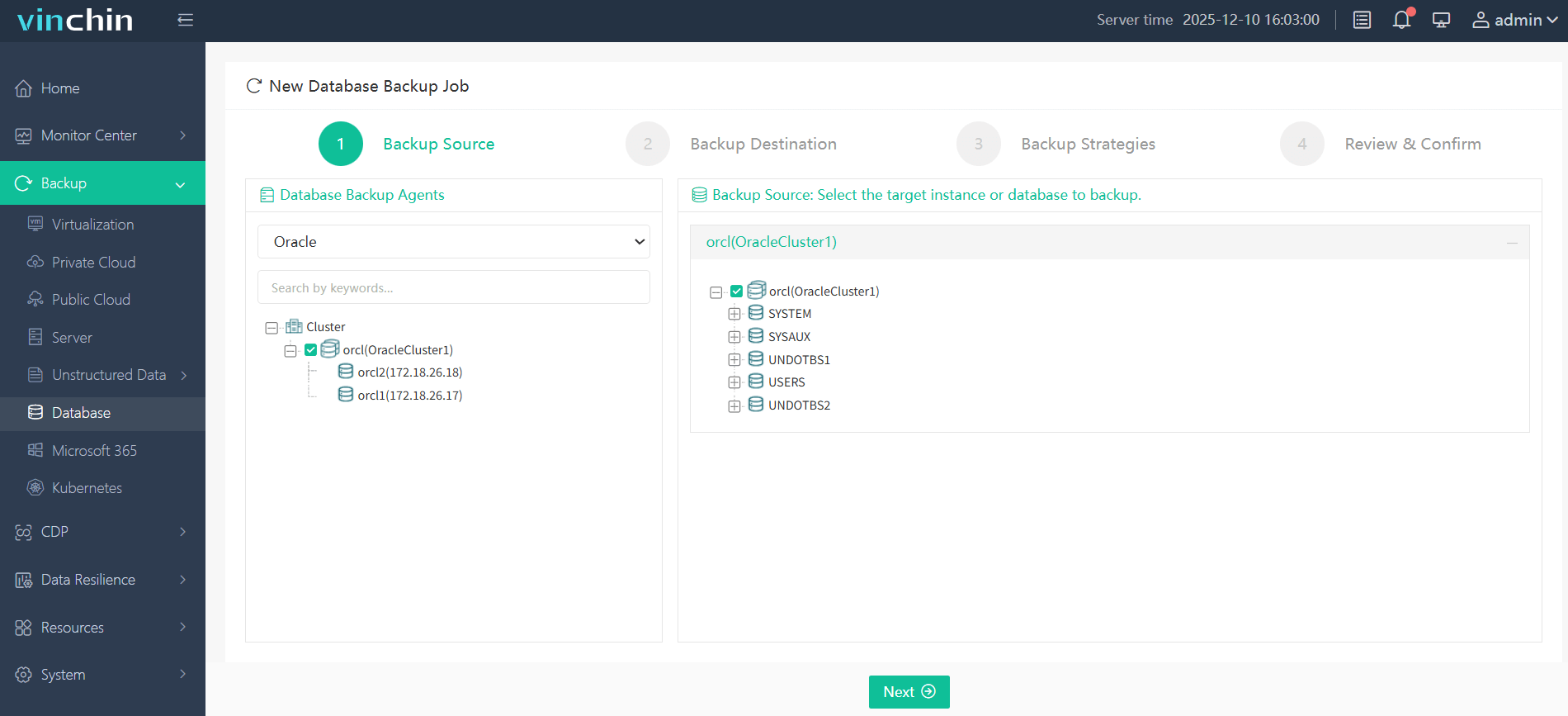
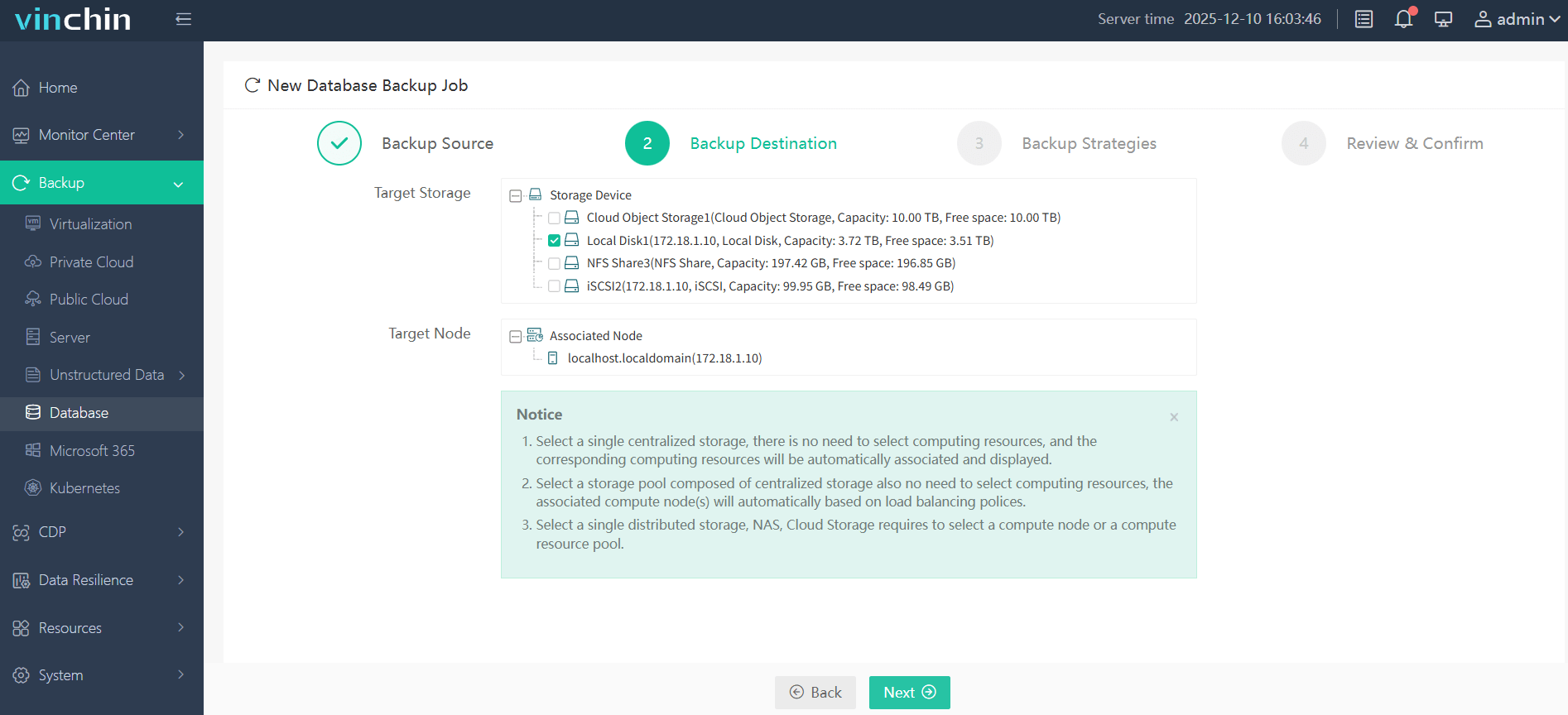
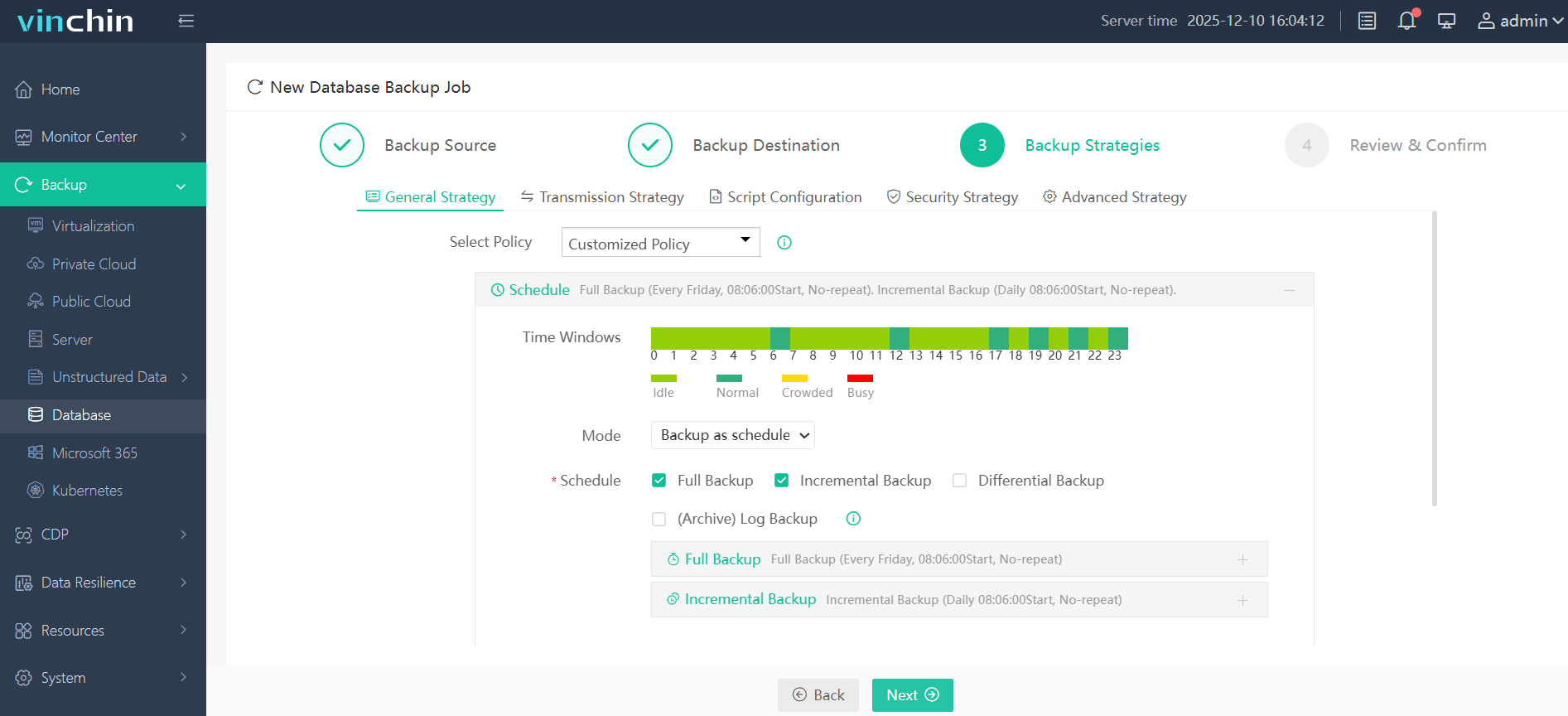
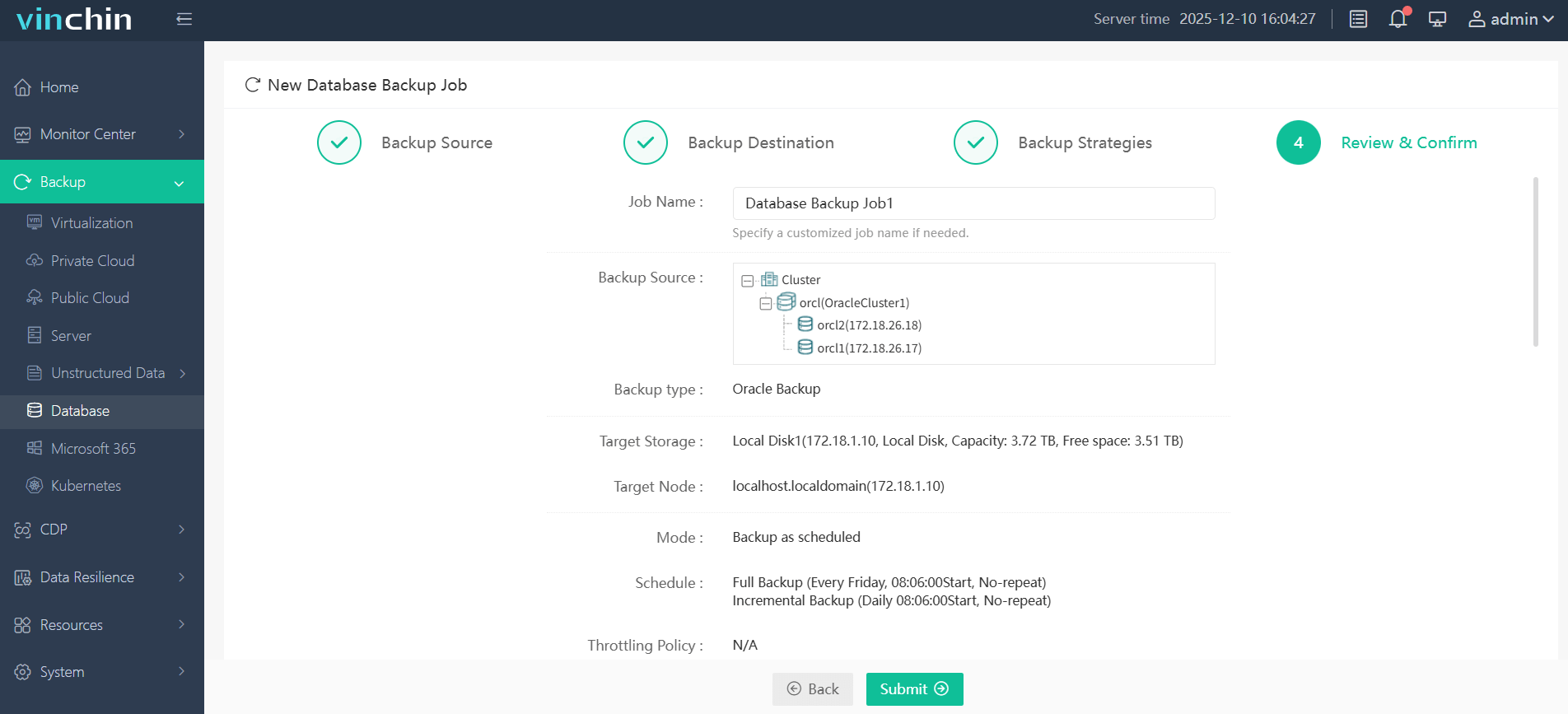
It requires just 4 steps to create a backup job with a streamlined wizard:
Step 1: Select the Oracle database to backup
Step 2: Choose the desired storage destination
Step 3: Define strategies according to business needs
Step 4: Submit the job
Recognized globally among leading enterprises with top ratings from satisfied customers worldwide, Vinchin Backup & Recovery offers a fully-featured free trial valid up to 60 days so you can evaluate its capabilities firsthand before committing further. Click below now to get started instantly.
Oracle Backup History FAQs
Q1: How do I automate daily email alerts if an Oracle scheduled nightly full-backup fails?
A1: Use cron-scheduled shell scripts calling SQL*Plus/RMAN queries filtered by status "FAILED", then send results via mail utility if found.
Q2: Can I safely delete old archive log files once they're marked "backed up" in my reports?
A2: Yes, but only after confirming they're included in at least two separate verified external copies per organizational policy/audit requirements first.
Q3: What does "EXPIRED" mean versus "OBSOLETE" regarding my stored pieces?
A3: "EXPIRED" means physically missing/unreachable while "OBSOLETE" means no longer needed per defined retention window even though still present locally/remotely somewhere else.
Conclusion
Knowing your Oracle backup history is vital for database safety and compliance at every stage, from basic reporting through advanced automation/testing routines alike! Native tools like RMAN and SQL*Plus provide robust visibility, but Vinchin offers streamlined management/protection beyond manual methods alone. Don't miss the free trial.