Protecting your Oracle database should never be left to chance. A full backup forms the backbone of any disaster recovery plan. Oracle Recovery Manager (RMAN) is Oracle’s built-in tool for this purpose. It offers flexibility, reliability, and deep integration with Oracle databases. In this guide, you’ll learn what an Oracle RMAN full backup is, why it matters for business continuity, and how to perform and automate it effectively. Whether you’re just starting out or looking to improve your current process, you’ll find clear steps here—plus tips for validation and automation that work in real-world environments.
What Is Oracle RMAN Full Backup?
An Oracle RMAN full backup creates a complete copy of all data files in your database at a specific point in time. This includes every used data block from each data file, the control file—which tracks database structure—and optionally archived redo logs that record changes since the last backup. With a full backup, you can restore your entire database exactly as it was when the backup finished.
This type of backup serves as a baseline for other types such as incremental or differential backups. Incremental backups only capture changes since the last full or incremental backup, saving storage space and reducing time needed for future backups. A full backup ensures you have everything required to recover from hardware failures, corruption events, or accidental deletions.
Why Perform Oracle RMAN Full Backup
A regular full backup is essential because it protects against total data loss scenarios. Without one, recovering from major incidents—like disk failure or severe corruption—becomes impossible. Full backups let you restore quickly with minimal downtime.
They also serve as anchor points for incremental backups. By combining regular full backups with incrementals and archived log backups, you can meet strict recovery point objectives (RPO) and recovery time objectives (RTO). This layered approach helps ensure compliance with business policies or regulatory requirements.
In short: if disaster strikes today, would you be able to recover? With consistent RMAN full backups in place, your answer should always be yes.
Method 1. Running Full Backup With RMAN Command Line
The command line interface is often preferred by administrators who want direct control over their backups. Before starting an RMAN full backup from the command line, make sure you have either SYSDBA or SYSBACKUP privileges—the latter being recommended by Oracle for least privilege operations—and confirm your database mode matches your needs.
First things first: check if your database runs in ARCHIVELOG mode. This mode allows online backups while users remain connected—a must-have for most production systems.
To check ARCHIVELOG status:
ARCHIVE LOG LIST;
If not enabled yet:
SHUTDOWN IMMEDIATE;
STARTUP MOUNT;
ALTER DATABASE ARCHIVELOG;
ALTER DATABASE OPEN;
Once enabled, consider running:
ALTER SYSTEM ARCHIVE LOG START;
to ensure automatic archiving begins right away.
Now let’s walk through performing a basic but reliable RMAN full backup:
Step 1: Connect to RMAN
Open a terminal window on your server where Oracle runs:
rman target /
Or connect remotely using:
rman target sys@yourdb
Step 2: Review and Configure RMAN Settings
It’s wise to review current settings before launching into production-level tasks:
SHOW ALL;
You may want to set up retention policies so old backups are cleaned up automatically:
CONFIGURE RETENTION POLICY TO RECOVERY WINDOW OF 7 DAYS;
CONFIGURE DEFAULT DEVICE TYPE TO DISK;
SHOW ALL;
Step 3: Run the Full Backup Command
To back up both all data files and archived redo logs in one go:
BACKUP DATABASE PLUS ARCHIVELOG;
This creates a backup set, which is compressed by default unless specified otherwise by configuration settings.
Want more control? Compress output further or specify destination paths like this:
BACKUP AS COMPRESSED BACKUPSET DATABASE PLUS ARCHIVELOG FORMAT '/backup/ora_full_%U.bkp';
Prefer image copies instead of compressed sets? Use:
BACKUP AS COPY DATABASE FORMAT '/backup/imagecopy_%U.dbf';
Need to save space by deleting archived logs after they’re backed up?
BACKUP DATABASE PLUS ARCHIVELOG DELETE INPUT;
Each method has its own pros and cons—compressed sets save space but require restoration via RMAN; image copies are faster during restores but use more disk space upfront.
Step 4: Verify the Backup
After completion, always verify what was created:
Check summaries quickly with:
LIST BACKUP OF DATABASE SUMMARY;
LIST BACKUP OF ARCHIVELOG ALL SUMMARY;
For deeper checks—including physical validation—use these commands:
VALIDATE BACKUPSET <backupset_key>;
RESTORE DATABASE VALIDATE;
VALIDATE DATABASE;
VALIDATE ARCHIVELOG ALL;
These commands help catch issues early before they become disasters during an actual restore event.
Step 5: Tag Your Backup
Tagging makes tracking easier later on—for example during audits or troubleshooting.
Assign tags like this:
BACKUP DATABASE TAG='FULL_BACKUP_JUNE2024' PLUS ARCHIVELOG;
LIST BACKUP TAG='FULL_BACKUP_JUNE2024' SUMMARY;
Step 6: Back Up in NOARCHIVELOG Mode
Some test environments run without ARCHIVELOG mode enabled—in those cases:
Shut down active sessions first,
then mount without opening fully,
and run your backup command:
SHUTDOWN IMMEDIATE;
STARTUP MOUNT;
BACKUP DATABASE;
ALTER DATABASE OPEN;
Remember that users cannot access the database during this process—a key reason most production systems use ARCHIVELOG mode instead!
Method 2. Scheduling Automated Full Backups In RMAN
Manual processes are risky—they rely too much on human memory! For true resilience in enterprise environments,
automate everything possible using system schedulers like cron (Linux/Unix) or Task Scheduler (Windows).
Automation ensures consistency across weeks or months—even if staff change roles or schedules shift unexpectedly.
Here’s how to get started:
First create a shell script containing all necessary commands—for example rman_full_backup.sh might look like this:
#!/bin/bash
rman target / <<EOF
BACKUP AS COMPRESSED BACKUPSET DATABASE PLUS ARCHIVELOG FORMAT '/backup/ora_full_%U.bkp';
DELETE NOPROMPT OBSOLETE RECOVERY WINDOW OF 7 DAYS;
EOF
chmod +x rman_full_backup.sh
On Linux add it to cron so it runs regularly without manual intervention:
Edit crontab with crontab -e, then add something like this line—
which triggers every Sunday at 2 AM:
0 2 0 /path/to/rman_full_backup.sh > /path/to/logs/rman_full_backup.log 2>&1
On Windows use Task Scheduler’s graphical interface to schedule similar batch scripts at times matching business needs.
Always monitor generated logs closely—and periodically test restores—to ensure automated jobs deliver real protection rather than false peace-of-mind!
How to Back Up Oracle Databases Using Vinchin Backup & Recovery?
Beyond native tools and scripting approaches described above, organizations seeking streamlined enterprise protection can leverage Vinchin Backup & Recovery—a professional solution supporting mainstream databases including Oracle (as well as MySQL, SQL Server, MariaDB, PostgreSQL, PostgresPro, TiDB).
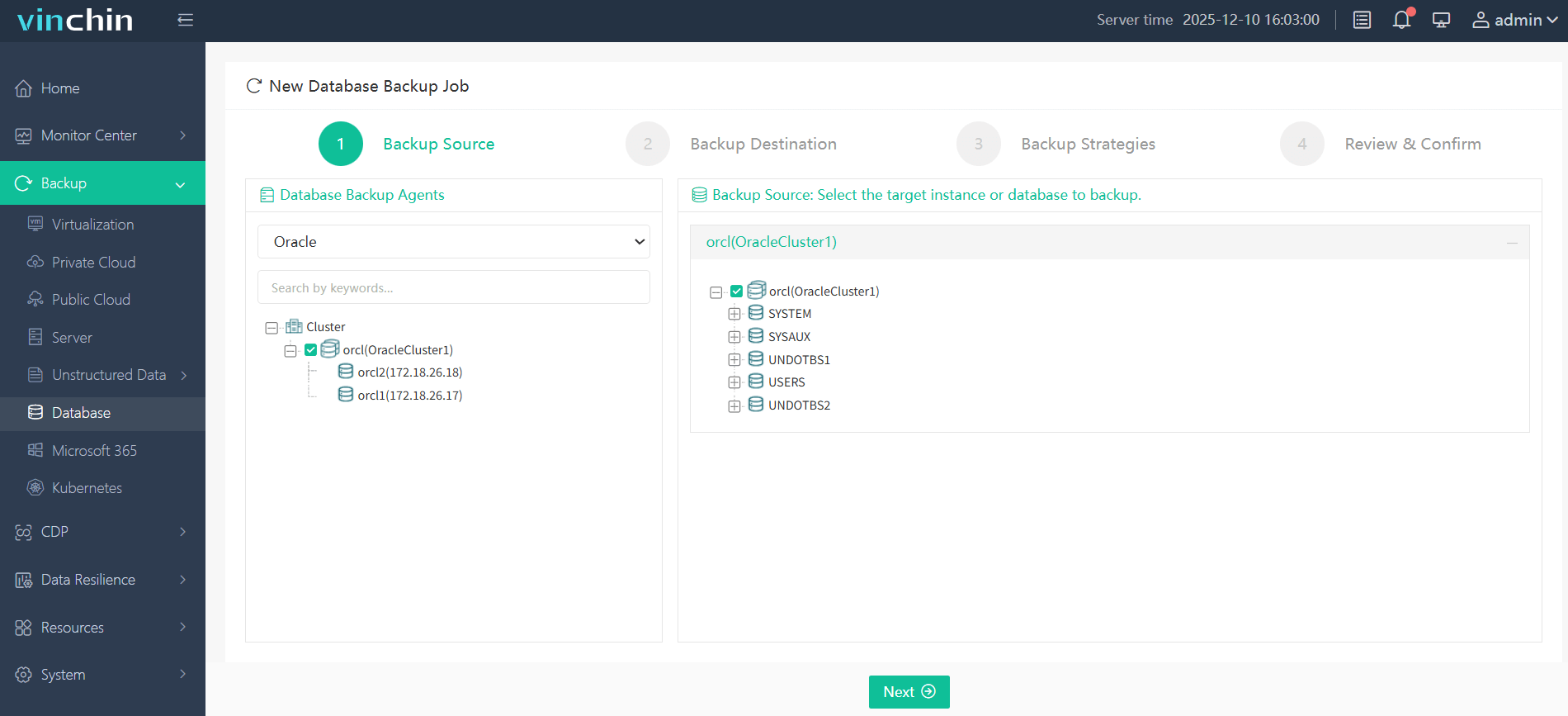
For Oracle environments specifically, Vinchin Backup & Recovery delivers advanced source-side compression and incremental backup capabilities alongside batch processing options and flexible retention strategies—all designed for efficiency and reliability at scale. Features such as log/archived log backup support, any-point-in-time recovery capability via intuitive scheduling interfaces, storage protection against ransomware threats, integrity checks with automated verification routines using SQL scripts after each job submission ensure robust coverage while minimizing administrative overhead. The web console simplifies management into four straightforward steps:
Step 1 – Select the Oracle database to back up;
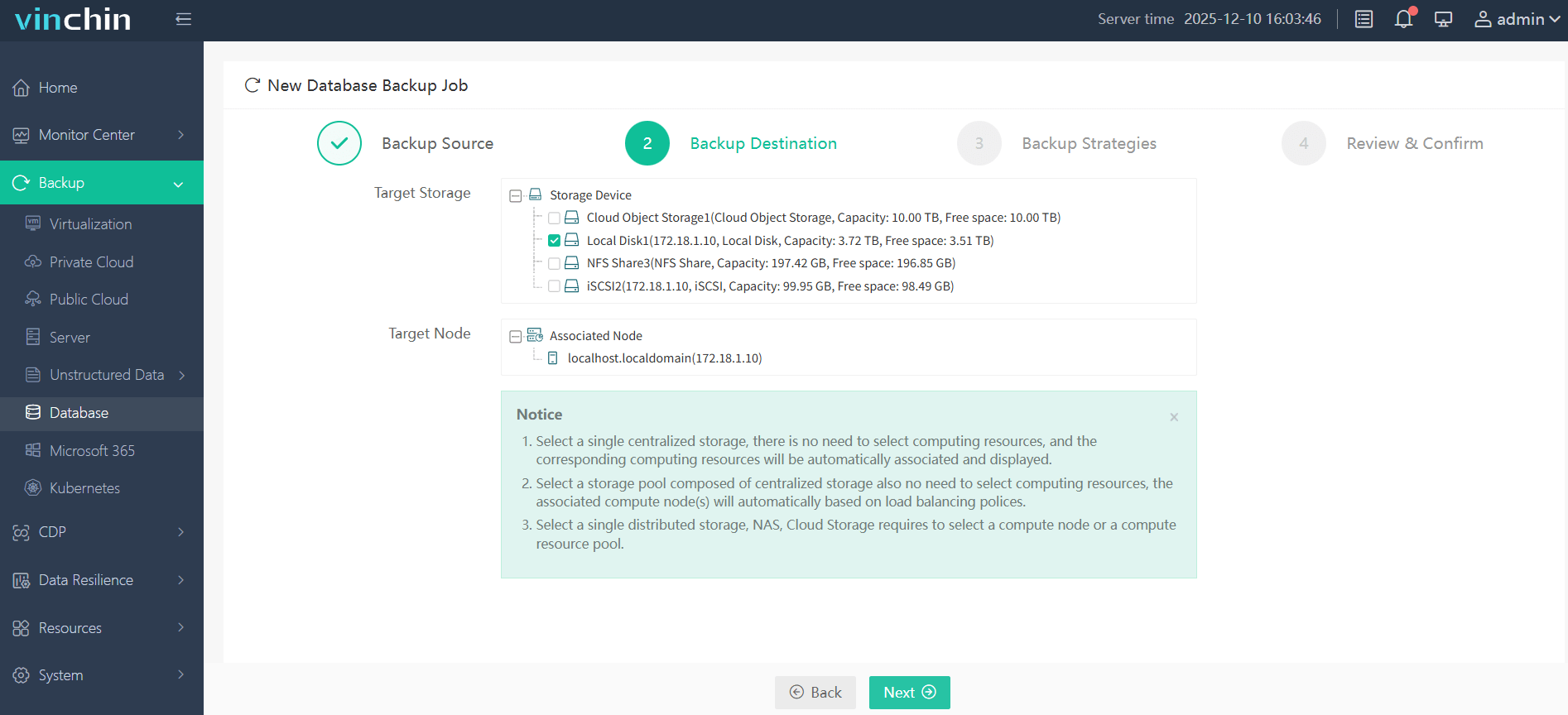
Step 2 – Choose desired storage location;
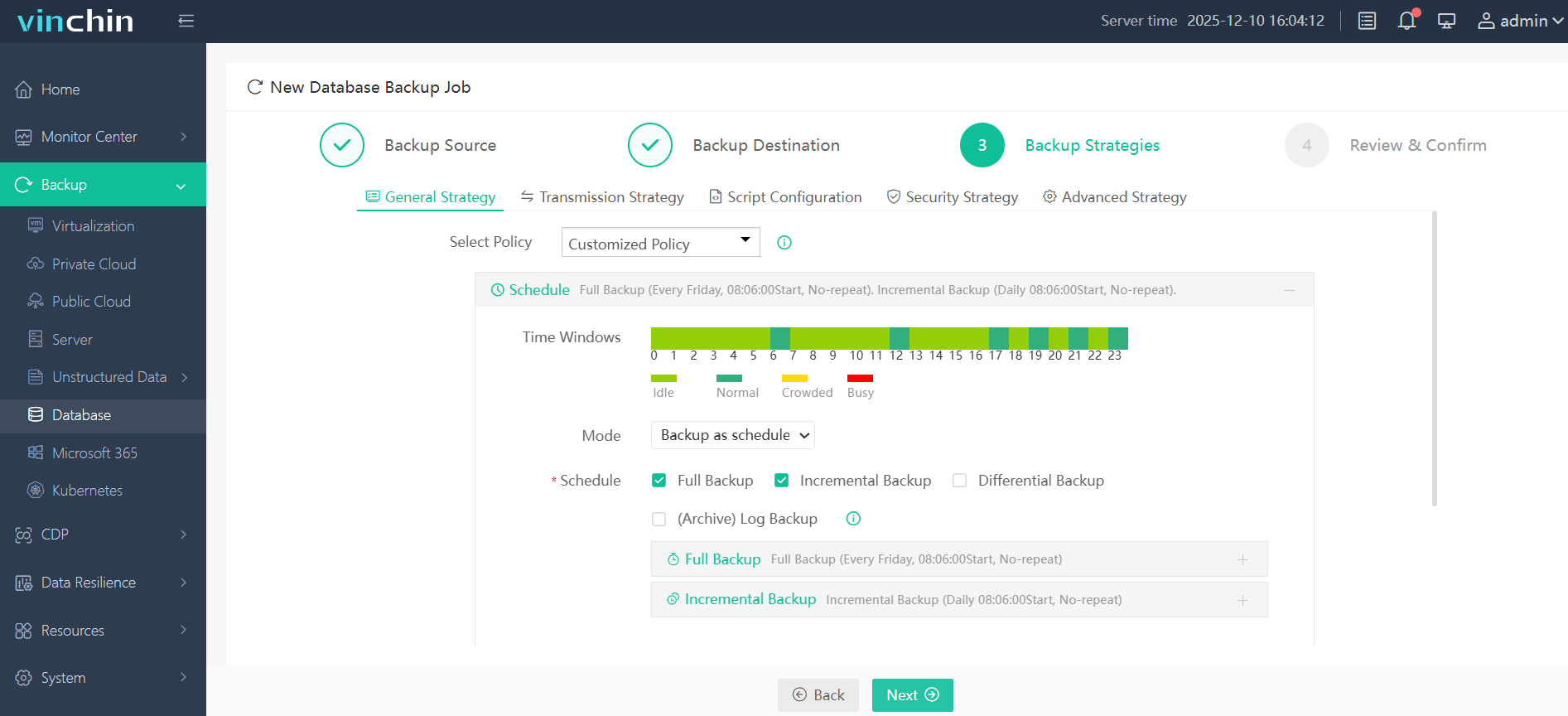
Step 3 – Define custom strategy parameters including schedules/policies;
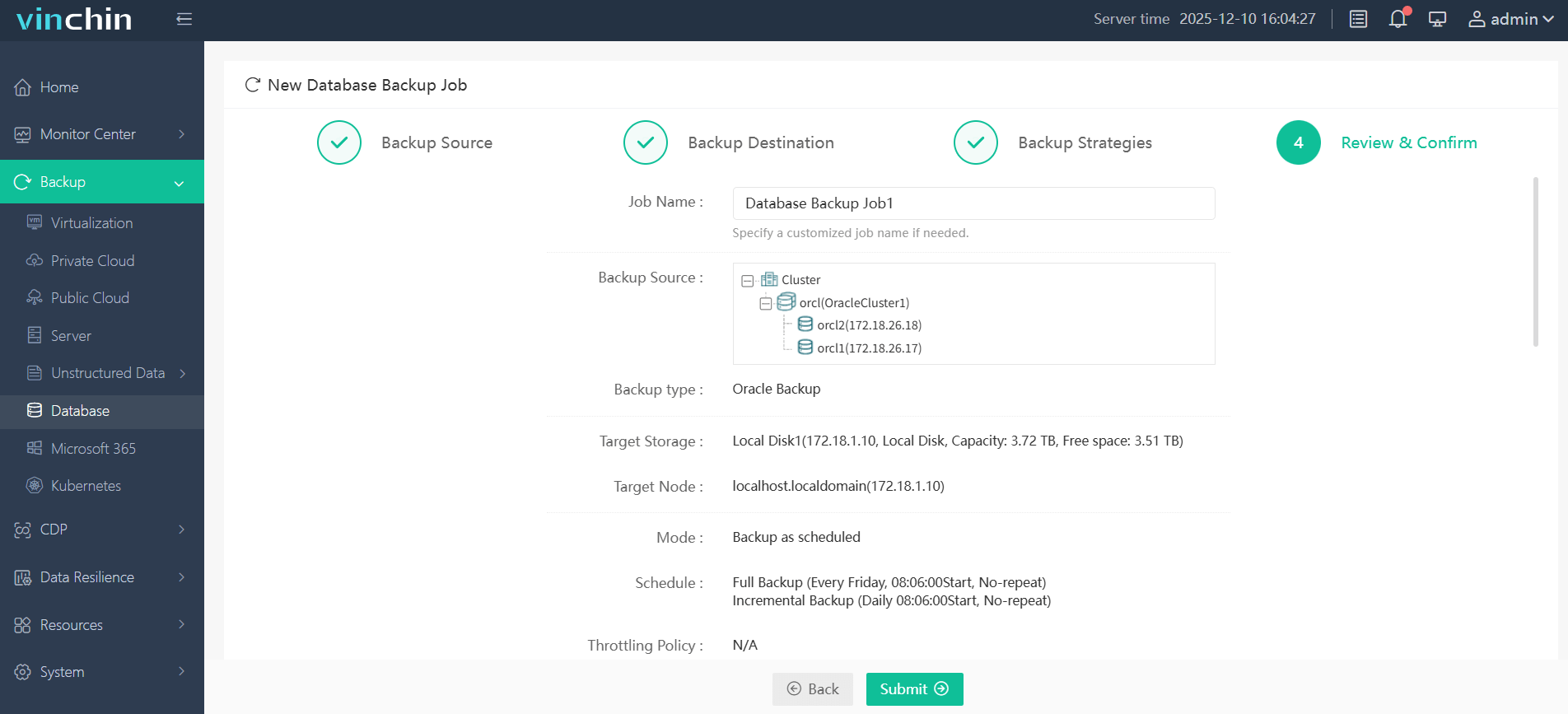
Step 4 – Submit job instantly—with no steep learning curve required even across complex deployments.
Globally trusted by thousands of enterprises—with top ratings for ease-of-use—Vinchin Backup & Recovery offers a fully featured free trial valid for sixty days so you can evaluate its power risk-free. Click below to download now!
Oracle RMAN Full Backup FAQs
Q1: Can I run an Oracle RMAN full backup while users are connected?
A1: Yes—as long as your database uses ARCHIVELOG mode,you can perform online full backups without disrupting user activity.
Q2: What should I do if my Oracle RMAN full backup fails due to lack of disk space?
A2: Free up space on both your destination path and FRA,retry,the operation,and adjust retention policy if needed.
Q3: How do I validate my latest Oracle RMAN full backup worked correctly?
A3: Use RESTORE DATABASE VALIDATE command in RMAN—it reads all blocks from recent backups without restoring them live.
Conclusion
Regularly scheduled Oracle RMAN full backups form a strong defense against unexpected data loss. With proper validation, scripting,and monitoring, your organization stays ready. For even greater simplicity, Vinchin offers enterprise-grade solutions worth exploring. Download their free trial today!