Running RMAN backup scripts is a core task for Oracle database administrators. Whether you want to automate backups, ensure data safety, or meet compliance requirements, knowing how to run these scripts is essential. This guide explains what RMAN is, how to prepare your environment for backups, common script structures you might use, several ways to run RMAN scripts—both manually and automatically—on different operating systems, as well as how to verify that your backups are working.
What Is RMAN in Oracle?
RMAN (Recovery Manager) is Oracle’s built-in tool for physical database backup and recovery. It helps you back up datafiles, control files, archived logs—and restore them when needed. With support for full and incremental backups plus automation features like scheduling and retention policies, it integrates tightly with Oracle’s security model. For most environments today, using RMAN is considered best practice.
Preparing for RMAN Backup Script
Before running any backup script with RMAN, make sure your environment is ready. Start by confirming you have the right privileges—usually SYSDBA or SYSBACKUP—to perform database-level operations. Check that all necessary Oracle environment variables are set correctly; these include ORACLE_HOME (the path to your Oracle installation) and ORACLE_SID (your database instance name).
Next, verify that your chosen backup destination has enough free space. You can estimate required space by querying V$DATAFILE or checking previous backup sizes if available. Decide whether you want to use a recovery catalog or just rely on the control file for metadata storage; a catalog offers more flexibility but requires extra setup.
Always test new scripts in a non-production environment first so you don’t risk production data. If possible, create a checklist:
Confirm user privileges
Set all required environment variables
Ensure sufficient disk space at the target location
Decide on using recovery catalog vs control file
Test script execution outside production
This preparation helps prevent common errors during actual runs.
Common RMAN Script Commands and Structure
Understanding basic script structure makes it easier to customize backups later on. Most scripts start with a RUN {} block containing one or more commands.
For example:
run {
  allocate channel c1 device type disk format '/backup/%U';
  backup database plus archivelog;
  release channel c1;
}
The allocate channel command reserves resources for the operation; %U in the format string ensures unique filenames so old backups aren’t overwritten accidentally.
You can also perform incremental backups:
run {
  allocate channel c1 device type disk format '/backup/incr_%U';
  backup incremental level 1 database;
  release channel c1;
}
Or back up only archived logs:
run {
  allocate channel c1 device type disk format '/backup/arch_%U';
  backup archivelog all delete input;
  release channel c1;
}
Scripts often end with release channel to free resources promptly.
Advanced users may add options like compression (as compressed backupset) or specify retention policies within their scripts depending on business needs.
Method 1. Running RMAN Script from Command Line
Running an RMAN script from the command line gives you direct control over every step of the process. This approach works across Linux/Unix and Windows platforms alike.
First create a command file—for example backup_full.rman:
run {
  allocate channel c1 device type disk format '/backup/%U';
  backup database plus archivelog;
  release channel c1;
}
To execute this script:
Open your terminal (Linux/Unix) or command prompt (Windows), then enter:
rman target / @backup_full.rman log=backup_full.log
Here’s what happens:
target / connects as a privileged user via OS authentication.
@backup_full.rman tells RMAN which commands to run.
log=backup_full.log saves output—including errors—to a log file for review later.
Alternatively use the cmdfile parameter:
rman target / cmdfile=backup_full.rman log=backup_full.log
If using a recovery catalog instead of just the control file metadata repository add this parameter:
rman target / catalog rman_user/password@catdb @backup_full.rman log=backup_full.log
Note that catdb refers to your net service name—not necessarily an SID—for connecting remotely.
Best practice: Always check both standard output and error streams by redirecting them into your log file if possible (log=/path/to/logfile.log 2>&1). After running any manual job inspect this log closely for warnings or failures before considering it complete.
Method 2. Scheduling RMAN Backups with Cron (Linux/Unix)
Automating regular backups reduces risk from human error or forgetfulness. On Linux/Unix systems use cron jobs alongside shell scripts that call your prepared .rman files.
First ensure your .rman script works as expected when run manually. Next build an executable shell wrapper such as run_rman_backup.sh:
#!/bin/bash
export ORACLE_HOME=/u01/app/oracle/product/19.0.0/dbhome_1
export ORACLE_SID=ORCL
$ORACLE_HOME/bin/rman target / @/path/to/backup_full.rman log=/path/to/backup_full.log 2>&1
EXIT_STATUS=$?
if [ $EXIT_STATUS -ne 0 ]; then echo "Backup failed" | mail -s "RMAN Backup Failure" admin@example.com; fi
exit $EXIT_STATUS
Make it executable using:
chmod +x run_rman_backup.sh
Then schedule it via cron by editing crontab entries (crontab -e). To run daily at two AM add:
0 2 * * * /path/to/run_rman_backup.sh
Cron now triggers automated execution at set times—even if no one remembers manually! Always review generated logs after each scheduled job completes; consider setting up email alerts if failures occur so problems don’t go unnoticed overnight.
Method 3. Scheduling RMAN Backups with Windows Task Scheduler
On Windows servers use Task Scheduler together with batch files (.bat) calling your .rman scripts—mirroring Unix automation but tailored for Microsoft environments.
Start by creating both an .rman command file (C:\scripts\backup_full.rman) and batch launcher (C:\scripts\run_rman_backup.bat) like this:
@echo off
set ORACLE_HOME=C:\app\oracle\product\19.0.0\dbhome_1
set ORACLE_SID=ORCL
%ORACLE_HOME%\bin\rman target / @C:\scripts\backup_full.rman log=C:\scripts\backup_full.log
IF %ERRORLEVEL% NEQ 0 (
    echo Backup failed | powershell -Command "Send-MailMessage -To 'admin@example.com' -Subject 'RMAN Backup Failure' -Body 'Check logs.'"
)
exit /b %ERRORLEVEL%
Test this batch file interactively first by double-clicking it; confirm successful completion before automating further steps.
Now launch Task Scheduler, click Create Basic Task, give it a name (“Nightly Oracle Backup”), choose frequency (“Daily”), set time (“2:00 AM”), select action (Start a program) pointing at your batch file location—and finish setup through remaining prompts.
For best results assign tasks under dedicated service accounts holding only necessary permissions rather than personal administrator credentials; this improves auditability while reducing accidental risks from unrelated changes elsewhere on system profiles.
After every scheduled run check output logs carefully—or configure alerts—to catch issues early rather than discovering missing data during disaster recovery scenarios!
Verifying and Monitoring RMAN Backups
Backing up isn’t enough—you must confirm those backups are valid! After each job finishes always review its associated log file (*.log). Look specifically for lines indicating success without errors such as "Finished backup" near end of output—and absence of "RMAN-" ERROR MESSAGE STACK.
Within an active session connect via SQL*Plus or another tool then issue commands like:
To list recent completed jobs quickly:
LIST BACKUP SUMMARY;
To validate integrity of specific sets without restoring actual data yet:
VALIDATE BACKUPSET <key>;
-- Or validate entire restore process readiness --
RESTORE DATABASE VALIDATE;
Regularly validating both current backups AND ability-to-recover ensures peace-of-mind should disaster ever strike unexpectedly!
Consider integrating monitoring tools that parse these logs automatically looking out for keywords like "ERROR" or "FAILED"—and send notifications immediately upon detection so corrective action starts sooner rather than later!
How to Back Up Oracle Databases Using Vinchin?
For organizations seeking streamlined enterprise-grade protection beyond native tools, Vinchin Backup & Recovery delivers comprehensive support for mainstream databases including Oracle 10g, 11g/11g R2, 12c, 18c, 19c, 21c, Oracle RAC, MySQL, SQL Server, MariaDB, PostgreSQL, PostgresPro, and TiDB—with robust compatibility across diverse IT environments.
When backing up Oracle databases specifically, Vinchin Backup & Recovery offers advanced features such as source-side compression, incremental backup capabilities tailored for efficient storage usage, flexible batch database management options, multiple levels of data compression strategies suited to varying workloads, and granular retention policy controls including GFS schemes—all designed to optimize performance while ensuring regulatory compliance and operational resilience.
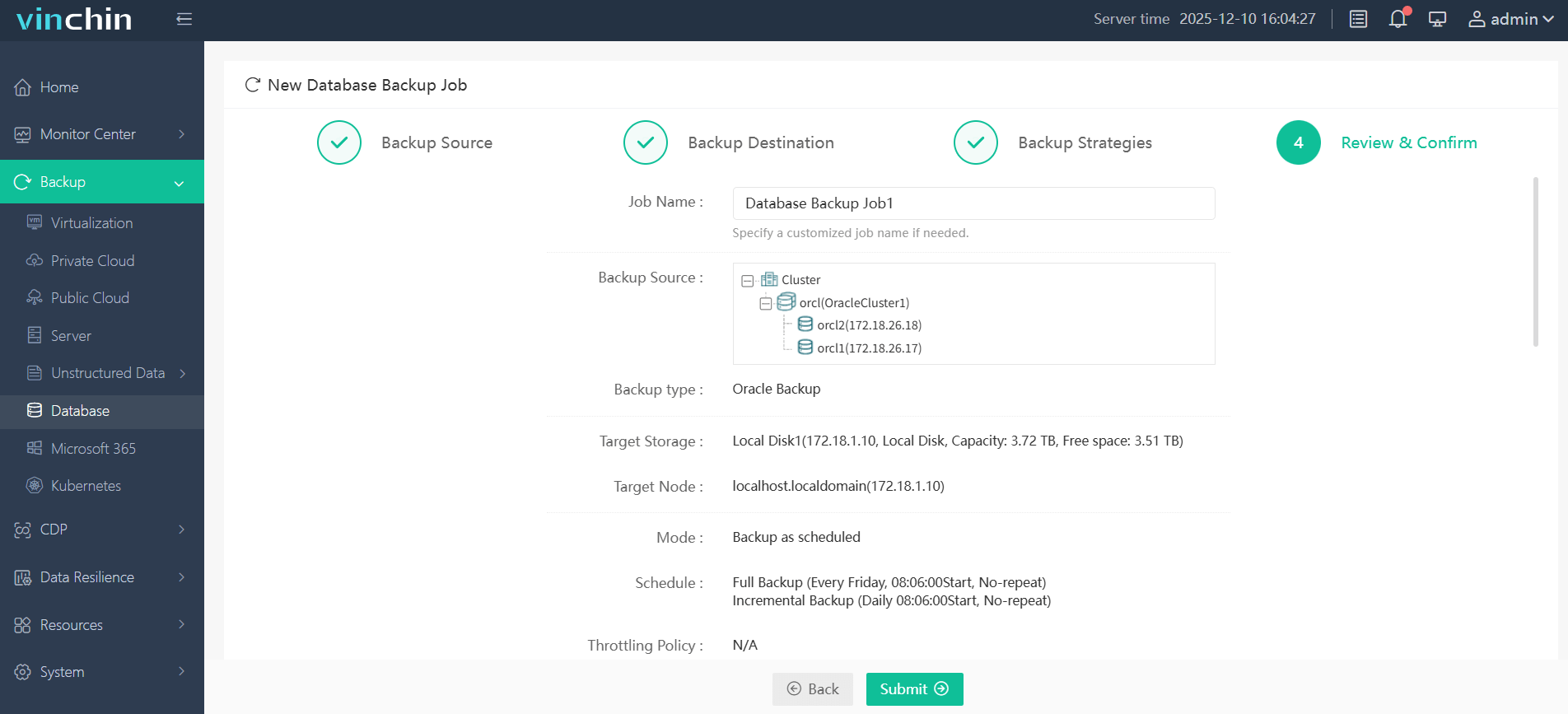
With Vinchin Backup & Recovery’s intuitive web console interface backing up an Oracle database typically involves four straightforward steps:
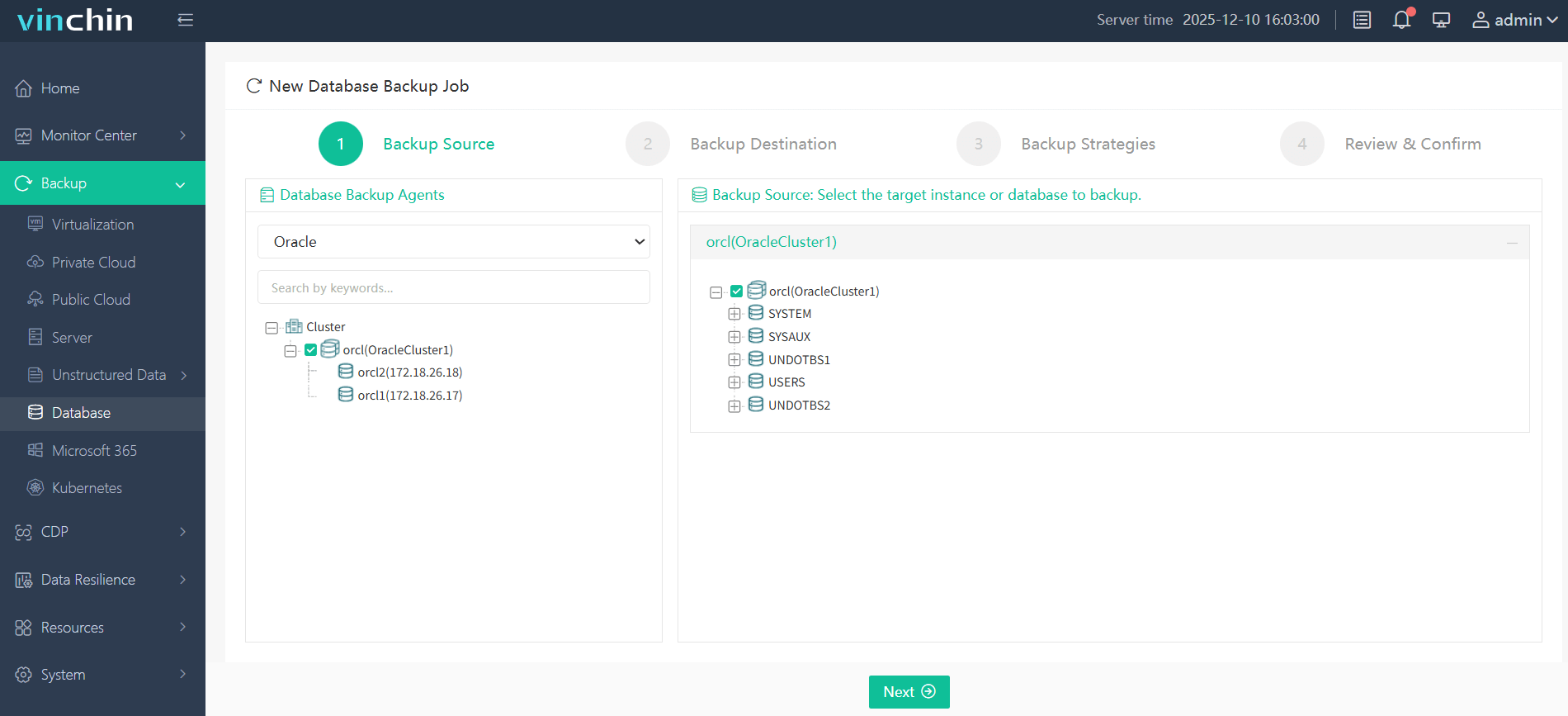
Step 1. Select the Oracle database to backup
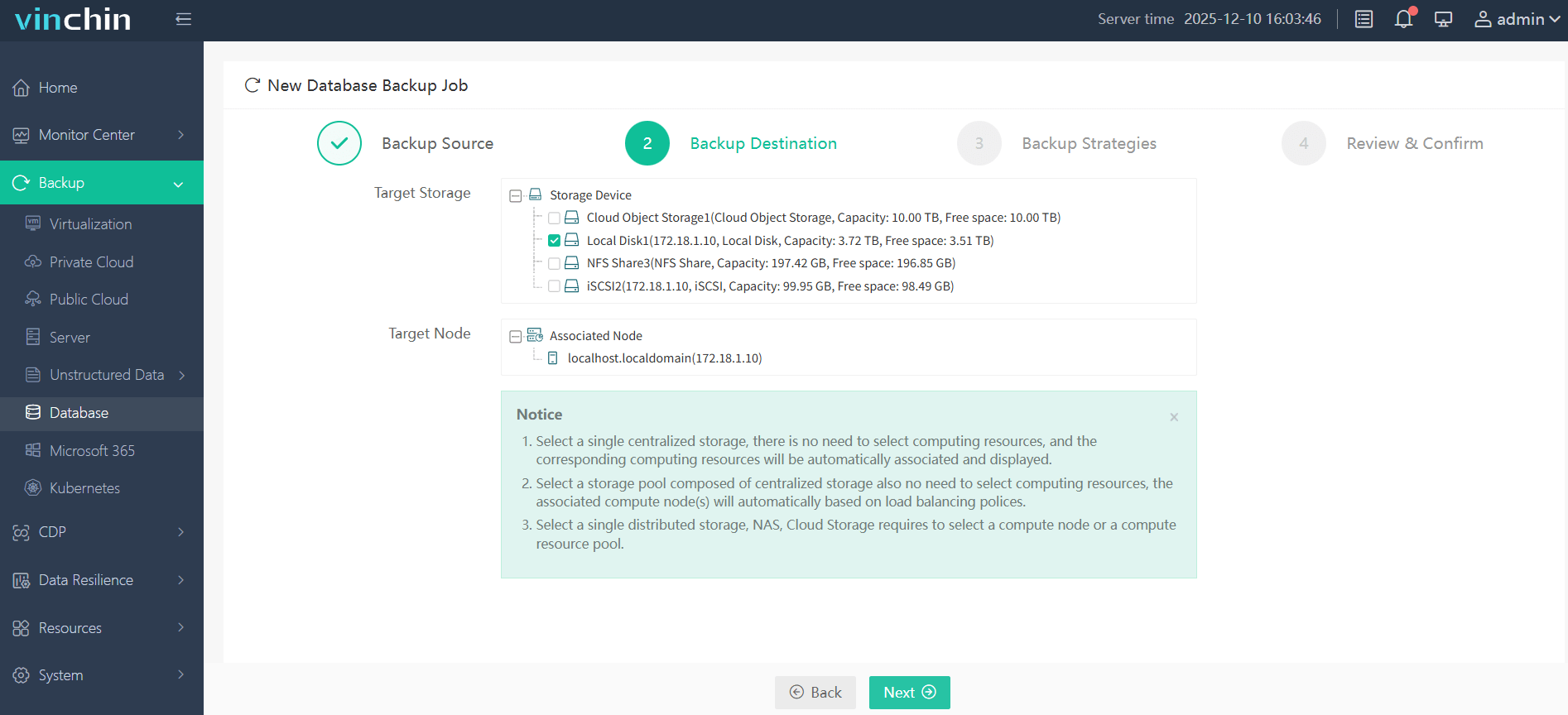
Step 2. Choose the backup storage
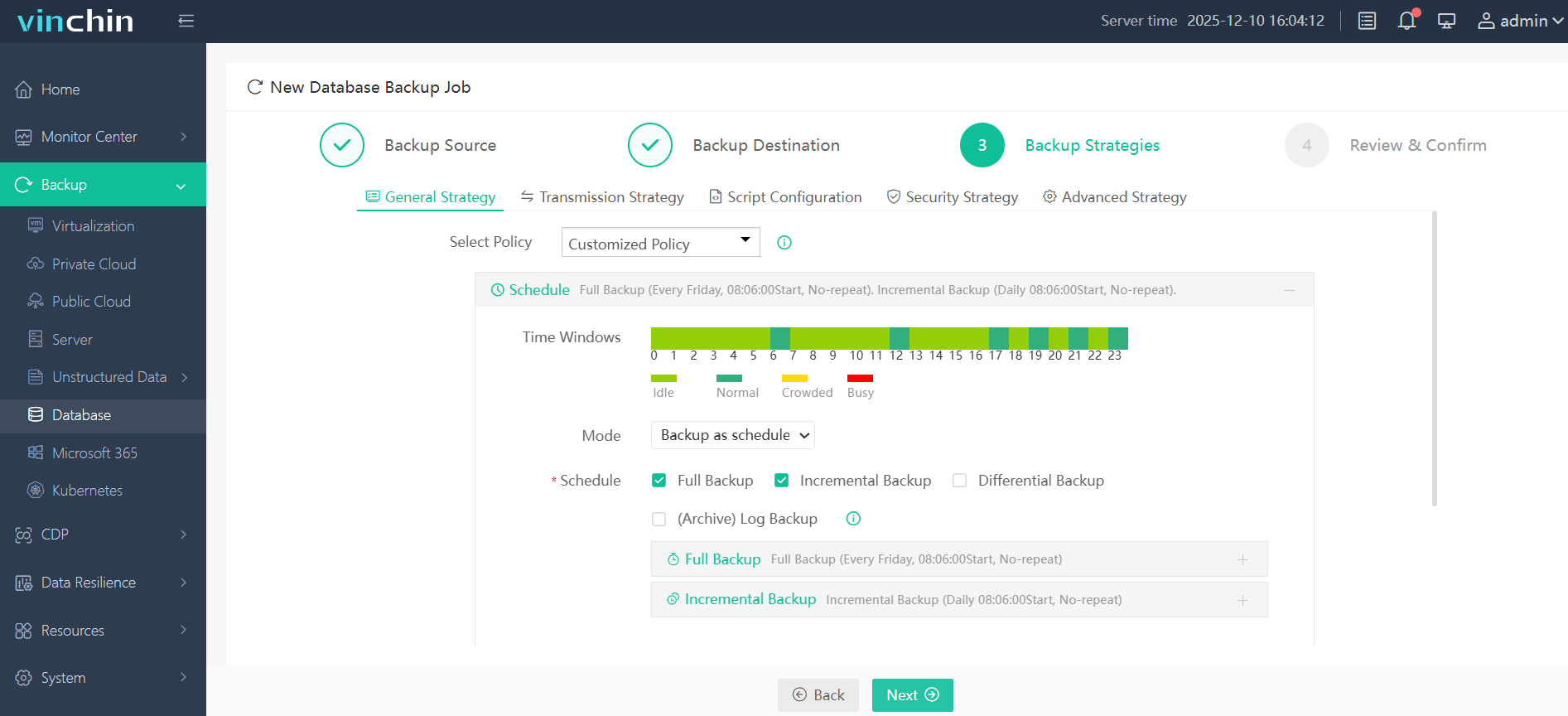
Step 3. Define the backup strategy
Step 4. Submit the job
Recognized globally among enterprise users for reliability and ease-of-use—with top industry ratings—Vinchin Backup & Recovery offers a fully functional free trial lasting up to 60 days; click below to experience its powerful features firsthand!
How to Run RMAN Backup Script in Oracle FAQs
Q1: Can I schedule multiple different types of backups (full/incremental) using cron?
Yes; create separate shell scripts referencing different .rman files then schedule each independently in crontab as needed.
Q2: How do I clean up old obsolete backups automatically?
Configure retention policy using CONFIGURE RETENTION POLICY TO RECOVERY WINDOW OF n DAYS then regularly run DELETE OBSOLETE within an .rman maintenance job.
Q3: What should I do if my scheduled task fails silently?
Check both system event logs (Windows Event Viewer/Cron syslogs) AND detailed .log outputs generated by rman's LOG argument.
Conclusion
Running reliable Oracle database backups means combining careful preparation with automation—and always verifying results afterward! Whether executing manually or scheduling jobs through cron or Task Scheduler these methods keep critical data protected day after day—with less stress along way! For even greater simplicity consider trying Vinchin’s unified enterprise solution today—it could transform how easily you safeguard business information tomorrow!