Backing up your Oracle database is not just a best practice—it is essential for business continuity. Oracle Recovery Manager (RMAN) is the built-in tool for this job. With RMAN, you can automate, schedule, and manage backups, making recovery fast and reliable. In this article, you will learn what RMAN is, why it matters, how to prepare your environment for backup success, and how to use it for both full and incremental database backups across all experience levels.
Always test backup and recovery procedures in a non-production environment before relying on them in production.
What Is Oracle RMAN Backup?
Oracle RMAN (Recovery Manager) is a command-line utility included with every Oracle Database installation. It lets you create backups of your entire database, specific tablespaces, or individual data files using simple commands. RMAN supports both full and incremental backups; it can also back up archived redo logs, control files, and server parameter files (spfile). Backups are stored either as backup sets (Oracle’s proprietary format) or image copies (exact file copies), giving you flexibility based on your needs.
RMAN tracks backup metadata automatically within its catalog or control file repository. This means you do not have to manually record which files were backed up or when—they are always available through queries within RMAN itself.
Why Use RMAN for Database Backup?
RMAN stands out because it integrates tightly with the Oracle database engine itself. It automates many critical tasks: tracking backup history over time; enforcing retention policies so old backups do not fill storage; verifying that each backup set is complete; even handling encryption if needed for compliance reasons.
You can run most types of RMAN backups while the database stays online—as long as ARCHIVELOG mode is enabled—so there’s no need to schedule downtime just to protect your data. Features like compression reduce storage costs while parallelism speeds up jobs on larger systems.
Most importantly? When disaster strikes or corruption occurs unexpectedly, RMAN makes point-in-time recovery straightforward—even down to restoring single tablespaces if required.
Before You Begin: Configure ARCHIVELOG Mode and Fast Recovery Area
Before running any online backups with RMAN—or planning point-in-time restores—you must enable ARCHIVELOG mode on your Oracle database instance. Without this setting active, only cold (offline) consistent backups are possible after shutting down the system cleanly.
First check whether ARCHIVELOG mode is already enabled:
SELECT log_mode FROM v$database;
If NOARCHIVELOG appears as the result:
1. Connect using SQL*Plus.
2. Shut down the instance gracefully:
SHUTDOWN IMMEDIATE;
3. Mount—but do not open—the database:
STARTUP MOUNT;
4. Enable archiving:
ALTER DATABASE ARCHIVELOG;
5. Open the database normally:
ALTER DATABASE OPEN;
Next configure a Fast Recovery Area (FRA), which acts as a managed location where Oracle stores archived logs and default backup pieces:
ALTER SYSTEM SET DB_RECOVERY_FILE_DEST_SIZE = 100G;
ALTER SYSTEM SET DB_RECOVERY_FILE_DEST = '/u01/app/oracle/fast_recovery_area';
This ensures enough space exists for ongoing archive logs plus recent backup sets—and helps automate deletion of obsolete files later via retention policies.
With these settings complete you’re ready to take advantage of all advanced features offered by oracle rman backup database workflows without risking incomplete protection due to missing prerequisites.
How to Perform a Full Database Backup with RMAN?
A full database backup captures all data files along with control files—and optionally includes archived redo logs plus server parameter file (spfile). This forms the foundation of any robust oracle rman backup database strategy at every skill level.
Beginner administrators should start here:
1. Open a terminal window.
2. Connect directly using:
rman target /
Once inside RMAN prompt check current configuration settings:
SHOW ALL;
To perform a basic full backup type:
BACKUP DATABASE;
This command backs up all datafiles plus current control file but does not include spfile unless specified separately:
BACKUP SPFILE;
For more comprehensive protection—including archived redo logs necessary for point-in-time restore—use:
BACKUP DATABASE PLUS ARCHIVELOG;
This sequence will archive current online redo log first; then back up all datafiles/control file/spfile if present; then copy all archived redo logs generated during process; finally archive again at end so nothing gets missed mid-backup.
Want custom naming or location? Specify format string like so:
BACKUP DATABASE FORMAT '/backup/oracle/backup_%U';
To save disk space add compression option:
BACKUP AS COMPRESSED BACKUPSET DATABASE;
Tagging helps identify specific runs later—for example weekly jobs versus ad-hoc ones:
BACKUP DATABASE TAG 'WEEKLY_FULL';
After completion list results using:
LIST BACKUP;
This shows summary details about each set created—including timestamps/locations/status—which aids troubleshooting later if needed.
How to Perform an Incremental Backup Using RMAN?
Incremental backups copy only those blocks changed since last baseline—saving both time & storage especially when working with very large databases day-to-day.
There are two main types supported by oracle rman backup database routines:
Intermediate users often combine these into efficient schedules such as “weekly Level 0 + daily Level 1” cycles—a proven approach balancing speed against risk.
To create initial baseline run,
BACKUP INCREMENTAL LEVEL 0 DATABASE;
For daily changes use differential style,
BACKUP INCREMENTAL LEVEL 1 DATABASE;
Or cumulative style—which collects all changes since last Level 0 regardless of intervening Level 1s,
BACKUP INCREMENTAL LEVEL 1 CUMULATIVE DATABASE;
Combine incrementals with archived log capture like this,
BACKUP INCREMENTAL LEVEL 1 DATABASE PLUS ARCHIVELOG;
Advanced users may want automatic cleanup post-backup—add DELETE INPUT clause after PLUS ARCHIVELOG so old logs don’t consume excess FRA space over weeks/months.
Vinchin Backup & Recovery: Enterprise-Level Protection for Oracle Databases
For organizations seeking streamlined automation beyond native tools, Vinchin Backup & Recovery delivers professional-grade protection tailored for enterprise environments. As an advanced solution supporting today’s mainstream databases—including Oracle, MySQL, SQL Server, MariaDB, PostgreSQL, PostgresPro, and TiDB—it offers broad compatibility ideal for mixed infrastructures where Oracle plays a central role.
Key features such as batch database backup management, multiple level data compression options, GFS retention policy enforcement, integrity check routines via SQL scripts, and robust storage protection against ransomware ensure both operational efficiency and strong security posture throughout your environment—all from one platform designed specifically for reliability at scale.
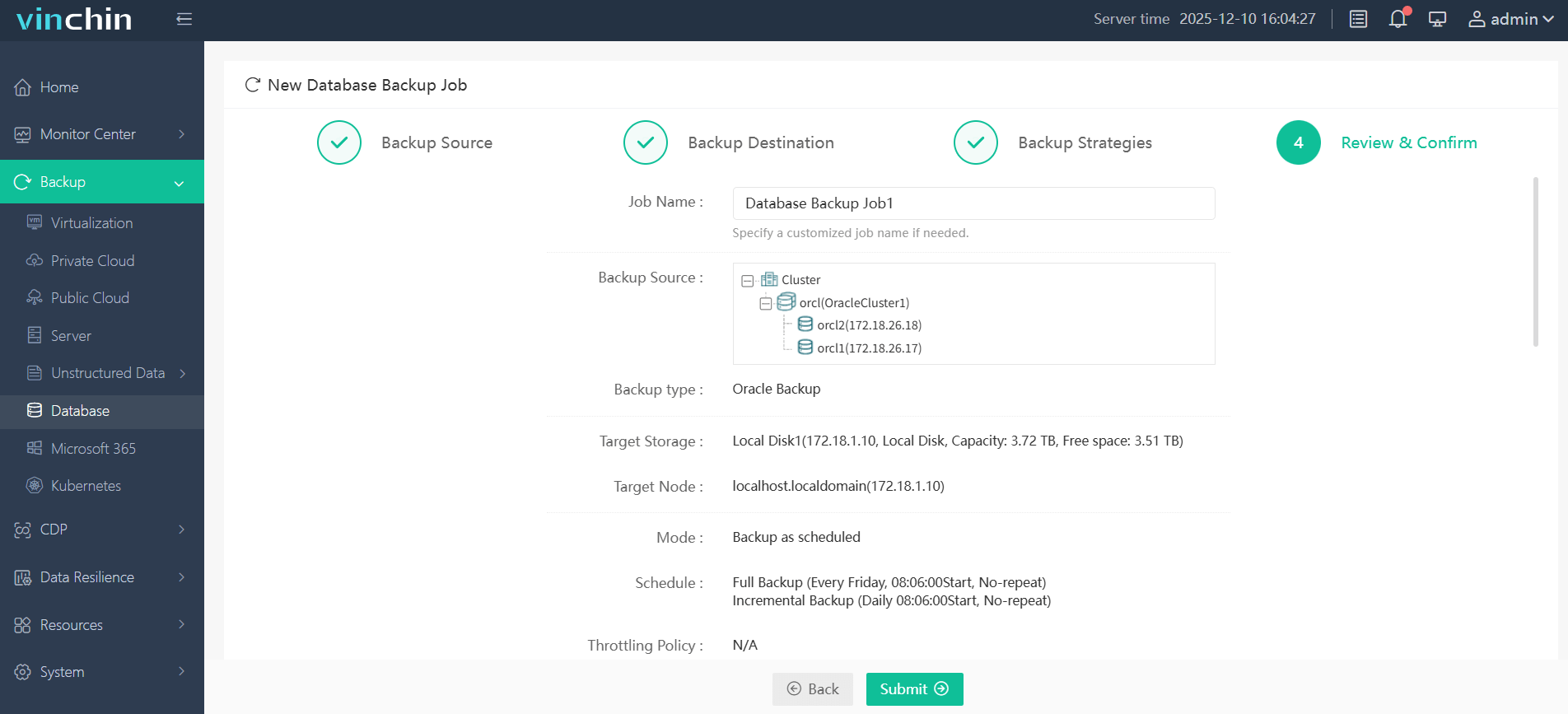
The intuitive web console makes safeguarding your Oracle databases remarkably simple:
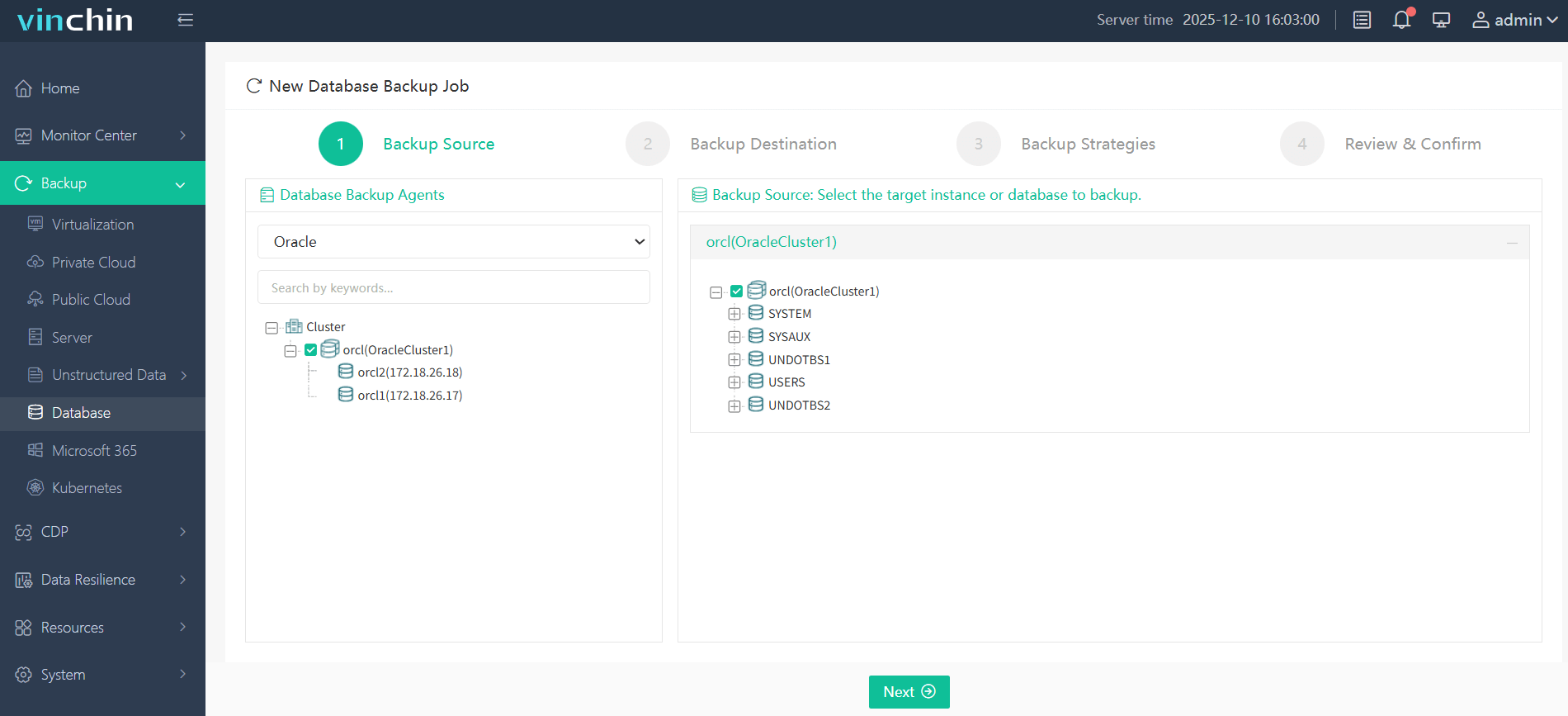
Step 1. Select the Oracle database to back up;
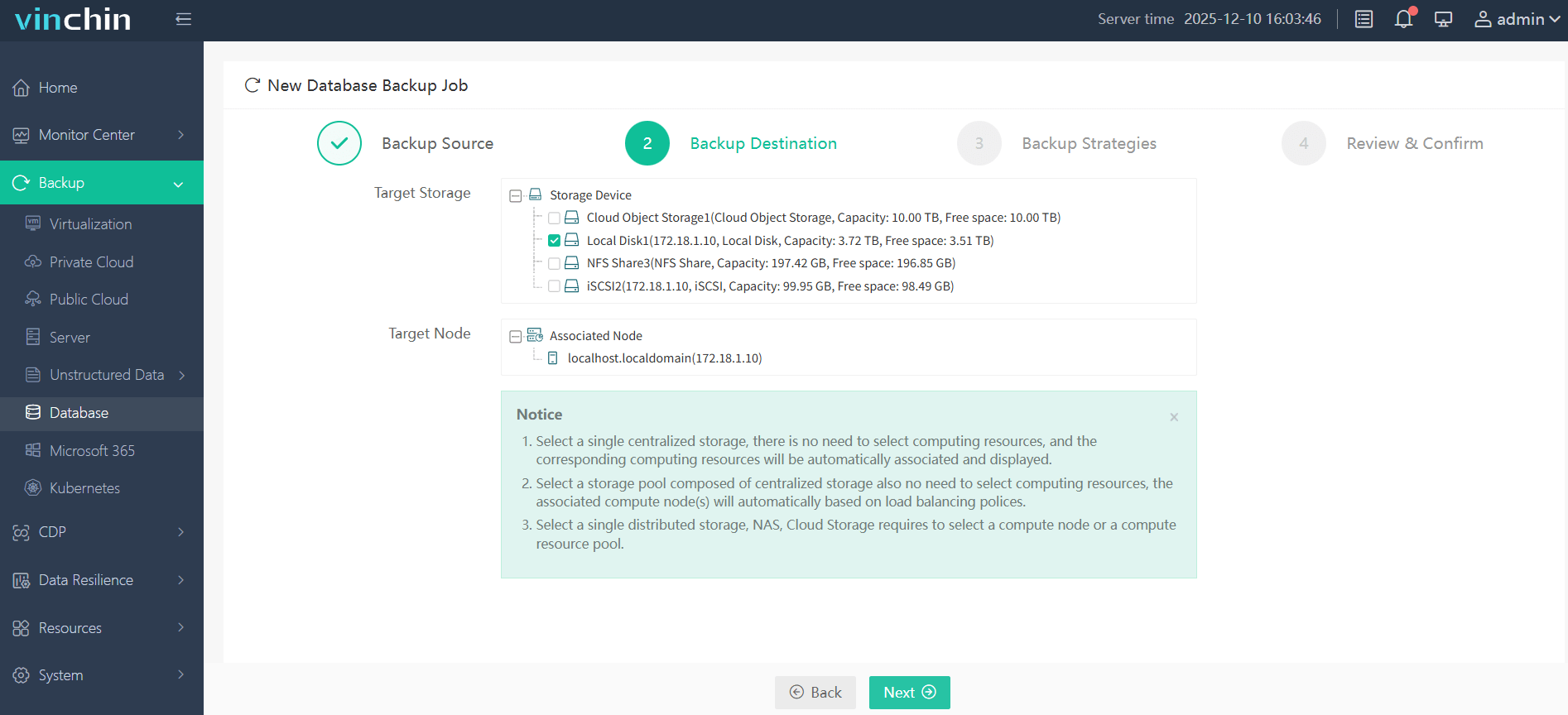
Step 2. Choose the desired storage destination;
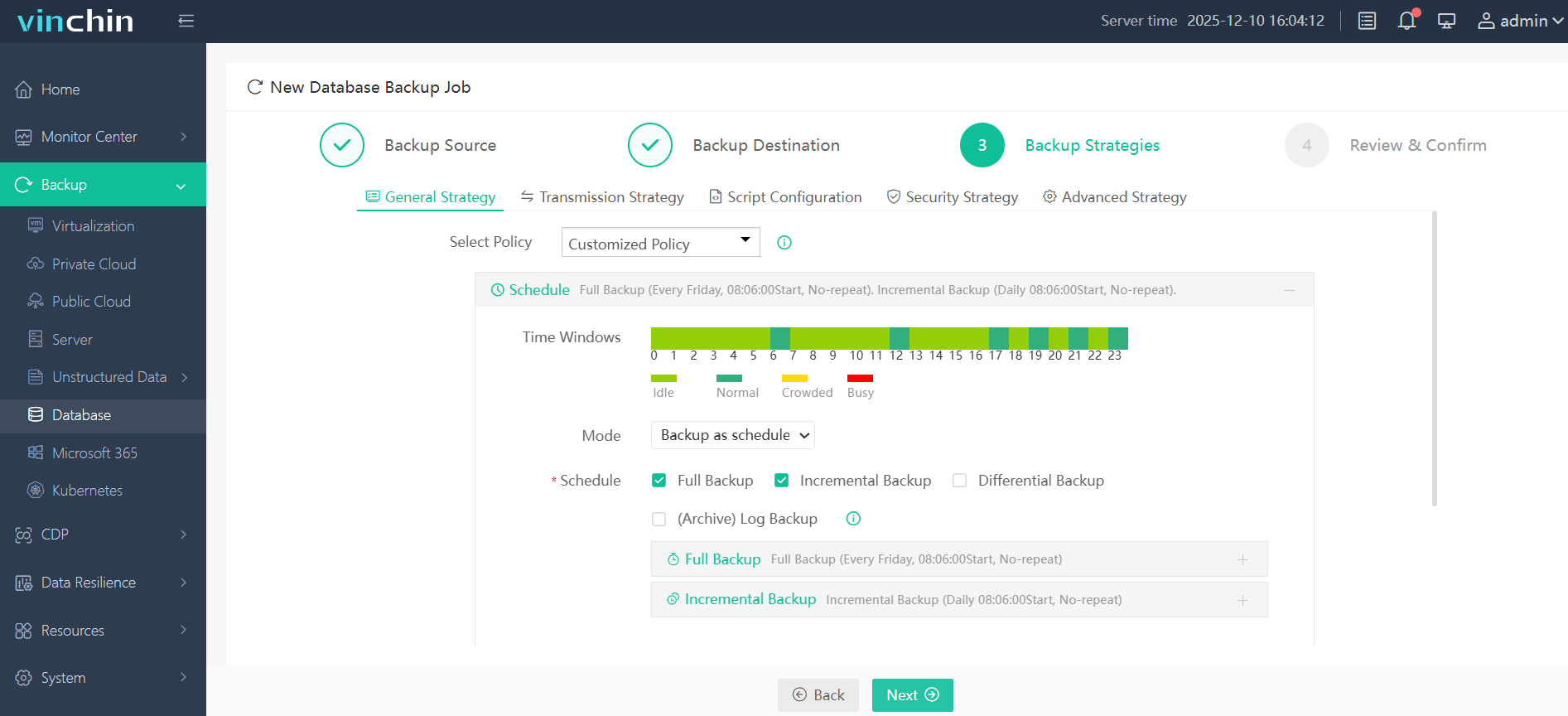
Step 3. Define your preferred backup strategy including scheduling and retention rules;
Step 4. Submit the job—no steep learning curve required.
Trusted globally by enterprises large and small—with top industry ratings—Vinchin Backup & Recovery offers a fully featured free trial lasting sixty days so you can experience its power firsthand before committing further.
Oracle RMAN Backup Database FAQs
Q1: Can I schedule automatic nightly incremental backups using native tools?
A1: Yes—use OS-level schedulers like cron combined with saved shell scripts calling desired rman commands at set times.
Q2: What should I do if my Fast Recovery Area fills up?
A2: Use DELETE OBSOLETE within RMAN prompt regularly—or increase FRA size via ALTER SYSTEM.
Q3: What’s an efficient strategy for large databases needing quick restores?
A3: Take weekly Level 0 incrementals plus daily Level 1 differentials including archived logs then validate frequently.
Conclusion
Backing up your Oracle database with RMAN protects against disasters big or small—from accidental drops through hardware failures alike—with flexible options suitable across beginner through expert roles alike For easier automation security verification consider trying Vinchin’s sixty-day free trial today