Have you ever needed to clone an Oracle database for testing, development, or recovery? Oracle’s Recovery Manager (RMAN) offers a powerful feature called the auxiliary database. This tool is essential for database administrators who want to duplicate, recover, or test Oracle databases without risking the production environment. In this article, we’ll break down what an RMAN auxiliary database is, why you might use it, and how to set it up step by step.
What Is an RMAN Auxiliary Database?
An RMAN auxiliary database is a separate Oracle instance that RMAN uses for special operations. It acts as a temporary or permanent copy of your main (target) database. The rman auxiliary database serves several purposes: duplicating databases for testing or development; performing tablespace point-in-time recovery; validating backup strategies; or creating standby environments. The auxiliary can run on the same server as your target or on a different host entirely. Each instance operates independently but must be configured correctly so that RMAN can manage both during complex operations.
The flexibility of an rman auxiliary database makes it invaluable when you need to experiment with data changes or simulate disaster recovery scenarios without touching live production systems. Whether you’re working in a lab environment or preparing for real-world incidents, understanding how this feature works gives you more control over your Oracle infrastructure.
Why Use an RMAN Auxiliary Database?
The rman auxiliary database provides a safe playground for critical operations that would otherwise put your main system at risk. By using this approach:
You can clone your production environment quickly—ideal if developers need fresh data sets without impacting business continuity. For example, teams often request full copies of production databases to test new features before deployment.
It enables point-in-time recovery of specific tablespaces or objects without rolling back the entire system. This targeted approach saves time when only part of your data needs restoration due to accidental deletion or corruption.
Testing backup and restore strategies becomes much safer since failures won’t affect users relying on live data. You can validate scripts and procedures in isolation before applying them in production.
Creating standby databases becomes straightforward with an rman auxiliary database acting as the foundation for disaster recovery plans.
By leveraging these capabilities, DBAs gain flexibility in maintenance tasks while reducing operational risks—a win-win scenario when uptime matters most.
How to Create an RMAN Auxiliary Database?
Setting up an rman auxiliary database involves several steps designed to ensure reliability throughout duplication or recovery processes. Let’s walk through each phase so you understand not just what to do but why each action matters.
First comes preparation: create a password file unique to the auxiliary instance using orapwd—the SYS password here must match exactly with your target’s SYS password if both reside on different hosts; alternatively, copy the existing password file from target if allowed by policy. This alignment ensures authentication succeeds during cross-instance communication required by RMAN jobs.
Next is network connectivity setup via Oracle Net Services. Confirm that both source (target) and destination (auxiliary) instances are reachable using SQL*Plus connections—test TNS entries thoroughly because even minor typos can halt automation later on.
Now prepare an initialization parameter file (PFILE) tailored for your rman auxiliary database instance. Set DB_NAME carefully: if duplicating onto another host with identical directory structures—and planning to use NOFILENAMECHECK—matching names is fine; otherwise choose something distinct to prevent confusion between environments sharing storage arrays. Don’t forget other essentials like CONTROL_FILES, DB_BLOCK_SIZE, COMPATIBLE, memory allocations (SGA_TARGET, MEMORY_TARGET) based on workload expectations during duplication.
With configuration ready, start up your rman auxiliary database in NOMOUNT mode using SQL*Plus:
SQL> STARTUP NOMOUNT PFILE='/path/to/initaux.ora';
This state allows control files creation but prevents accidental access until structure copying begins.
Meanwhile ensure your target (source) Oracle instance remains mounted—or open—for duration of duplication process so backups remain accessible throughout operation windows.
Before launching any commands verify all necessary backups plus archived redo logs exist where they’re needed: either locally if running everything on one machine; remotely via NFS mounts; or shared storage visible from both hosts depending on architecture choices made earlier in planning stages.
Connect everything together inside RMAN itself:
rman TARGET SYS/oracle@trgt AUXILIARY SYS/aux@auxdb CATALOG rman/cat@catdb
This triple connection model lets you orchestrate actions across source/clone/catalog seamlessly within one session window—a big timesaver compared with manual scripting outside RMAN’s native interface!
If automatic channels aren’t pre-configured globally then allocate them explicitly within scripts—number of channels directly affects parallelism/speed:
RUN {
  ALLOCATE AUXILIARY CHANNEL aux1 DEVICE TYPE DISK;
  ALLOCATE AUXILIARY CHANNEL aux2 DEVICE TYPE DISK;
  DUPLICATE TARGET DATABASE TO dupdb;
}
For large environments consider adding more channels (ALLOCATE AUXILIARY CHANNEL auxN) based on available CPU/storage/network resources—but always monitor load closely during initial runs!
Finally execute the DUPLICATE command itself specifying options like NOFILENAMECHECK when directory layouts match across hosts—or leverage DB_FILE_NAME_CONVERT/LOG_FILE_NAME_CONVERT parameters whenever paths differ between source/clone locations:
DUPLICATE TARGET DATABASE TO dupdb NOFILENAMECHECK;
-- Or
DUPLICATE TARGET DATABASE TO dupdb
  DB_FILE_NAME_CONVERT=('/u01/oradata/prod','/u02/oradata/test')
  LOG_FILE_NAME_CONVERT=('/u01/oradata/prod','/u02/oradata/test');
Once launched successfully sit back while RMAN restores files from backup pieces/applies logs/rebuilds dictionary structures—and finally opens up your shiny new clone ready for further customization!
How to Use an RMAN Auxiliary Database for Recovery?
The power of an rman auxiliary database extends beyond simple cloning—it shines brightest during advanced recovery scenarios such as tablespace point-in-time recovery (TSPITR). Here’s how experienced DBAs harness its strengths:
Begin by preparing another dedicated instance following earlier steps: build out password file matching SYS credentials; configure network access ensuring seamless connectivity between all involved nodes; assemble custom PFILE reflecting correct settings including memory/file path adjustments suited specifically for temporary workloads expected during TSPITR jobs—not forgetting disk space requirements which may spike briefly under heavy redo application phases!
Start this new instance again in NOMOUNT mode:
SQL> STARTUP NOMOUNT PFILE='/path/to/initaux_tspitr.ora';
Connect through RMAN just like before—ensuring catalog/database links resolve cleanly every time:
rman TARGET SYS/oracle@trgt AUXILIARY SYS/aux@auxdb CATALOG rman/cat@catdb
To launch TSPITR specify exact objects/tablespaces needing rollback alongside precise timestamps representing desired restore points:
RECOVER TABLESPACE users UNTIL TIME '2024-06-01:12:00:00' AUXILIARY DESTINATION '/u01/auxiliary';
RMAN now leverages its internal intelligence—restoring relevant datafiles into isolated workspace managed by your rman auxiliary database before replaying archived logs only up until requested moment-in-history…then automatically migrates recovered content safely back into primary environment leaving rest untouched! This surgical precision means minimal downtime/disruption even amid complex multi-user workloads common across enterprise deployments today.
After successful completion cleanup routines kick in automatically if job was fully scripted—but manual intervention may still be required sometimes especially after ad-hoc experiments where persistent clones linger longer than planned! Always double-check resource utilization post-recovery ensuring no orphaned instances consume valuable compute/storage unnecessarily going forward…
Using this method keeps core business systems insulated from risky trial-and-error exercises while empowering IT teams with granular restoration tools previously reserved only for full-system rollbacks—a major leap forward in operational agility!
Enterprise-Level Backup Solution: Vinchin Backup & Recovery
For organizations seeking streamlined protection beyond native tools like RMAN, Vinchin Backup & Recovery delivers comprehensive enterprise-level backup support across mainstream databases—including Oracle first and foremost—as well as MySQL, SQL Server, MariaDB, PostgreSQL, PostgresPro, and TiDB environments. With features such as batch backup management, incremental backup capabilities tailored specifically for Oracle workloads, robust integrity checks through automated verification routines via SQL scripts, secure storage protection against ransomware threats including WORM safeguards, and flexible cloud/tape archiving options built-in by default—you gain reliable automation combined with strong security controls that simplify ongoing administration while maximizing recoverability across diverse infrastructures.
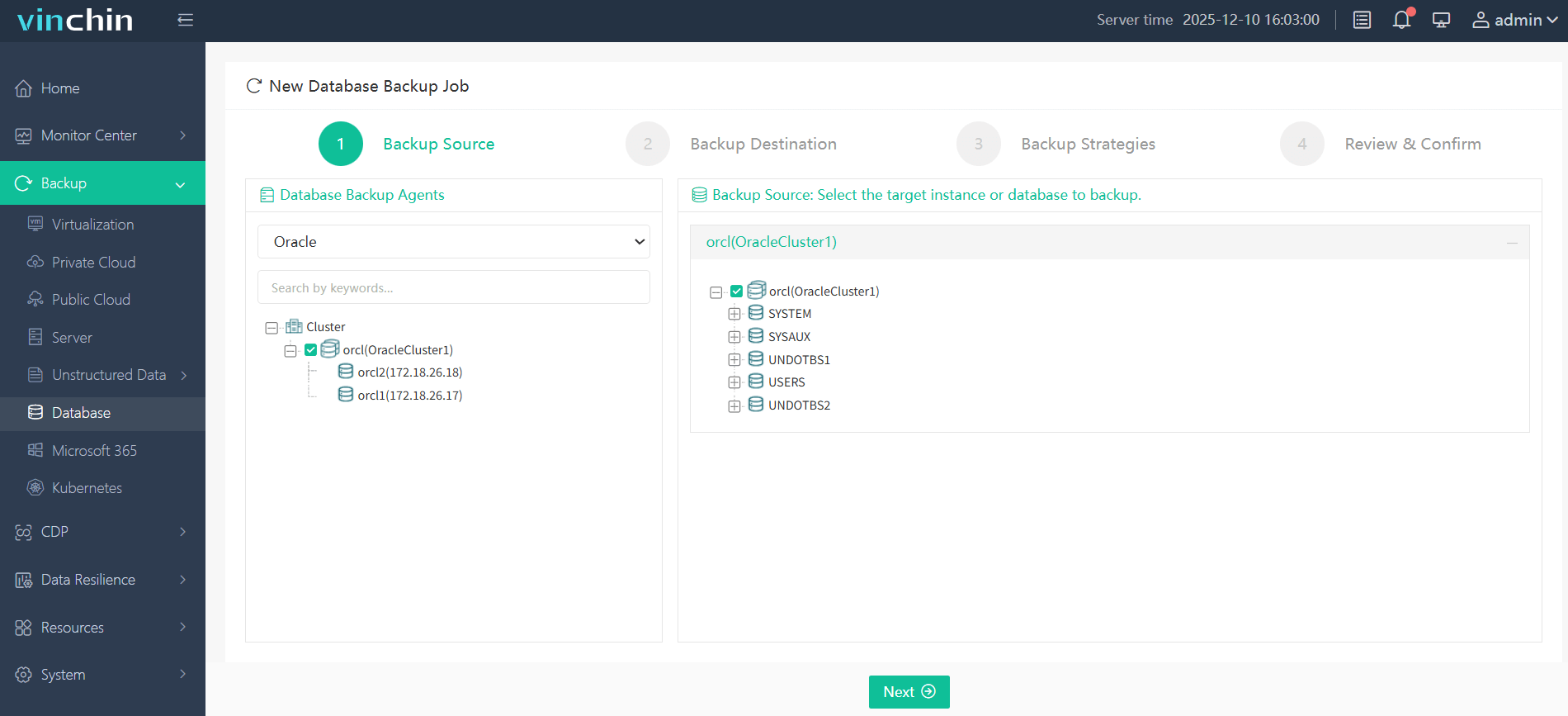
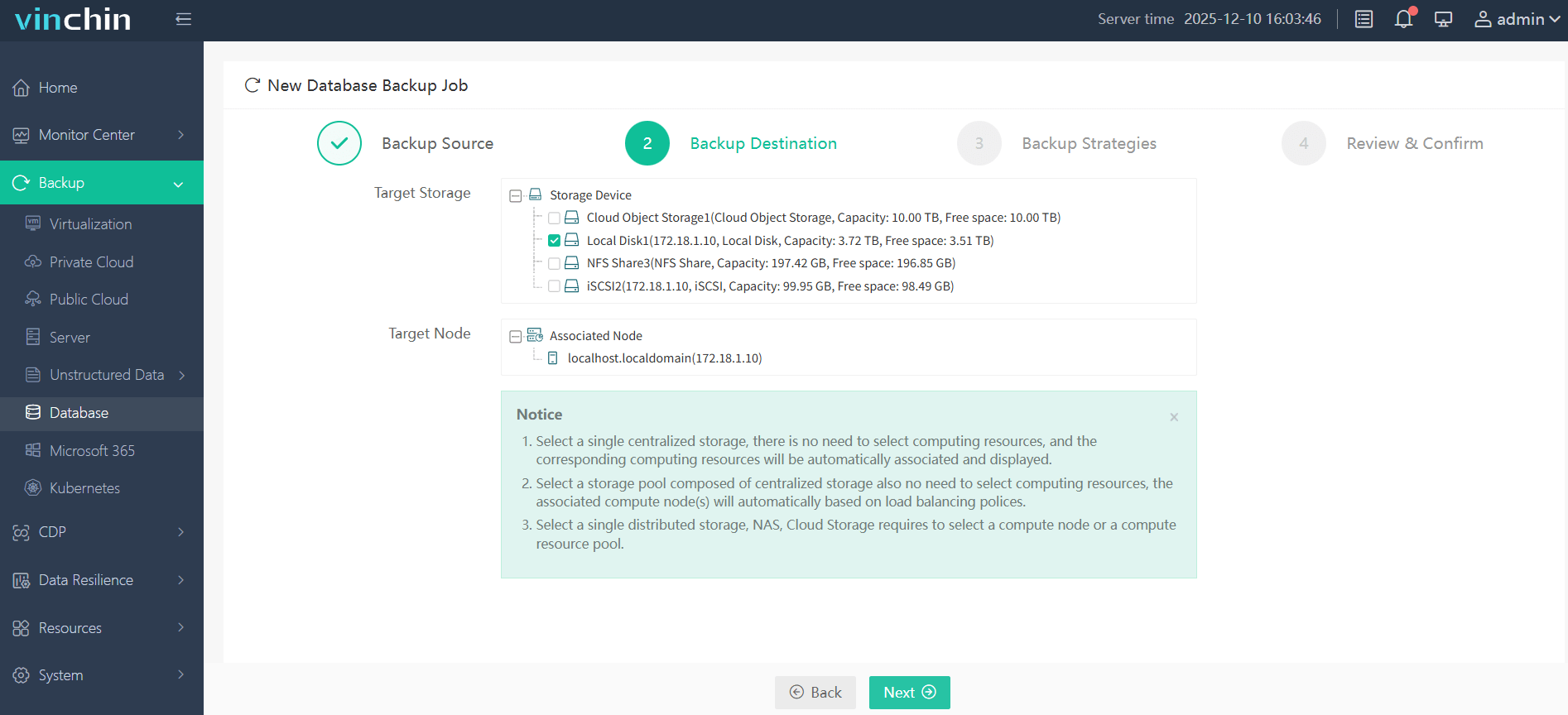
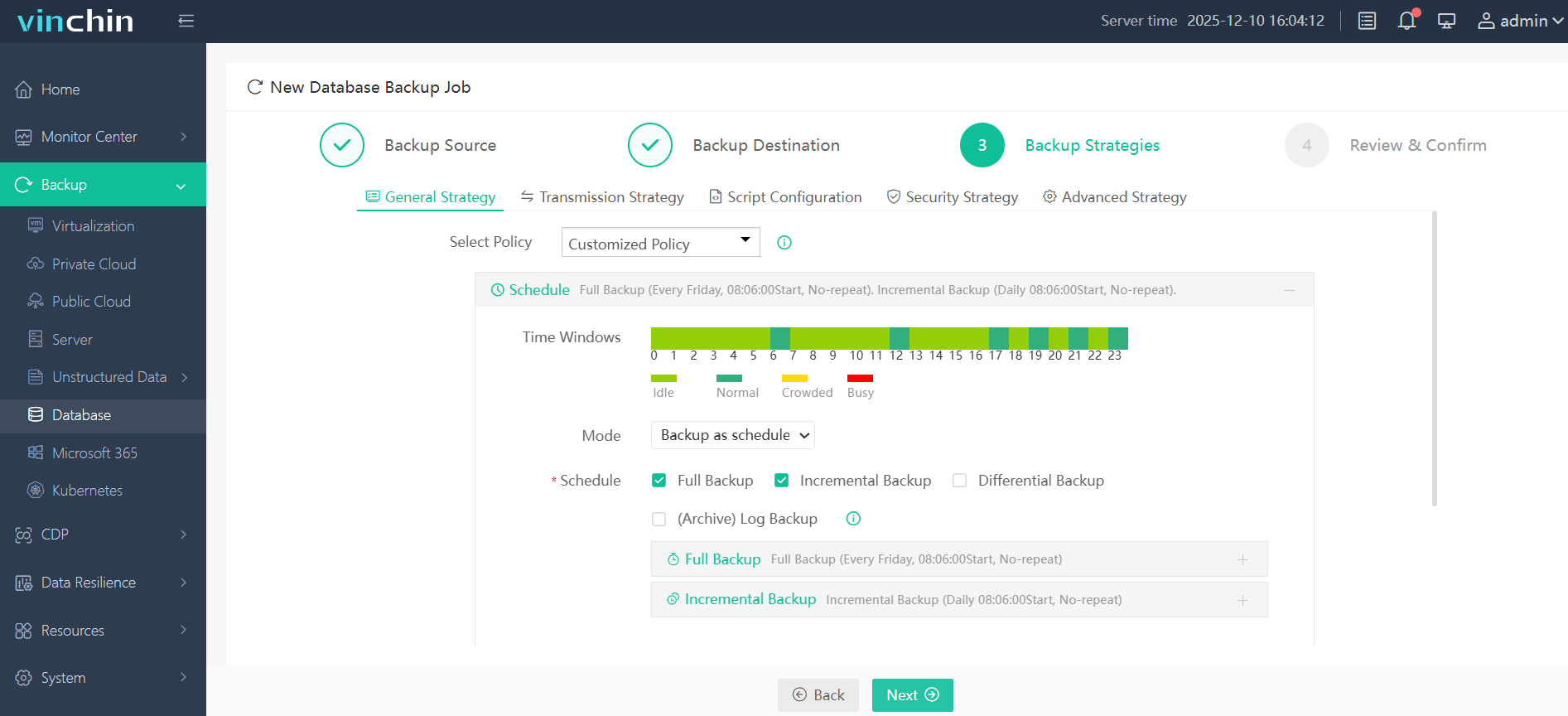
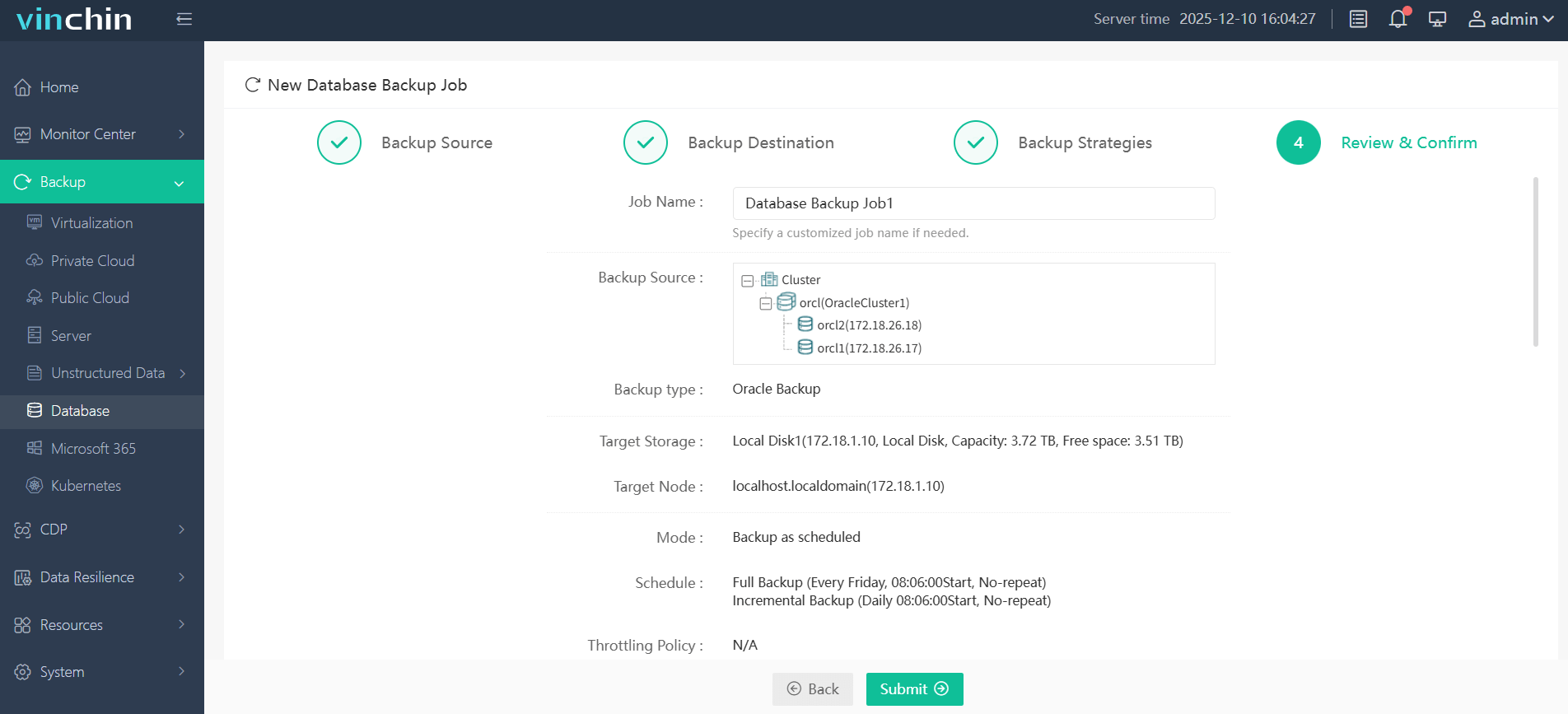
Vinchin Backup & Recovery stands out thanks to its intuitive web console interface designed around four clear steps:
Step 1. Select the Oracle database to back up
Step 2. Choose the backup storage
Step 3. Define the backup strategy
Step 4. Submit the job
Recognized worldwide by thousands of enterprises—with top industry ratings—Vinchin Backup & Recovery offers a fully featured free trial valid for 60 days so you can experience leading-edge data protection firsthand; click below to get started today.
RMAN Auxiliary Database FAQs
Q1: Can I use an RMAN auxiliary database on a different server than the target?
A1: Yes—you can create it remotely provided network connectivity exists between servers and paths are mapped correctly.
Q2: What happens if my duplicate uses same filenames as original?
A2: Specify NOFILENAMECHECK within DUPLICATE command when directories match across hosts so conflicts don’t occur during creation process.
Q3: How do I speed up large-scale duplications?
A3: Allocate multiple AUXILIARY CHANNELS in script use fast storage schedule jobs off-hours optimize network throughput where possible.
Conclusion
The RMAN auxiliary database is a flexible tool for cloning testing disaster recovery scenarios within modern Oracle environments—with careful setup anyone can duplicate/recover safely anytime needed! Vinchin makes protecting those assets even easier thanks robust automation intuitive controls try free trial today see difference firsthand!