When you use Oracle RMAN (Recovery Manager) to back up your database, knowing exactly where your backups are stored is critical. The backup location affects your recovery speed, storage planning, and even your compliance with company policies. Ever needed to perform a critical recovery only to find your RMAN backups are on a disk that's out of space or no longer mounted? Have you ever wondered where RMAN puts your backups by default or how you can change that location to fit your needs? This article will walk you through the details step by step.
What is Oracle RMAN Backup Location?
The Oracle RMAN backup location is the directory or storage device where RMAN writes backup files such as backup sets, image copies, and archived redo logs. By default, RMAN uses either a managed area called Fast Recovery Area (FRA) if configured or expects you to specify a path; otherwise it may fail with an error if neither is set up properly. You can configure it to use different directories on disk or integrate with tape or cloud storage for long-term retention. The backup location is essential for both backup and restore operations because RMAN tracks every file's exact path in its repository.
Default Locations for RMAN Backups
If you do not specify a backup location in your command or configuration settings, RMAN relies on defaults set in your environment. On most systems without FRA configured or explicit FORMAT clauses provided during backup commands, RMAN may attempt to write files into system-specific directories like $ORACLE_HOME/dbs (on Unix/Linux) or similar paths under the Oracle installation directory on Windows—but this is not always reliable for operational use.
More commonly in modern environments, administrators configure a Fast Recovery Area (FRA). If FRA is enabled by setting both DB_RECOVERY_FILE_DEST (the destination path) and DB_RECOVERY_FILE_DEST_SIZE (the maximum size), then all disk-based backups—including archived logs—are written there automatically unless overridden by specific commands.
You can check what locations are currently configured by running SHOW ALL at the RMAN prompt. To see actual file paths of existing backups, use LIST BACKUP.
If neither FRA nor explicit paths are set up correctly when performing backups, you may encounter errors indicating that no suitable destination exists for writing files.
Method 1: Setting Disk-Based Backup Location
Disk-based backups remain popular due to their speed and simplicity compared to other media types. You have several ways to control exactly where these files go—either temporarily for one job or permanently for all future jobs.
To set a disk-based oracle rman backup location just for one operation, include the FORMAT clause in your command like this:
BACKUP DATABASE FORMAT '/u01/backups/%U';
This tells RMAN to write output files into /u01/backups, using unique filenames generated by %U.
For ongoing changes affecting all future disk-based jobs unless specifically overridden later on that session or job:
CONFIGURE CHANNEL DEVICE TYPE DISK FORMAT '/u01/backups/%U';
After running this at the RMAN prompt once per database instance (or per channel), every subsequent disk-based backup will target /u01/backups.
If you're working with multiple disks—for example /disk1/rman and /disk2/rman—to improve performance through parallelism while reducing risk from single-disk failure:
CONFIGURE DEVICE TYPE DISK PARALLELISM 2;
CONFIGURE CHANNEL 1 DEVICE TYPE DISK FORMAT '/disk1/rman/%U';
CONFIGURE CHANNEL 2 DEVICE TYPE DISK FORMAT '/disk2/rman/%U';
With this setup active during jobs using parallelism of two channels or more (set via PARALLELISM n), each channel writes independently into its assigned directory.
Important: Before configuring any custom oracle rman backup location on disk—whether temporary via FORMAT clause or permanent via CONFIGURE CHANNEL—the target OS directory must already exist and be writable by the Oracle software owner account (oracle). Failing this results in permission errors during execution.
Verifying and Managing the Fast Recovery Area (FRA)
Fast Recovery Area offers centralized management of all recovery-related files including datafile copies, archived logs, flashback logs—and most importantly—all automatic oracle rman backup locations if enabled.
To verify whether FRA is active:
  SHOW PARAMETER DB_RECOVERY_FILE_DEST
  SHOW PARAMETER DB_RECOVERY_FILE_DEST_SIZE
If these values are non-null/greater than zero respectively then FRA is operational; otherwise it's not being used yet.
Be aware: When FRA fills up near its defined size limit (DB_RECOVERY_FILE_DEST_SIZE), new backups may fail until space becomes available again! Use these commands regularly:
  SELECT SPACE_USED/1024/1024 AS MB_USED,
         SPACE_LIMIT/1024/1024 AS MB_LIMIT
    FROM V$RECOVERY_FILE_DEST;
Within RMAN:
Run REPORT OBSOLETE followed by DELETE OBSOLETE
This identifies old/unneeded files eligible for deletion based on current retention policy settings.
CONFIGURE RETENTION POLICY TO REDUNDANCY n;
Or
CONFIGURE RETENTION POLICY TO RECOVERY WINDOW OF n DAYS;
Managing space proactively ensures smooth ongoing operations without unexpected failures due to full storage areas—a common challenge in busy production environments!
Method 2: Configuring Tape or Cloud Backup Location
For long-term retention requirements—or offsite disaster protection—you might want oracle rman backup locations outside local disks such as tape libraries or cloud object stores.
Backing up directly onto tape requires integration with supported media management software installed on your server(s). After installing/integrating according to vendor documentation:
   CONFIGURE CHANNEL DEVICE TYPE SBT PARMS 'SBT_LIBRARY=/path/to/media/manager/library';
   CONFIGURE DEFAULT DEVICE TYPE TO SBT;
Optionally define naming convention:
CONFIGURE CHANNEL DEVICE TYPE SBT FORMAT 'bk_%U';
Cloud integration works similarly but uses vendor-provided modules loaded into Oracle Database; after installation/configuration follow their guidance regarding credentials/bucket names/etc., then configure channels accordingly using cloud-specific parameters alongside standard syntax above.
Practical Note: After configuring any new tape/cloud integration always run test jobs—a simple BACKUP DATABASE followed immediately by RESTORE VALIDATE—to confirm end-to-end connectivity before relying upon it for real-world recoveries!
Remember: Each media manager/cloud module has unique requirements; consult official documentation closely when setting up integrations beyond basic disk usage.
Why Choosing the Right Backup Location Matters?
Selecting an appropriate oracle rman backup location impacts much more than just convenience—it shapes performance outcomes during both routine operations and emergencies! Disk-based destinations offer fast access times ideal for frequent restores but may lack durability against site-wide disasters unless mirrored elsewhere offsite via replication/tape/cloud archiving strategies instead.
Tape solutions provide cost-effective long-term archival but introduce latency delays during restores; cloud options combine flexibility/scalability but depend heavily upon network bandwidth/reliability factors outside DBA control sometimes too!
Backup locations also dictate how easily you manage available storage capacity over time plus influence regulatory compliance posture depending upon industry standards requiring encrypted/offsite copies etc.—choose wisely based upon business priorities rather than technical defaults alone!
How to Back Up Oracle Workloads Using Vinchin Backup & Recovery?
For organizations seeking streamlined enterprise-level protection of their Oracle databases—including precise control over oracle rman backup locations—a robust solution exists. Vinchin Backup & Recovery delivers comprehensive support not only for Oracle but also MySQL, SQL Server, MariaDB, PostgreSQL, PostgresPro, and TiDB environments. With features such as batch database backup management, flexible data retention policies including GFS options, scheduled cloud/tape archiving capabilities, integrity checks ensuring recoverability verification via SQL scripts, and secure restore-to-new-server workflows—all designed around automation and reliability—Vinchin Backup & Recovery helps enterprises safeguard mission-critical workloads efficiently while meeting compliance demands.
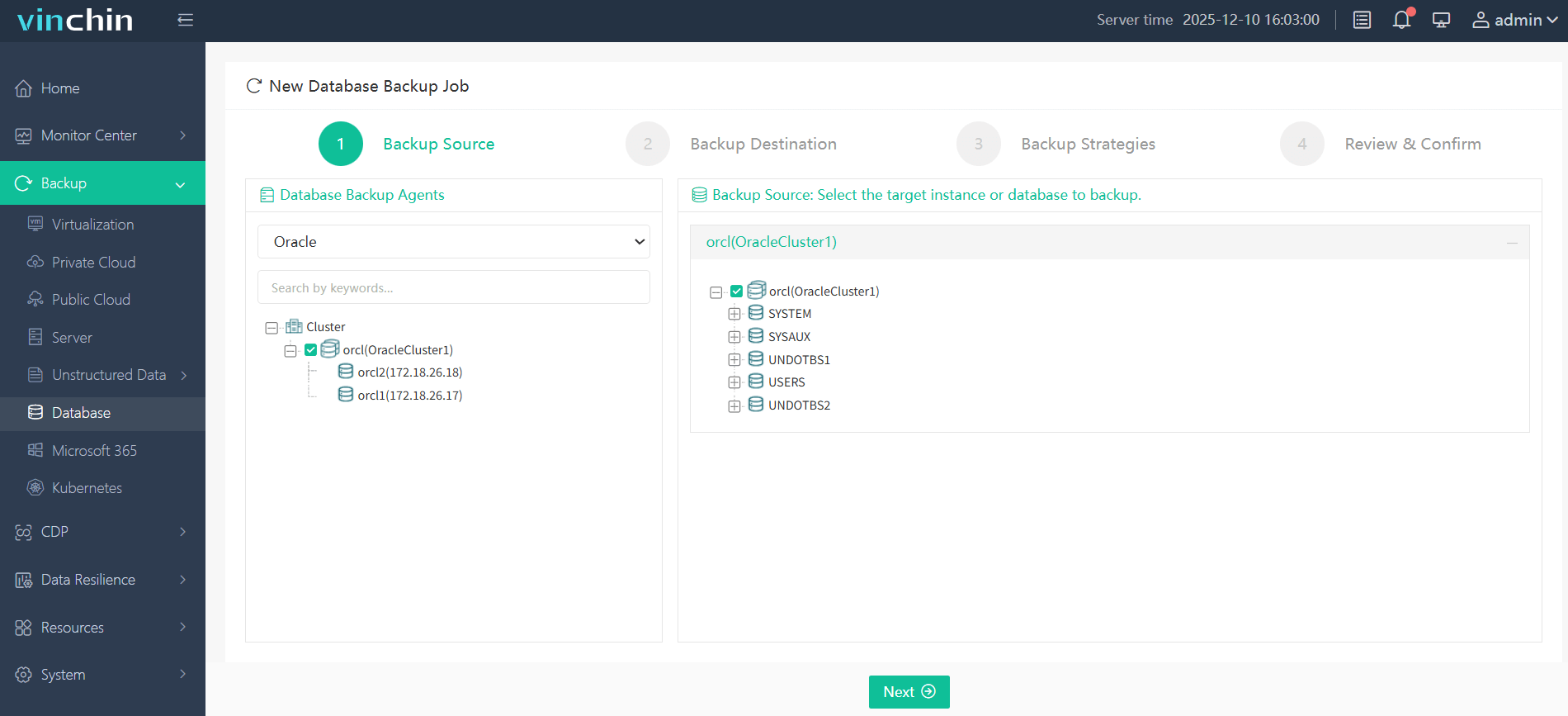
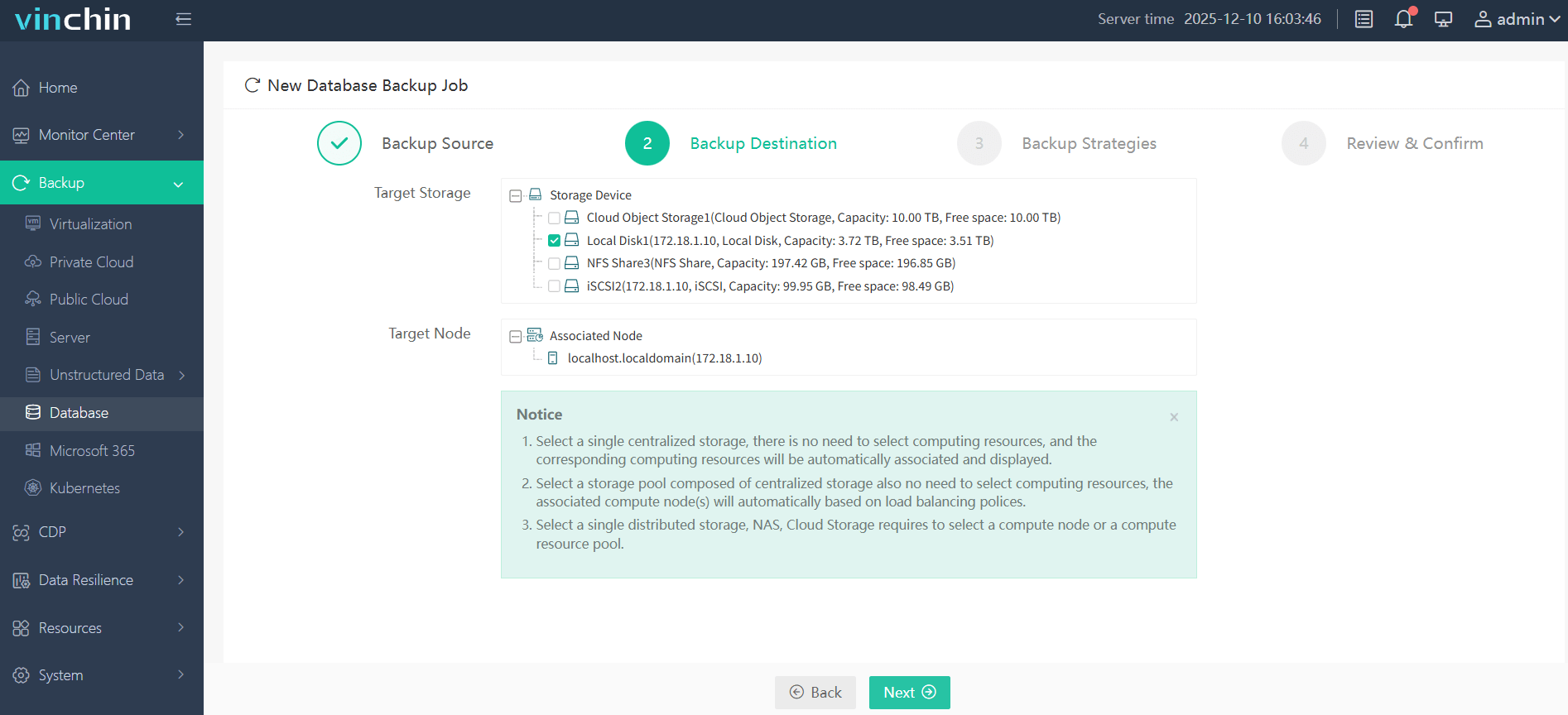
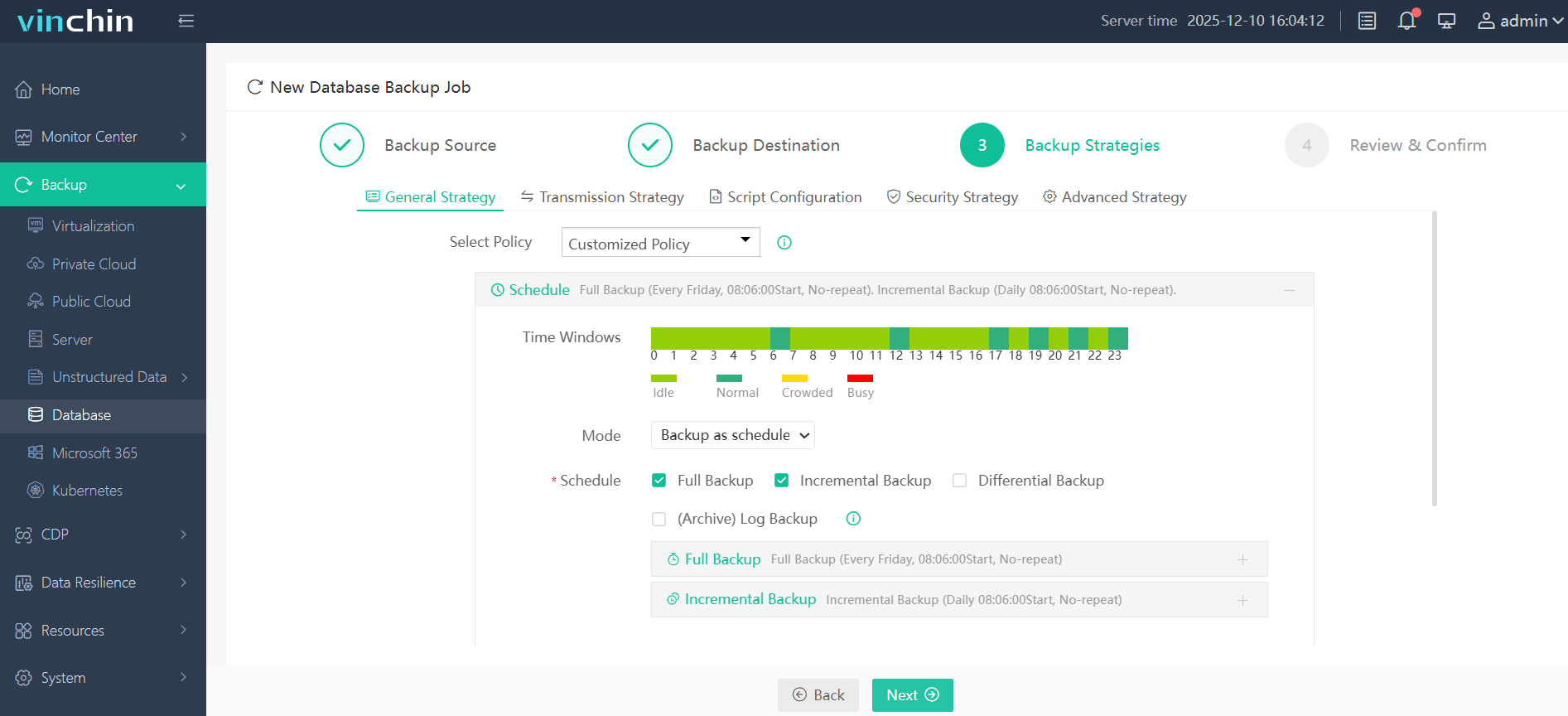
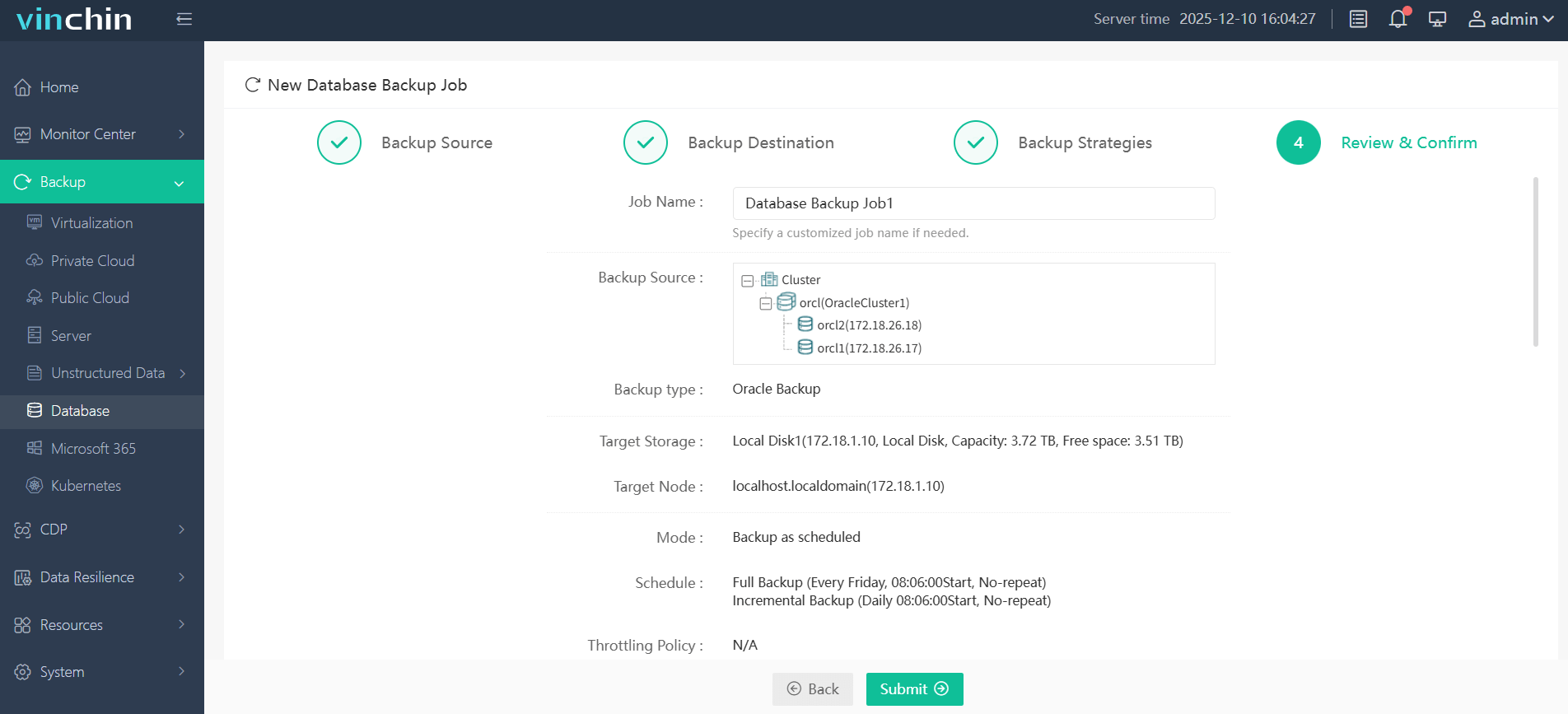
The web console offered by Vinchin Backup & Recovery makes managing complex tasks intuitive—even at scale. To back up an Oracle database workload typically involves four straightforward steps:
Step 1. Select the Oracle database to back up
Step 2. Choose the desired backup storage
Step 3. Define a tailored backup strategy
Step 4. Submit the job
Recognized worldwide as trusted enterprise data-protection software—with top customer ratings—Vinchin Backup & Recovery offers a fully featured free trial valid for 60 days so you can experience its benefits firsthand; click below to get started today!
Oracle RMAN Backup Location FAQs
Q1: How do I verify my current oracle rman backup location?
A1: Run SHOW ALL at the RMAN prompt; use LIST BACKUP for detailed file paths.
Q2: Can I move existing backups between disks safely?
A2: Use BACKUP BACKUPSET within RMAN to copy sets officially; avoid manual moves which break catalog tracking.
Q3: What should I do if my FRA runs out of space?
A3: Run REPORT OBSOLETE, then DELETE OBSOLETE, increase DB_RECOVERY_FILE_DEST_SIZE, or move older files offsite as needed.
Conclusion
Understanding where your oracle rman backup location resides—and controlling it—is vital for reliable protection and fast recovery times across any environment. Disk, tape, and cloud each offer unique strengths. Vinchin makes managing enterprise-grade Oracle database protection easier than ever. Try it free today!