Introduction
OpenStack powers many enterprise IT environments today. It delivers flexibility, scalability, and cost savings for critical workloads, databases, customer-facing apps, analytics engines, and more. But this power comes with risk: data loss or downtime can cripple operations in minutes. Even brief outages may disrupt supply chains or customer transactions.
Industry standards such as ISO/IEC 27001 stress the need for resilient information security management systems (ISMS), which include strong data protection measures like backup and recovery planning. NIST SP 800-209 further outlines best practices for cloud backup strategies. These frameworks highlight that robust backup is not just a technical choice, it's essential for compliance, reputation management, and operational stability.
The Importance of Enterprise Business Continuity
Business continuity means your organization keeps running through any disruption, planned or unplanned. This includes cyberattacks, hardware failures, software bugs, natural disasters, or human mistakes.
● Uninterrupted access to applications and data is crucial because customers expect services to be available at all times. If your CRM or billing system goes down due to an OpenStack failure, you risk losing sales opportunities or damaging client trust.
● Regulatory compliance requires organizations to maintain reliable access to records and sensitive information even during incidents. Laws like GDPR or HIPAA mandate strict controls over data availability and integrity, non-compliance can result in heavy fines.
● Downtime costs escalate quickly, both financially and reputationally. According to Gartner research, average downtime costs exceed $5,600 per minute for large enterprises, a figure that multiplies if backups are missing or incomplete.
● Disruptions can cause contractual penalties if service-level agreements (SLAs) are breached due to extended outages or lost data.
A single incident, ransomware attack on a Nova compute node or accidental deletion of a Cinder volume can halt operations across departments until recovery completes.
Why This Matters for Enterprise Operations
OpenStack often serves as the backbone of mission-critical workloads across industries, from healthcare patient portals to financial transaction systems.
● Loss of reliable backups exposes businesses to permanent data loss after events like ransomware attacks or storage corruption. Without recent copies of VMs or volumes stored offsite or in immutable repositories, some data may never return.
● Regulatory violations become likely when organizations cannot produce historical records on demand after an incident, leading auditors to flag gaps in business continuity planning.
● Missed revenue opportunities arise when core services remain offline longer than planned RTOs (Recovery Time Objectives). For example: an e-commerce platform hosted on OpenStack could lose thousands per hour if order processing halts due to failed restores.
● Stakeholder confidence erodes rapidly when partners see repeated disruptions without clear evidence of robust disaster recovery plans in place.
Proactive backup acts as insurance against these risks by ensuring fast restoration from recent points-in-time, even under stress from widespread failures.
What Makes a Good OpenStack Backup Strategy?
A solid OpenStack backup strategy ensures consistent recoverability while supporting growth and compliance needs, even during peak load periods or complex upgrades.
The foundation lies in meeting two key metrics: Recovery Point Objective (RPO), the maximum acceptable amount of lost data measured in time and Recovery Time Objective (RTO), the target duration for restoring service after disruption.
Decision-makers must balance flexibility with governance so teams can adapt infrastructure while still protecting vital assets from emerging threats:
● Alignment with compliance requirements guarantees that backups meet legal mandates around retention periods, encryption standards, audit trails, and geographic storage restrictions set by regulators worldwide.
● Support for scalable growth without sacrificing security allows organizations to expand their OpenStack clusters seamlessly while maintaining centralized control over backup policies, critical when onboarding new projects quickly across multiple regions or clouds.
● Flexibility paired with strong governance controls lets IT teams customize schedules (hourly/daily/monthly), select between full/incremental/differential backups based on workload type (e.g., databases vs static files), yet enforce role-based access controls so only authorized users manage sensitive restore operations.
A good strategy also leverages automation, using policy-driven jobs to reduce manual errors while enabling rapid response during emergencies such as mass VM restores after malware outbreaks.
Vinchin Backup & Recovery: Enterprise-Grade Protection for OpenStack
To address the unique challenges of protecting virtualized environments like OpenStack at scale, Vinchin Backup & Recovery stands out as a professional enterprise-level solution supporting over 15 mainstream virtualization platforms, including comprehensive support for OpenStack itself alongside VMware, Hyper-V, Proxmox VE, oVirt/OLVM/RHV family, XCP-ng/XenServer/ZStack/H3C CAS/UIS/FusionCompute/InCloud Sphere/Sangfor HCI/FusionOne Compute/Arcfra environments. For OpenStack users specifically, Vinchin Backup & Recovery offers agentless full/incremental/differential backups, granular restore, scheduled policy-driven jobs, V2V migration, LAN-free backup, multi-thread transmission, advanced deduplication/compression, GFS retention policy, cloud/tape archive integration, all designed for efficiency and reliability at scale. These features enable rapid recovery from ransomware attacks or accidental deletions while optimizing storage use and minimizing operational overheads.
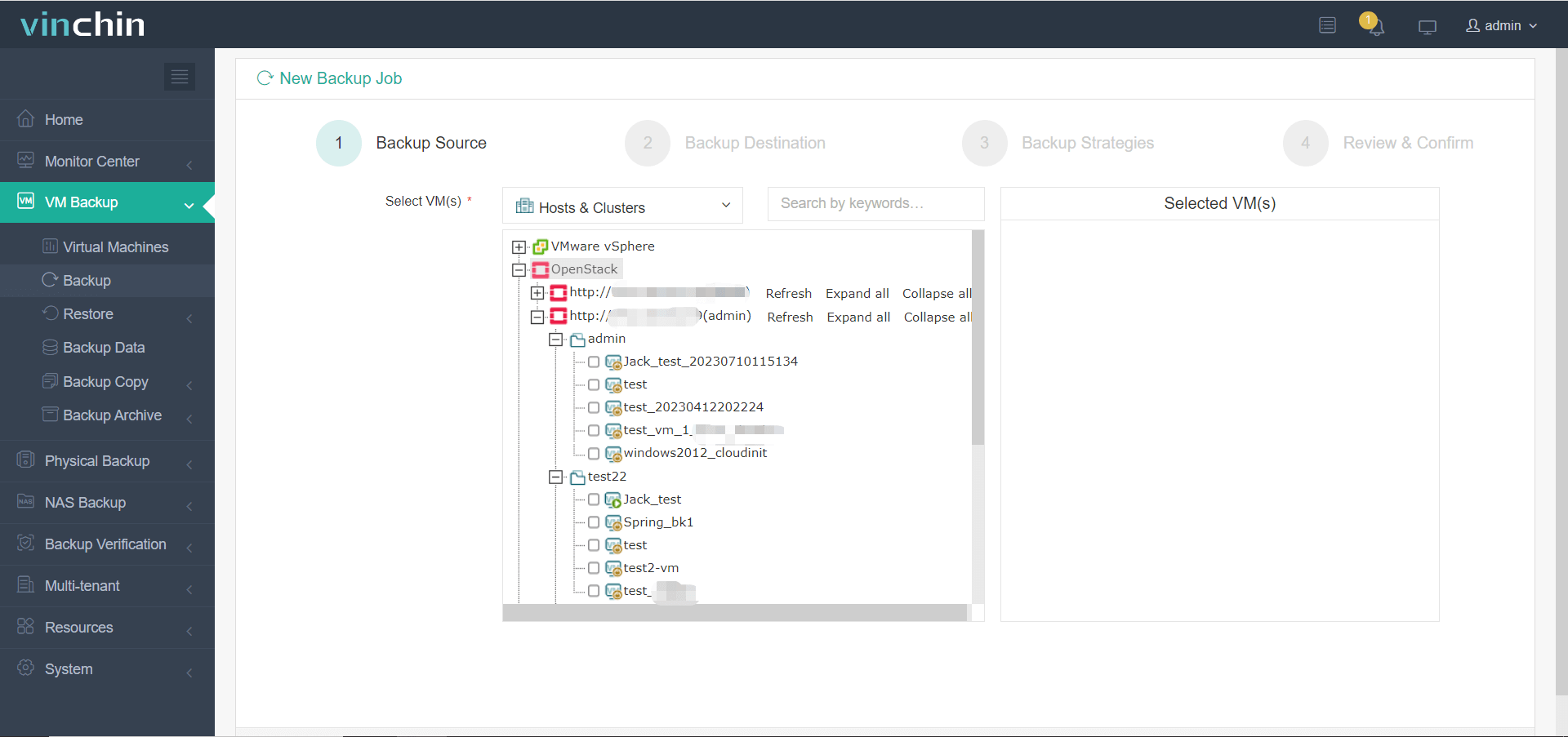
The intuitive web console makes it easy:
Step 1: Select the OpenStack VM to back up
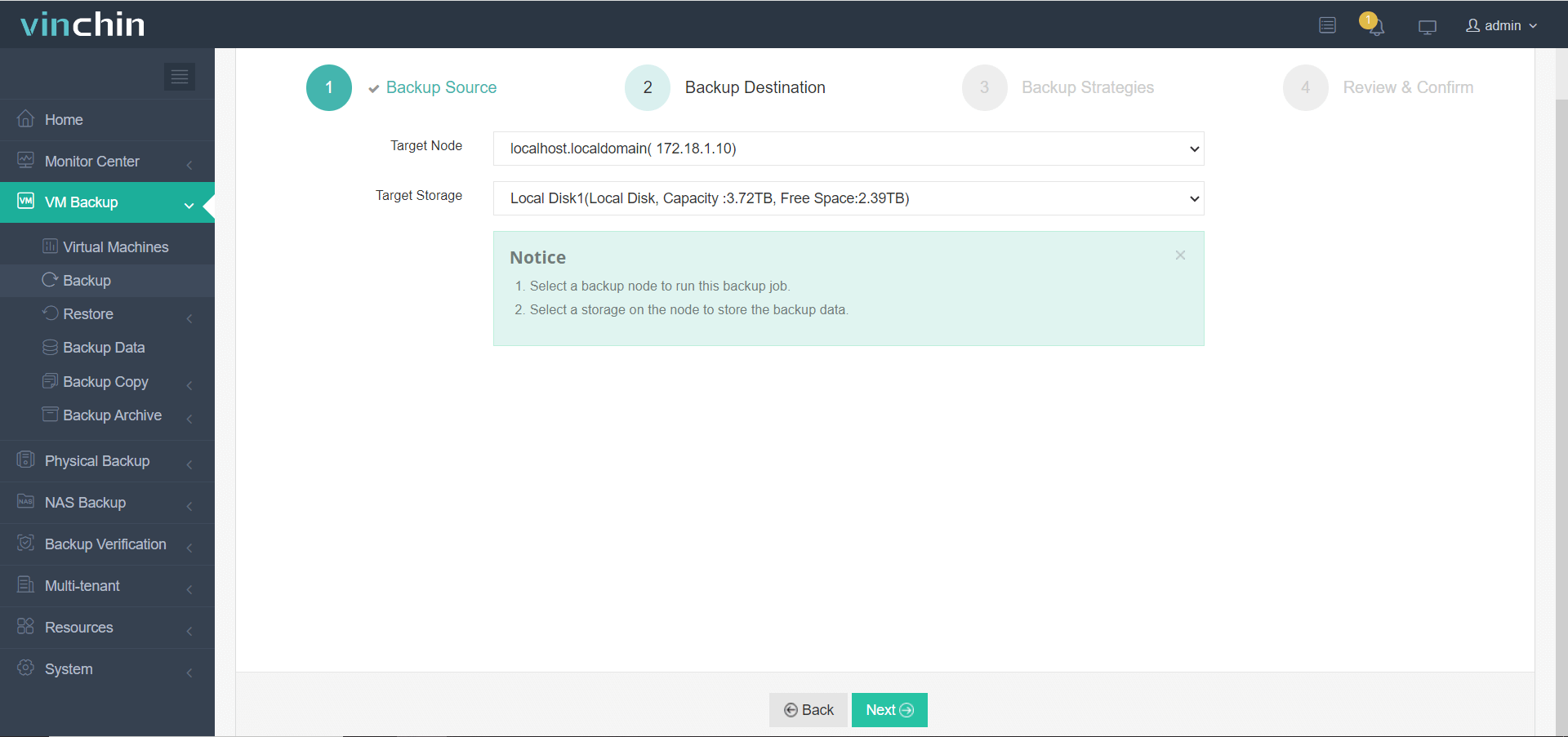
Step 2: Choose the backup storage
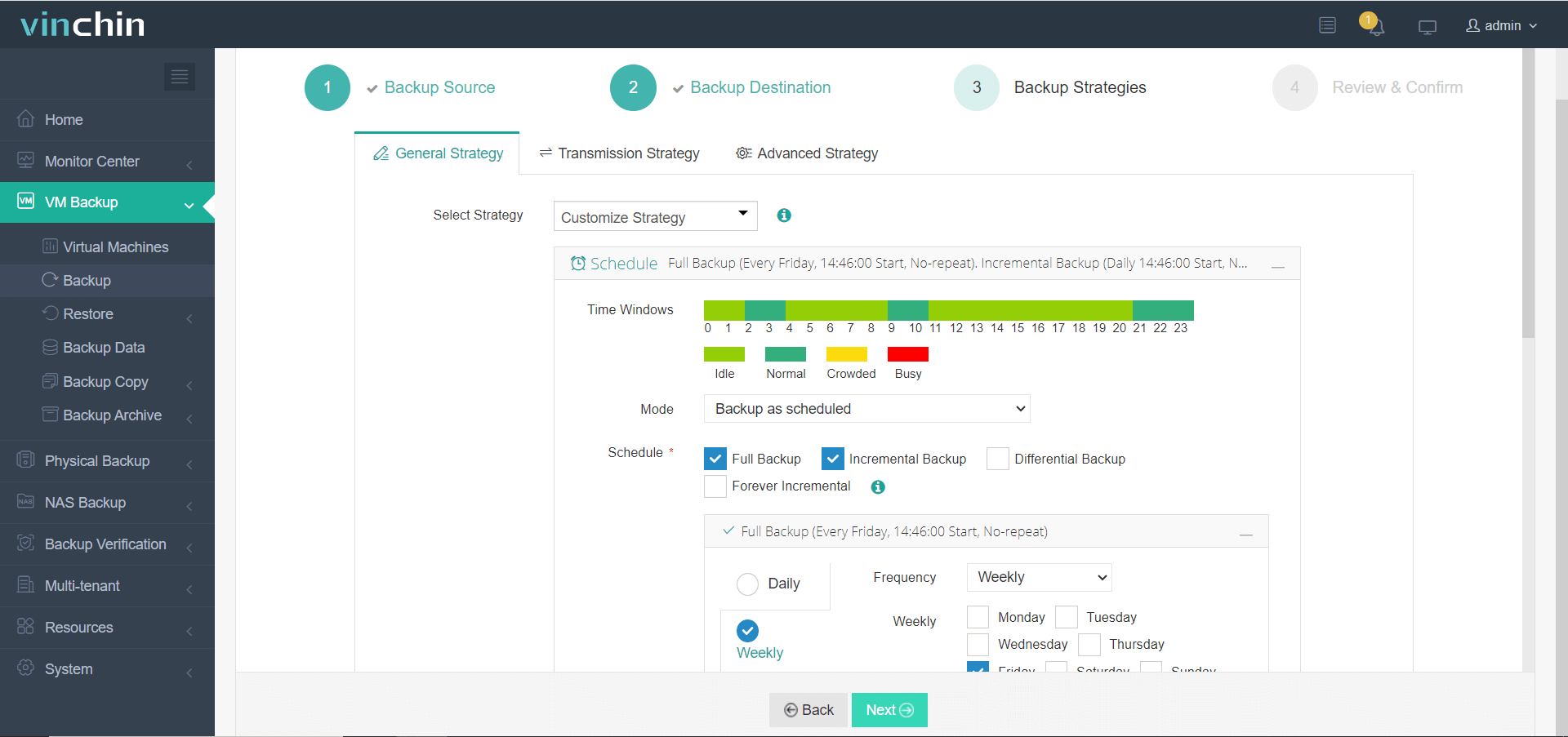
Step 3: Configure the backup strategy
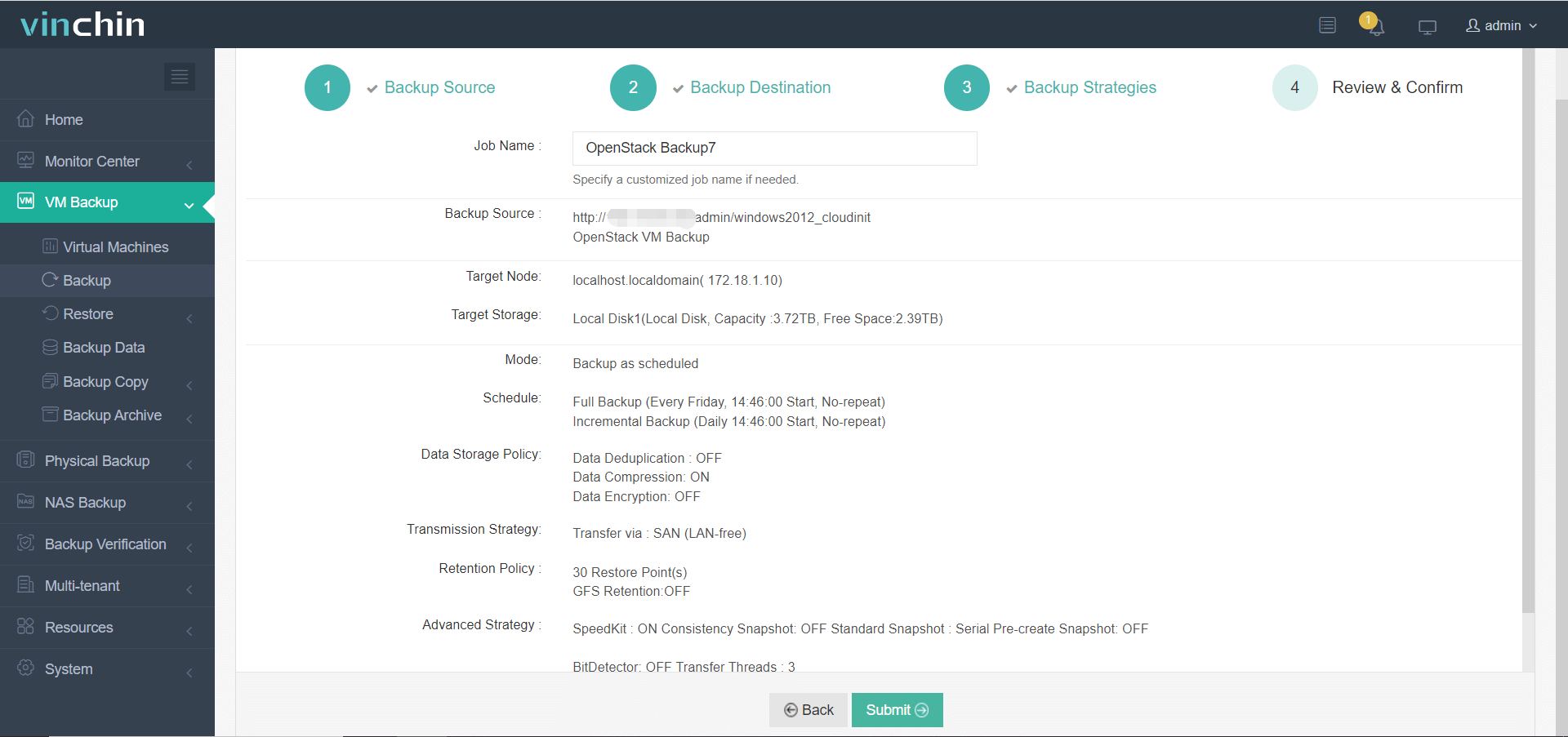
Step 4: Submit the job
With its global reputation among enterprises and top-rated customer satisfaction scores worldwide, Vinchin Backup & Recovery offers a fully functional 60-day free trial, click below to experience industry-leading protection firsthand.
Best OpenStack Backup Software FAQs
Q1: What are key risks if I don't back up my OpenStack environment?
Unprotected systems are at high risk for data loss from failures or attacks such as ransomware targeting Nova compute nodes or Cinder block storage volumes, this leads directly to costly downtime and potential compliance breaches if regulated records become unrecoverable.
Q2: How quickly can I restore services after an incident?
With a robust solution configured using optimized RTO/RPO settings, including instant VM recovery features, you can restore critical workloads within minutes depending on network bandwidth and snapshot frequency, automated orchestration further reduces manual intervention during disaster scenarios.
Q3: Does backup impact performance during production hours?
Enterprise-grade tools like Vinchin minimize resource usage by leveraging agentless architecture along with techniques such as changed block tracking (CBT) that only copy modified data blocks, flexible scheduling enables jobs outside peak windows while snapshot quiescing ensures application consistency without disrupting live workloads.
Conclusion
Reliable backups safeguard enterprise operations running on OpenStack against disruption or loss while reducing risk exposure through swift recovery.