For operations administrators, protecting Oracle databases is not just about having backups. It's about optimizing backup strategies for speed, efficiency, and reliable recovery within strict service levels.
Oracle RMAN differential backup is a core technique that helps balance Recovery Time Objective (RTO), Recovery Point Objective (RPO), and resource consumption. However, implementing it well requires precise understanding to avoid restore complexities or performance issues. In this article, we’ll break down how Oracle RMAN differential backup works, guide you through advanced commands and automation best practices, highlight common pitfalls, and introduce a modern alternative for managing Oracle backups.
What Is Oracle RMAN Differential Backup?
In Oracle RMAN terminology, differential and cumulative are both types of incremental backups, copying only the data blocks that have changed.
It's important to distinguish between differential and cumulative incremental backups in RMAN:
A differential level 1 backup includes all blocks changed since the most recent previous incremental backup (level 0 or level 1).
A cumulative level 1 backup includes all blocks changed since the last level 0 backup only.
This means that with differential backups, each new backup depends on all previous incrementals in the chain after the last full (level 0) backup. For large databases where daily full backups are impractical due to size or time constraints, using differentials can be an efficient solution.
Imagine your baseline as Level 0 taken on Sunday and then you take a Level 1 differential every night from Monday through Saturday. Each nightly Level 1 contains only what has changed since the previous night's Level 1, not since Sunday’s Level 0, so restoring requires applying each one in order after restoring Level 0.
Why Use Differential Backups in Oracle RMAN
Differential backups offer several advantages for busy Oracle environments.
They reduce both backup windows and storage needs by copying only changed data blocks instead of everything in your database every time. This minimizes network traffic during scheduled jobs so daily operations face less impact.
During recovery with differentials, you restore your latest level 0 baseline first, and then apply each subsequent differential in sequence before replaying archived redo logs if needed. This method strikes a good balance between fast backups and efficient storage use.
However, there’s an important trade-off: restore times can be longer than with cumulative incrementals because you must apply multiple sequential differentials after restoring your baseline image. If rapid recovery is critical for your business processes or if you want simpler restores, you might consider using cumulative incrementals instead despite their larger size.
In short: choose differentials when minimizing daily resource use matters most but ensure your team understands how restore chains work so there are no surprises during disaster recovery testing.
Method 1: Performing Differential Backup with RMAN Commands
Before running any incremental or differential backups with RMAN, make sure your database meets these prerequisites:
The database must be running in ARCHIVELOG mode.
You should have configured an appropriate retention policy.
Ensure enough disk space exists at your chosen destination.
Always maintain at least one recent validated level 0 (full) baseline image.
To perform a differential backup using RMAN's command-line interface:
First connect to both RMAN and your target database:
rman TARGET /
Create a new baseline by running:
BACKUP INCREMENTAL LEVEL 0 DATABASE;
Then create a standard differential (level 1) incremental:
BACKUP INCREMENTAL LEVEL 1 DATABASE;
This backs up all blocks changed since either the last level 0 or most recent level 1 incremental—whichever came later.
You can narrow scope by replacing DATABASE with TABLESPACE users or DATAFILE n if needed:
BACKUP INCREMENTAL LEVEL 1 TABLESPACE users;
Add options like FORMAT for custom file naming:
BACKUP INCREMENTAL LEVEL 1 DATABASE FORMAT '/backup/rman_diff_%U.bkp';
Include archived redo logs automatically by adding PLUS ARCHIVELOG:
BACKUP INCREMENTAL LEVEL 1 DATABASE PLUS ARCHIVELOG;
For easier management during restores or audits, tag each job:
BACKUP INCREMENTAL LEVEL 1 DATABASE TAG 'WEEKLY_DIFF';
After any major change—like patching or schema updates—it’s wise to validate that new backups are restorable:
RESTORE VALIDATE DATABASE;
To monitor progress of long-running jobs from another session query:
SELECT SID,SERIAL#,OPNAME,TARGET_DESC,SOFAR,TOTALWORK FROM V$SESSION_LONGOPS WHERE OPNAME LIKE '%RMAN%';
SELECT * FROM V$RMAN_STATUS ORDER BY START_TIME DESC;
Optimizing Performance with Block Change Tracking
Block Change Tracking (BCT) dramatically speeds up incremental/differential jobs by recording which blocks have changed since the last scan, so RMAN doesn’t need to read every block across large filesystems.
Enable BCT like this:
ALTER DATABASE ENABLE BLOCK CHANGE TRACKING USING FILE '/u01/app/oracle/oradata/yourdb/change_tracking.fnd';
Verify status anytime:
SELECT status, filename FROM V$BLOCK_CHANGE_TRACKING;
With BCT enabled on large production systems, even those hundreds of gigabytes, the difference in elapsed time for nightly differentials can be dramatic compared to scanning without it.
Method 2: Automating Oracle RMAN Differential Backups
Manual execution works for testing but isn’t practical at scale. Automation ensures consistency across schedules while reducing human error risk.
A robust shell script should include error handling and logging so failures don’t go unnoticed and old files don’t fill up disks over time:
#!/bin/bash
export ORACLE_SID=yourdb
export ORACLE_HOME=/path/to/oracle
export PATH=$ORACLE_HOME/bin:$PATH
LOGFILE="/backup/logs/rman_diff_$(date +%Y%m%d_%H%M%S).log"

{
echo "=== Differential Backup Starting at $(date) ==="
rman TARGET / <<EOF
BACKUP INCREMENTAL LEVEL 1 DATABASE FORMAT '/backup/rman_diff_%U.bkp' TAG 'AUTO_DIFF';
DELETE NOPROMPT OBSOLETE;
EXIT;
EOF
} > $LOGFILE 2>&1

if [ $? -eq 0 ]; then
    echo "Backup succeeded at $(date). Log: $LOGFILE"
else
    echo "ALERT: Backup failed! Check log: $LOGFILE"
    # Insert alerting mechanism here such as mailx/sendmail/webhook/SNMP trap integration.
    exit 1
fi
Make it executable (chmod +x rman_diff_backup.sh) then schedule via cron. For example, use the command below to run nightly at two AM server time.:
0 2 * /path/to/rman_diff_backup.sh
On Windows platforms use Task Scheduler paired with batch scripts following similar logic. Always redirect output logs somewhere persistent for review later if troubleshooting becomes necessary.
Regularly test restores from these automated jobs, not just successful completion messages, to confirm integrity end-to-end.
Best Practices Summary for Oracle RMAN Differential Backup
Building an effective protection plan means more than just scheduling jobs. It requires discipline around validation checks plus regular review of policies as business needs evolve:
Always maintain current validated Level 0 baselines and never let too much time pass between them.
Enable Block Change Tracking immediately on any sizable production instance.
Use robust scripts featuring logging/error-handling/alerting integrations, not just basic cron entries.
Test restores regularly, including applying sequences of differentials, to ensure chains aren’t broken.
Monitor chains using commands like LIST BACKUP SUMMARY; or REPORT NEED BACKUP;.
Align deletion routines (DELETE OBSOLETE) tightly with corporate retention requirements so disk usage stays predictable.
Re-evaluate whether cumulative incrementals might better fit environments where RTO trumps minimal resource use per job cycle.
How to Backup Oracle Databases Using Vinchin Backup & Recovery?
Beyond manual scripting and native tools, organizations seeking streamlined protection often turn to specialized solutions.
Vinchin Backup & Recovery is a professional enterprise-level database backup solution supporting today’s mainstream platforms including Oracle, MySQL, SQL Server, MariaDB, PostgreSQL, PostgresPro, and TiDB with robust features tailored for complex environments.
It will help easily create differential backup, which means the changed data compared with the last full backup, and incremental backup, which means the changed data compared with the last backup.
For Oracle, it also offers features like advanced source-side compression, multiple-level data compression policies, flexible restore-to-new-server workflows, log/archived log backups, any-point-in-time recovery options, cloud/tape archiving integration, scheduled tasks with granular retention controls (including GFS), built-in integrity checks and recovery verification, all helping safeguard business continuity while simplifying compliance management.
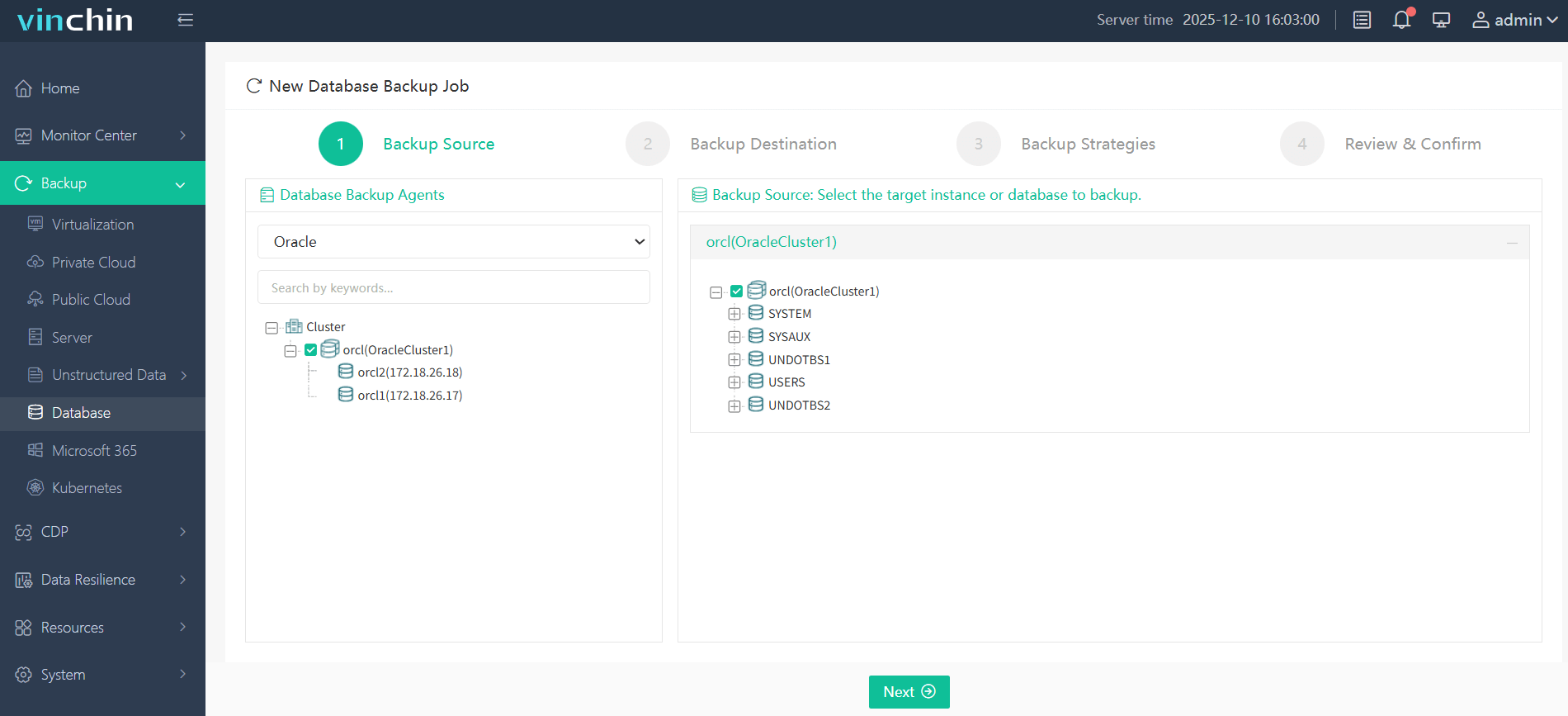
The intuitive web console makes administration easy. Just 4 steps to create a backup job of your oracle databases:
Step 1. Select the Oracle databases to backup
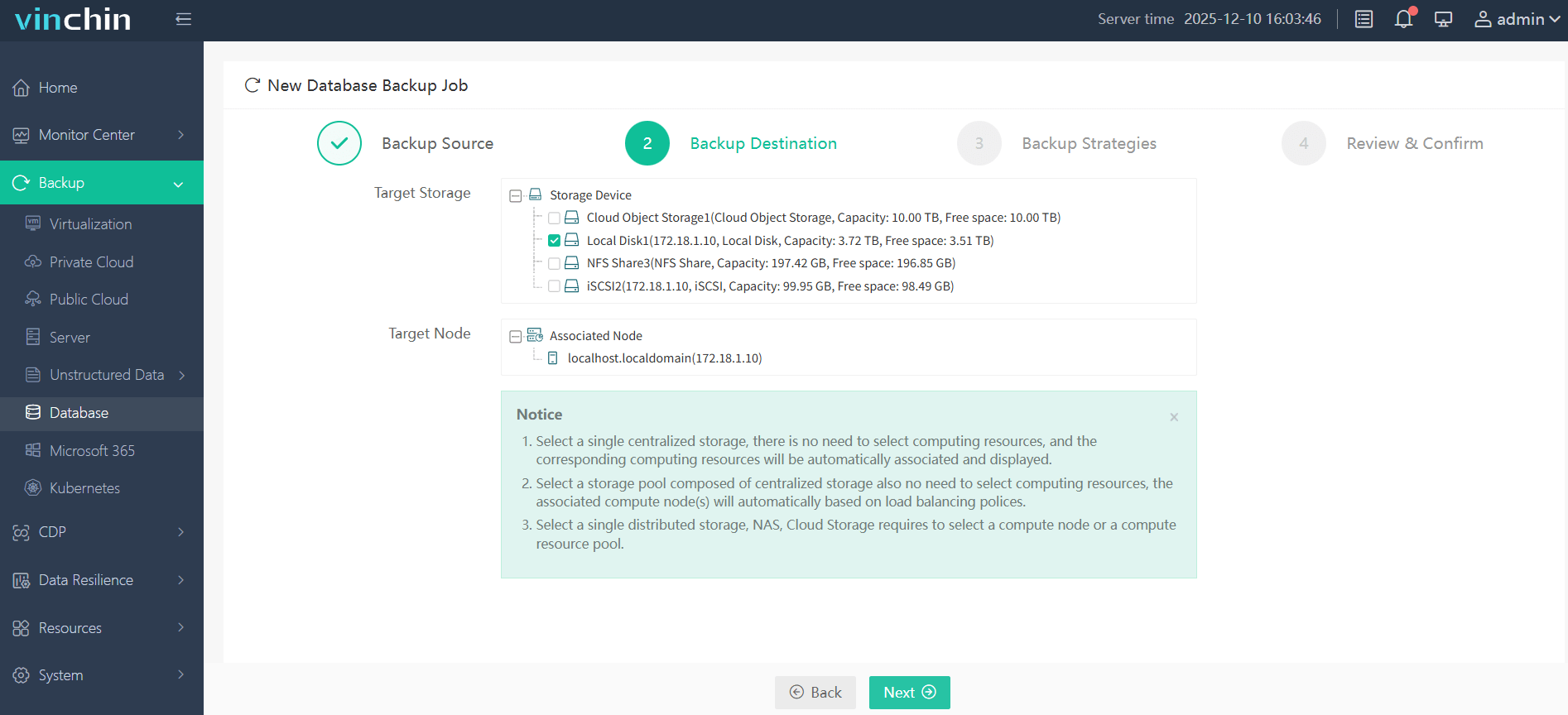
Step 2. Choose the backup storage
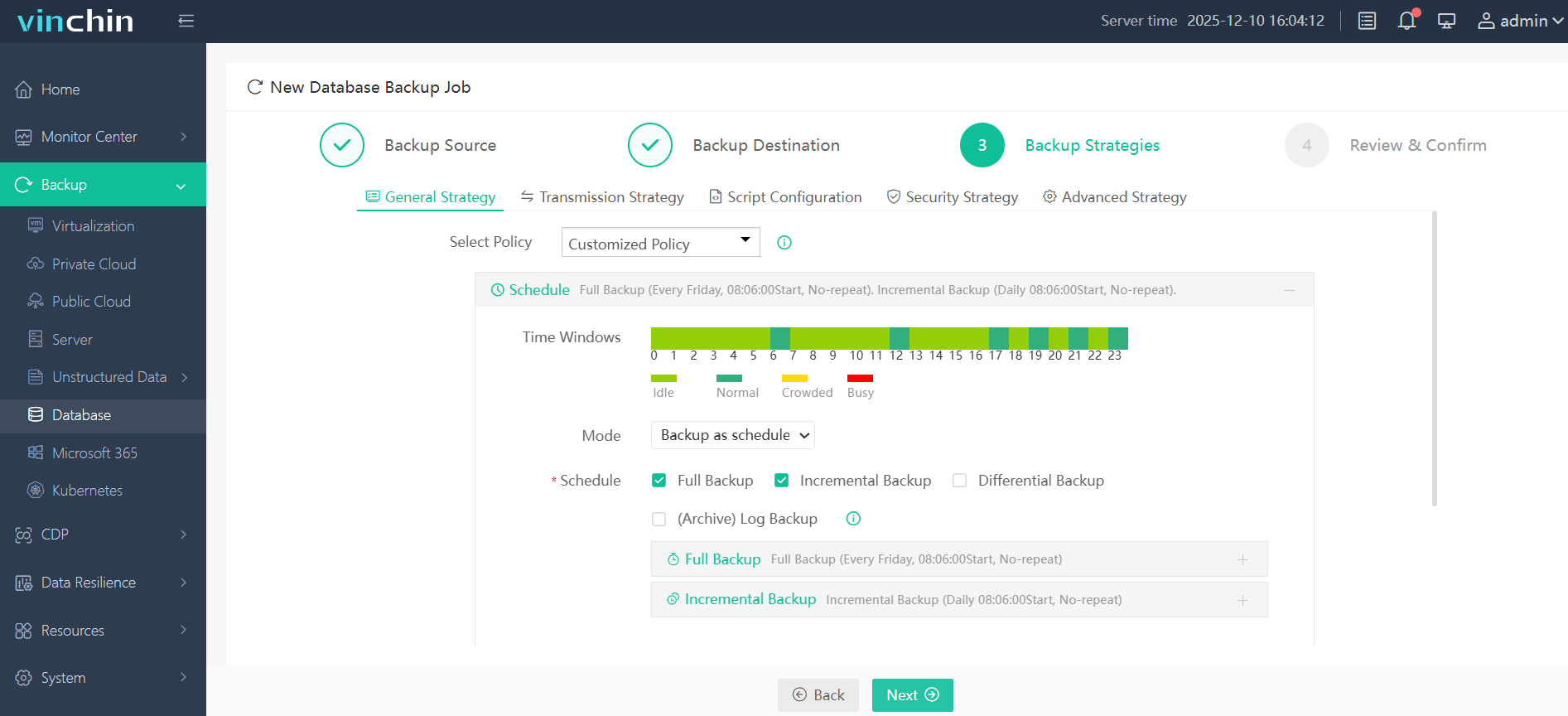
Step 3. Define the backup strategies
Step 4. Submit the job
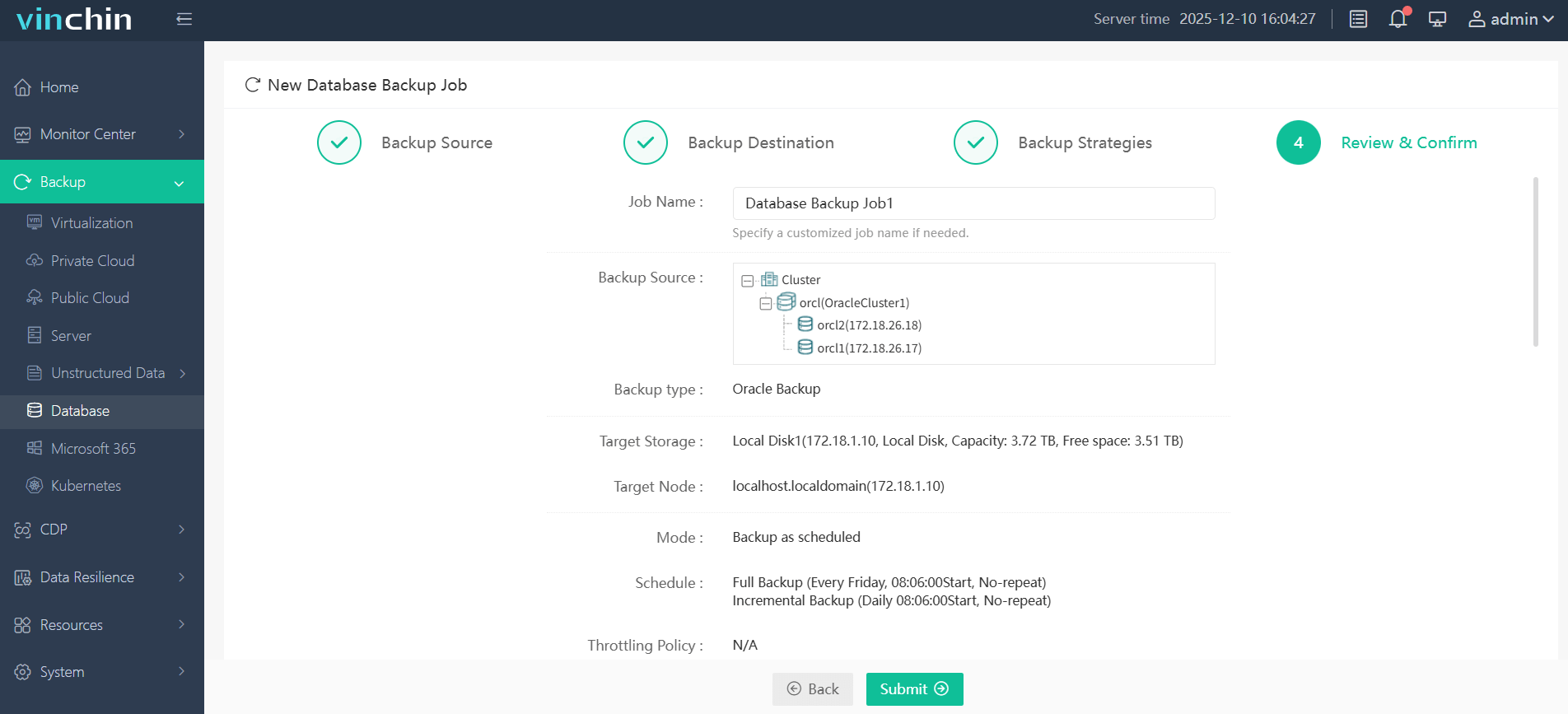
Vinchin Backup & Recovery enjoys global recognition among enterprises thanks to its reliability ratings and strong customer base worldwide. Try all features free for 60 days by clicking Download now.
Oracle RMAN Differential Backup FAQs
Q1: What happens if one of my differential backups gets corrupted?
A1: Restore up through the last valid differential then apply archived redo logs from that point forward using RECOVER UNTIL command as needed.
Q2: Should I enable Block Change Tracking even if my database changes very little day-to-day?
A2: Yes. It improves scan speed regardless of change volume so nightly jobs finish faster even when few blocks differ from yesterday’s state.
Q3: How do I get notified automatically if my scheduled script fails?
A3: Integrate alerting into your script using tools like mailx/email/webhooks/SNMP traps right after checking exit codes.
Conclusion
Oracle RMAN differential backup helps protect critical data efficiently while saving resources, but success depends on careful planning around baselines/automation/testing/restores over time. For streamlined management across complex environments try Vinchin’s modern solution today with no risk thanks to our free trial offer.