Have you ever needed to restore your Oracle database to a specific point in time—just before a critical error or data loss? Oracle RMAN point in time recovery (PITR) is designed for these moments. While Flashback Database lets you quickly rewind recent changes within the undo retention window, PITR allows you to recover from logical errors or corruptions that fall outside that window. With RMAN, you can recover entire databases, tablespaces, or even individual tables to an earlier state. This minimizes downtime and data loss. In this article, we’ll break down what PITR is, why it matters for operations teams, how it differs from other recovery methods—and guide you through each step.
What Is Point in Time Recovery?
Point in time recovery lets you restore data to a precise moment in the past using backups and archived redo logs. This approach is essential when you need to undo unwanted changes—such as accidental deletions or corruptions—without rolling back your entire system. Instead of restoring everything, you can target only affected data sets. Oracle RMAN supports PITR at three levels: database-wide (DBPITR), tablespace-level (TSPITR), and table-level (Table PITR). This flexibility gives administrators powerful options when planning their disaster recovery strategy.
Prerequisites and Critical Pre-Recovery Checks
Before starting any Oracle RMAN point in time recovery operation, it’s crucial to prepare thoroughly. Skipping these checks can lead to failed recoveries or even further data loss.
First, ensure your database runs in ARCHIVELOG mode; this is non-negotiable for all PITR operations because archived logs bridge the gap between backup creation and your chosen recovery point. To verify this setting quickly:
SELECT log_mode FROM v$database;
If the result isn’t ARCHIVELOG, enable it before proceeding.
Next, confirm that all required backups exist and are usable. Having a backup isn’t enough—you must check its integrity using commands like:
RESTORE DATABASE VALIDATE;
CROSSCHECK BACKUP;
These steps help ensure no missing pieces will halt your restore process.
Also verify archive log continuity from your backup date up until your intended recovery point. Use:
LIST ARCHIVELOG ALL;
or query V$ARCHIVED_LOG directly to spot any gaps.
For TSPITR or Table PITR operations involving an auxiliary instance—a temporary clone used during restoration—make sure there’s enough free disk space at your specified AUXILIARY DESTINATION path. The space required often matches the size of involved datafiles; running out of room here is one of the most common causes of failed recoveries.
Finally, review dependencies between objects if recovering only part of a database (like specific tablespaces). Cross-tablespace relationships can block partial restores unless resolved first.
Taking these precautions helps avoid surprises during critical restores—and keeps downtime short when every minute counts.
Why Use Oracle RMAN Point in Time Recovery?
Oracle RMAN point in time recovery is essential for handling user errors such as dropped tables or bad batch updates—and also protects against failed upgrades or logical corruptions that standard backups alone cannot fix. Imagine someone accidentally deletes key records just after midnight; with PITR you can roll back only those changes while leaving unaffected areas untouched.
RMAN automates much of this process by managing backup selection and log application behind the scenes—reducing manual effort while lowering risk of mistakes during high-pressure situations. According to Oracle documentation, regular use of PITR forms part of best practice business continuity planning because it minimizes both downtime and potential data loss across enterprise environments.
Method 1: Recovering Tablespaces with RMAN
Restoring a tablespace to an earlier state is common when only certain parts of your database are affected by error or corruption. This targeted approach avoids unnecessary disruption elsewhere—but requires careful setup beforehand.
Begin by identifying exactly when things went wrong: pinpoint either a timestamp or System Change Number (SCN) using queries like:
SELECT * FROM V$ARCHIVED_LOG;
or reviewing audit logs for clues about problem timing.
Next check whether selected tablespaces are self-contained—that means they don’t have cross-tablespace dependencies which could block automated TSPITR:
EXEC DBMS_TTS.TRANSPORT_SET_CHECK('USERS,TOOLS', TRUE);
SELECT * FROM TRANSPORT_SET_VIOLATIONS;
If results show violations—for example if indexes reside outside USERS but reference its tables—you must resolve them first since TSPITR won’t proceed otherwise.
Start RMAN connected as SYSDBA on your target database—not an auxiliary unless managing one yourself—and run:
RECOVER TABLESPACE users, tools UNTIL TIME '2024-07-10 10:00:00' AUXILIARY DESTINATION '/tmp/auxdest';
Replace names/times/paths as needed for your environment.
After completion back up recovered tablespaces immediately then bring them online:
ALTER TABLESPACE users ONLINE;
ALTER TABLESPACE tools ONLINE;
Be aware: after TSPITR completes successfully all other tablespaces remain logically ahead—their transactions include events beyond your restored ones! You must now take a full backup right away; without it future recoveries past this point may require full DBPITR instead.
Common pitfalls include insufficient auxiliary storage space—which halts progress—or unresolved dependency violations blocking automation entirely. Always double-check prerequisites before launching into production restores!
Method 2: Recovering Tables with RMAN
Starting from Oracle 12c onward administrators can perform granular table-level point-in-time restores—a lifesaver when just one table suffers accidental deletion or corruption while others remain healthy.
First determine precisely which SCN marks “safe” ground—using
SELECT DBMS_FLASHBACK.GET_SYSTEM_CHANGE_NUMBER FROM dual;
-- Or consult V$LOG_HISTORY/V$ARCHIVED_LOG
While UNTIL TIME works too SCNs offer greater precision especially if transaction times overlap closely around incidents being reversed.
Connect RMAN as SYSDBA/SYSBACKUP then issue something like:
RECOVER TABLE schema_name.table_name UNTIL SCN 1234567 AUXILIARY DESTINATION '/tmp/aux' REMAP TABLE 'SCHEMA'.'TABLE':'TABLE_PREV';
The REMAP TABLE clause lets you restore under a new name—for example EMPLOYEES_OLD—so current production rows aren’t overwritten outright but instead allow side-by-side comparison or selective merging via SQL (INSERT INTO, etc.).
Alternatively output recovered contents into Data Pump format rather than importing automatically:
RECOVER TABLE schema_name.table_name UNTIL SCN 1234567 AUXILIARY DESTINATION '/tmp/aux' DATAPUMP DESTINATION '/tmp/export' DUMP FILE 'table_prev.dmp' NOTABLEIMPORT;
Once complete verify restored rows using SQL*Plus queries against either remapped table name or imported dump file contents depending on chosen workflow.
Watch out for auxiliary destination problems here too—lack of disk space remains top cause of failure—as well as permission issues preventing temporary instance startup during restoration phase!
Method 3: Recovering Full Database with RMAN
Sometimes broad-reaching mistakes require rolling back everything—not just isolated objects—to an earlier safe state via full Database Point In Time Recovery (DBPITR).
Start by identifying exactly where rollback should stop: choose either timestamp SCN number or named restore point based on available logs/audit trails so nothing important gets lost unintentionally along way!
Shutdown running services cleanly then mount database ready for exclusive access:
SHUTDOWN IMMEDIATE;
STARTUP MOUNT;
Connect RMAN again then execute core sequence below adjusting parameters accordingly:
RUN {
   SET UNTIL TIME '2024-07-10 10:00:00';
   RESTORE DATABASE;
   RECOVER DATABASE;
}
You may substitute SET UNTIL SCN / SET UNTIL SEQUENCE if preferred over wall-clock times depending on incident details captured previously via monitoring tools/logs/etc..
When finished open newly-restored environment using RESETLOGS command—which creates fresh incarnation history going forward!
ALTER DATABASE OPEN RESETLOGS;
It’s vital now to take immediate full backup since previous ones become invalidated by incarnation change. Failing here risks losing ability to recover future incidents efficiently—a costly oversight many admins learn about too late!
Typical stumbling blocks include missing archive logs breaking chain mid-way through apply phase—or attempting RESETLOGS without proper mounting/preparation leading system into inconsistent state requiring further intervention/rework…
Always validate readiness before executing irreversible steps like RESETLOGS!
How Vinchin Backup & Recovery Simplifies Oracle Backup
For organizations seeking streamlined management beyond native tools, Vinchin Backup & Recovery delivers robust enterprise-grade protection tailored for Oracle databases alongside support for MySQL, SQL Server, MariaDB, PostgreSQL, PostgresPro, and TiDB environments. As an advanced solution built specifically for today’s mainstream platforms—including Oracle—it offers features such as incremental backup capabilities, batch database backup operations, multiple level data compression options, GFS retention policies for compliance needs, and comprehensive storage protection against ransomware threats. Together these functions automate complex tasks while ensuring reliable disaster recovery readiness across large-scale deployments—all managed through one intuitive interface.
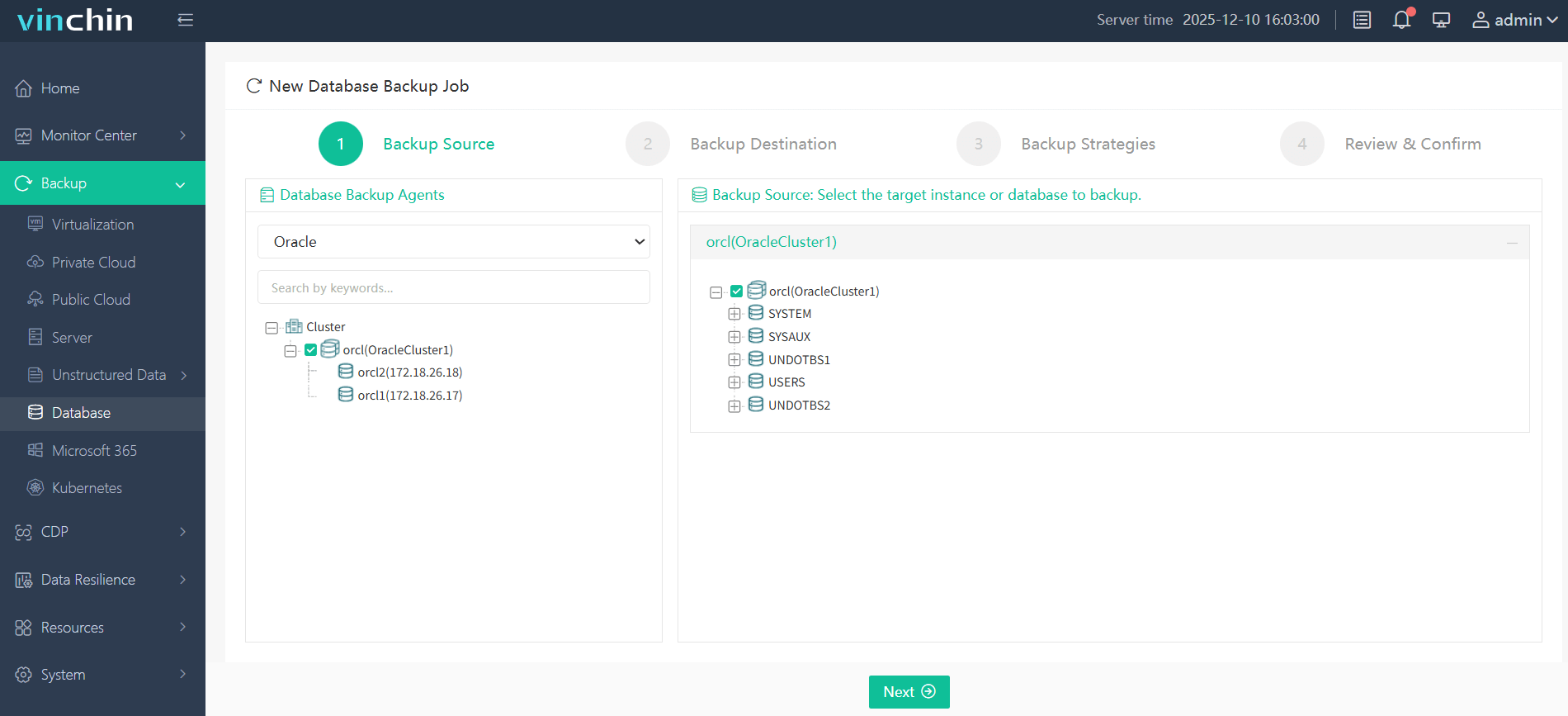
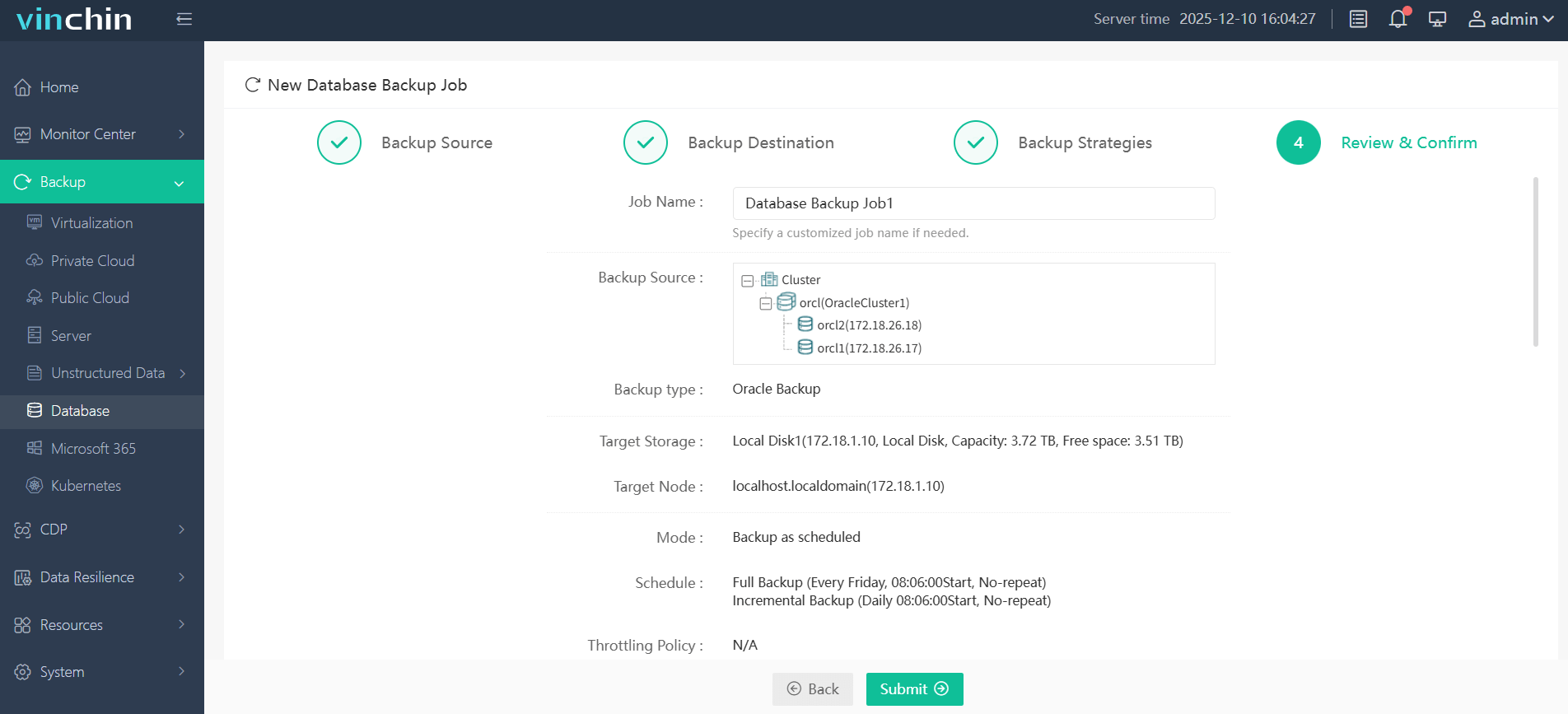
The intuitive web console simplifies every step of protecting your Oracle workloads
Step 1. Select the Oracle database to back up
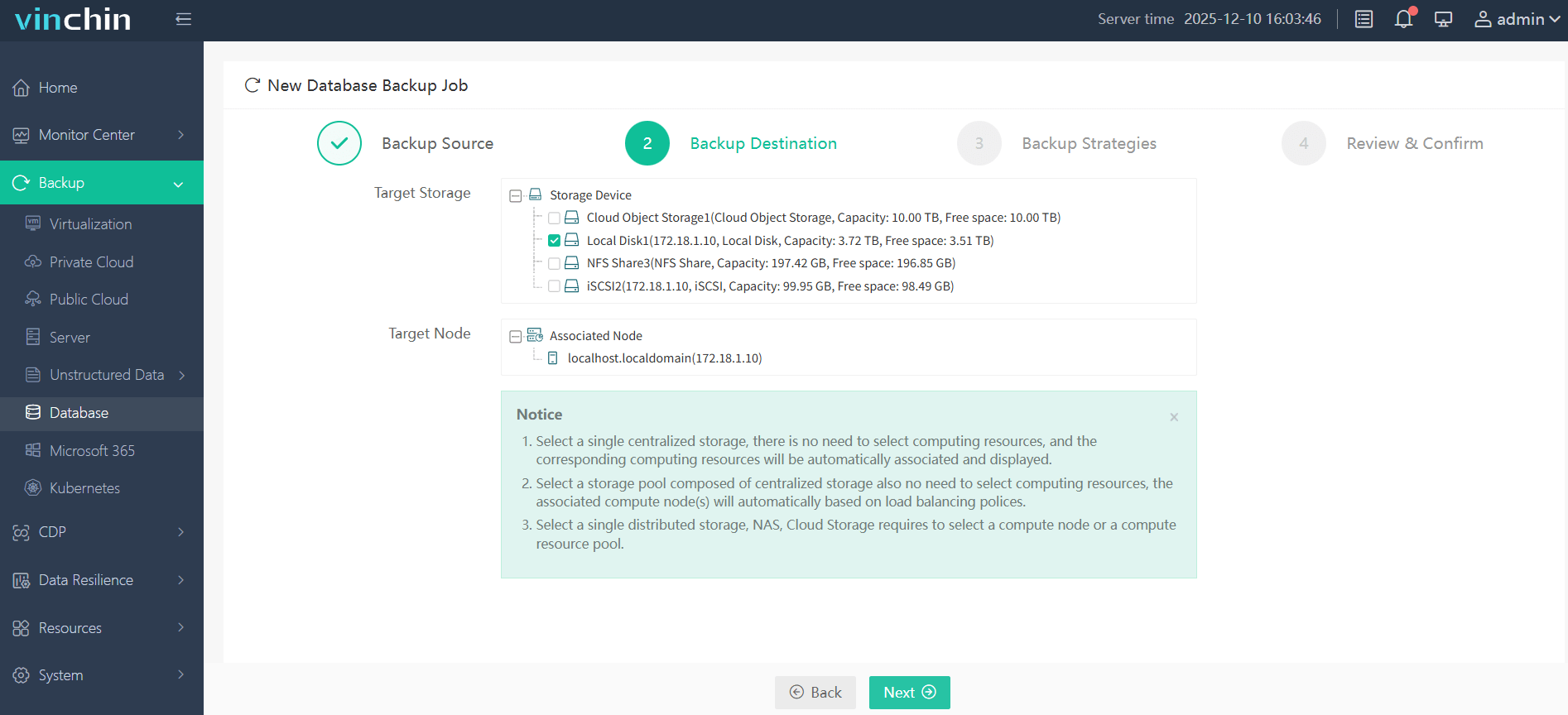
Step 2. Choose the backup storage
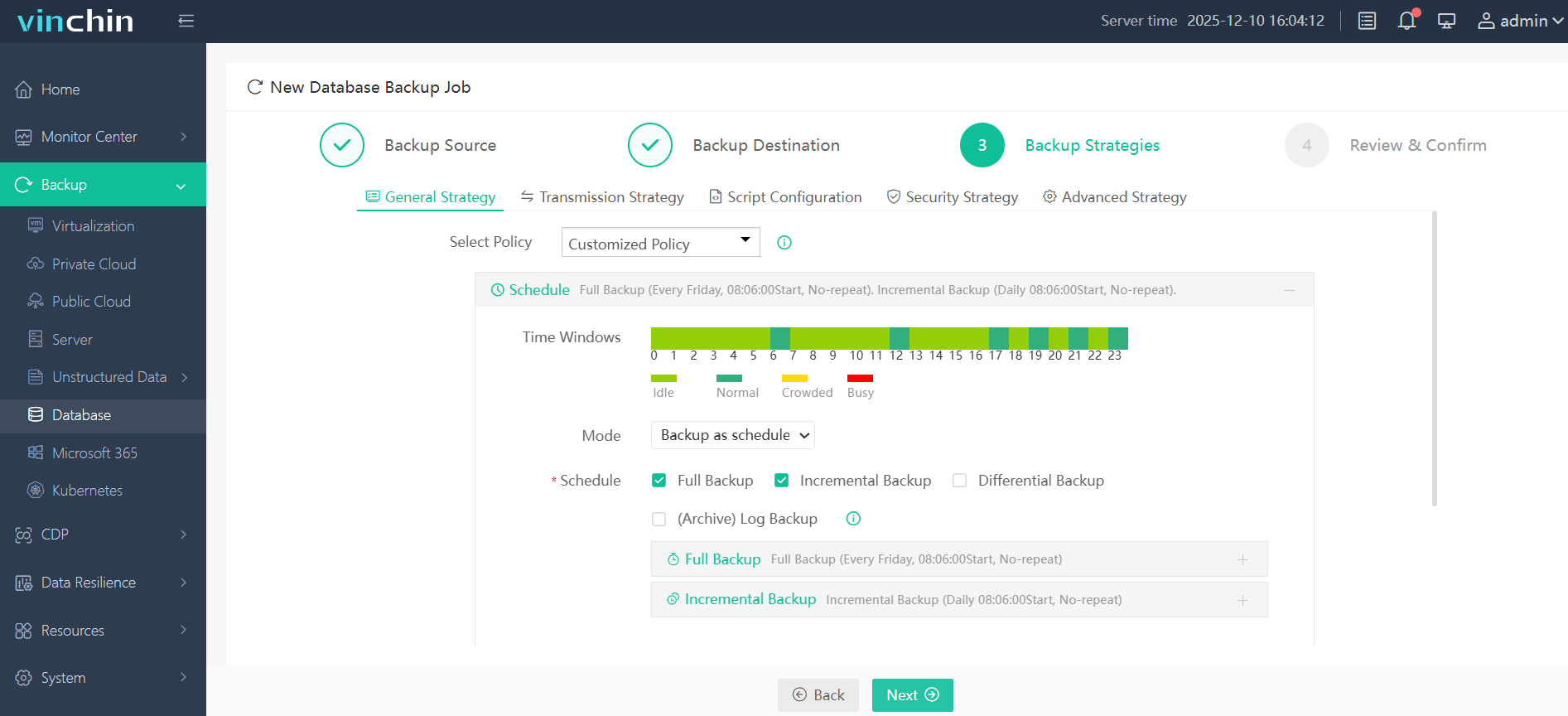
Step 3. Define the backup strategy
Step 4. Submit the job
Recognized globally with top ratings from thousands of customers worldwide,Vinchin Backup & Recovery offers a fully featured free trial lasting 60 days—click download now and experience trusted enterprise-grade data protection firsthand.
Oracle RMAN Point in Time Recovery FAQs
Q1: Can I perform Oracle RMAN point in time recovery if my archive log chain has gaps?
No; uninterrupted archived logs covering from last valid backup through target time are mandatory for successful PITR operations.
Q2: My TSPITR fails due to "auxiliary instance" errors—what should I check?
Check available disk space at AUXILIARY DESTINATION path; also confirm no port conflicts prevent temporary instance startup during restore process.
Q3: Do I need new backups after opening my database with RESETLOGS?
Yes; always create fresh full/incremental backups immediately after RESETLOGS since prior ones become unusable due to changed incarnation history.
Conclusion
Oracle RMAN point in time recovery gives administrators flexible ways to reverse unwanted changes—from single-table mishaps up through catastrophic system-wide failures—with minimal disruption when done right. For streamlined management across complex environments consider trying Vinchin’s comprehensive solution free today!