Kubernetes has changed how we deploy applications at scale. But running your own cluster can be tough—there are updates to manage, security patches to apply, and hardware to monitor around the clock. That’s why many teams turn to hosted Kubernetes solutions instead of building everything themselves.
In this guide, you’ll learn what hosted Kubernetes means, how it works behind the scenes, why so many organizations choose it over self-managed clusters—and how you can protect your workloads with Vinchin’s enterprise-grade backup solution.
What Is Hosted Kubernetes?
Hosted Kubernetes is a managed service where a cloud provider sets up and operates your Kubernetes clusters on their infrastructure. Instead of installing software on your own servers or virtual machines, you use a ready-made environment maintained by experts.
You get access through web consoles or APIs while the provider handles most of the heavy lifting: control plane management, upgrades, scaling nodes up or down—even patching critical vulnerabilities before they become problems. This approach is often called “Kubernetes as a Service” or “managed Kubernetes.”
How Hosted Kubernetes Works
Let’s break down who does what in hosted Kubernetes:
Provider responsibilities: They run the control plane (API server, scheduler), manage etcd databases for cluster state storage, handle networking between pods and nodes, automate upgrades and patches.
Your responsibilities: You deploy applications using YAML manifests or Helm charts; set up namespaces; configure role-based access control (RBAC); monitor app health; manage persistent volumes if needed.
This division lets you focus on delivering features—not babysitting infrastructure.
Core Components in Hosted Environments
Every hosted Kubernetes platform includes several key parts:
Control Plane: The brain of your cluster—handles scheduling containers across nodes.
Worker Nodes: Where your application containers actually run.
Networking Layer: Connects pods securely inside clusters.
Storage Integration: Lets you attach persistent disks or network storage to workloads.
Monitoring & Logging Tools: Built-in dashboards help track resource usage and troubleshoot issues fast.
Providers usually offer these components out-of-the-box so you can launch production apps quickly without deep setup work.
Why Choose Hosted Kubernetes?
Choosing hosted Kubernetes frees up time and resources so teams can focus on building great products instead of managing servers. But what makes it such an attractive option?
First off: no more late-night emergencies when something breaks at the infrastructure level—the provider handles cluster uptime guarantees through service-level agreements (SLAs). Second: scaling becomes simple—you can add new worker nodes with just a few clicks or API calls when demand spikes.
Security is another big win: providers follow industry standards like ISO 27001 or SOC 2 compliance frameworks and roll out security patches automatically across all clusters they host.
Isn’t it easier letting experts worry about hardware failures while you concentrate on shipping code?
Operational Advantages
Hosted platforms reduce operational overhead in several ways:
Automated Upgrades: Providers schedule rolling updates so there’s minimal downtime.
Centralized Monitoring: Dashboards show node health and resource consumption at-a-glance.
Integrated Support Channels: Get help from certified engineers when issues arise.
Cost Predictability: Pay-as-you-go pricing models mean no surprise bills from unexpected hardware failures.
For example: A team managing its own cluster might spend ten hours per week patching nodes; with hosted services this drops to one hour focused only on app-level monitoring—a huge productivity boost!
Cost Benefits
Hosted solutions often lower total cost of ownership (TCO) compared to self-hosted clusters:
1. No need for dedicated staff maintaining physical servers
2. Reduced risk of downtime thanks to built-in redundancy
3. Flexible billing lets you match spending with actual usage patterns
By shifting responsibility upstream—to providers who specialize in running reliable infrastructure—you free up budget for innovation rather than maintenance.
Hosted vs Self-Managed Kubernetes
How do these two approaches stack up? Let’s compare them side-by-side from an operations perspective:
With self-managed clusters:
You’re responsible for everything—from provisioning bare metal servers or VMs to configuring networking plugins like Calico or Flannel; setting up etcd backups; applying OS-level security patches; troubleshooting outages at any hour of day or night.
With hosted platforms:
The provider automates most tasks outside application deployment—control plane upgrades happen behind the scenes; node pools scale automatically based on CPU/memory thresholds you define; logs are aggregated centrally so root-cause analysis takes minutes instead of hours.
Common Use Cases
Self-managed clusters make sense if:
You need full control over every aspect of configuration—for example due to strict regulatory requirements—or want custom integrations not supported by mainstream providers.
Hosted solutions fit best when:
Speed-to-market matters more than granular tuning; compliance needs are met by standard certifications offered by major clouds; teams prefer focusing on business logic rather than system administration chores.
Think about your team size too—a small ops group may struggle keeping pace with manual patch cycles while larger enterprises might justify dedicated staff for bespoke setups.
Top Hosted Kubernetes Providers
The market offers plenty of choices—all certified by CNCF—which means strong compatibility across tools and APIs. Most vendors provide robust automation features plus global data center reach so apps stay close to users worldwide.
Some well-known options include:
Google Kubernetes Engine (GKE): Deep integration with Google Cloud services plus automated node pool management
Azure Kubernetes Service (AKS): Seamless tie-ins with Microsoft Azure ecosystem plus advanced RBAC controls
Amazon Elastic Kubernetes Service (EKS): High availability zones across AWS regions plus tight IAM integration
Other players like IBM Cloud Managed K8s also offer similar core features tailored toward specific industries’ needs.
All major providers deliver web consoles for visual management alongside CLI/API support for automation workflows. Features like auto-scaling groups let admins adjust capacity dynamically without manual intervention—and built-in monitoring tools simplify troubleshooting complex deployments.
Selection Criteria When Choosing a Provider
When picking a hosted platform consider these factors:
1. Data center locations—can you deploy close enough to end-users?
2. Compliance certifications—does the provider meet industry standards relevant for your sector?
3. Support SLAs—is expert help available around-the-clock?
4. Pricing transparency—are costs predictable month-to-month?
5. Ecosystem integrations—will existing CI/CD pipelines plug in easily?
Evaluating these points ensures smooth onboarding—and fewer surprises down the road.
How to Protect Hosted Kubernetes with Vinchin Backup & Recovery
While cloud providers secure their underlying infrastructure, safeguarding application data within hosted environments remains essential for every organization. Vinchin Backup & Recovery stands out as a professional, enterprise-level solution purpose-built for comprehensive protection of hosted Kubernetes workloads across leading platforms worldwide.
Vinchin Backup & Recovery delivers robust capabilities including full/incremental backups, fine-grained recovery at multiple levels (cluster, namespace, application, PVC), policy-driven automation alongside one-off jobs, cross-cluster/cross-version restore flexibility—even encrypted transmission and WORM protection for regulatory compliance. These features together ensure rapid recovery from accidental deletions or disasters while optimizing storage efficiency and meeting stringent data governance requirements—all through streamlined workflows that minimize administrative burden.
The intuitive web console makes protecting your hosted Kubernetes environment straightforward in four steps:
1. Select backup source

2. Choose backup storage
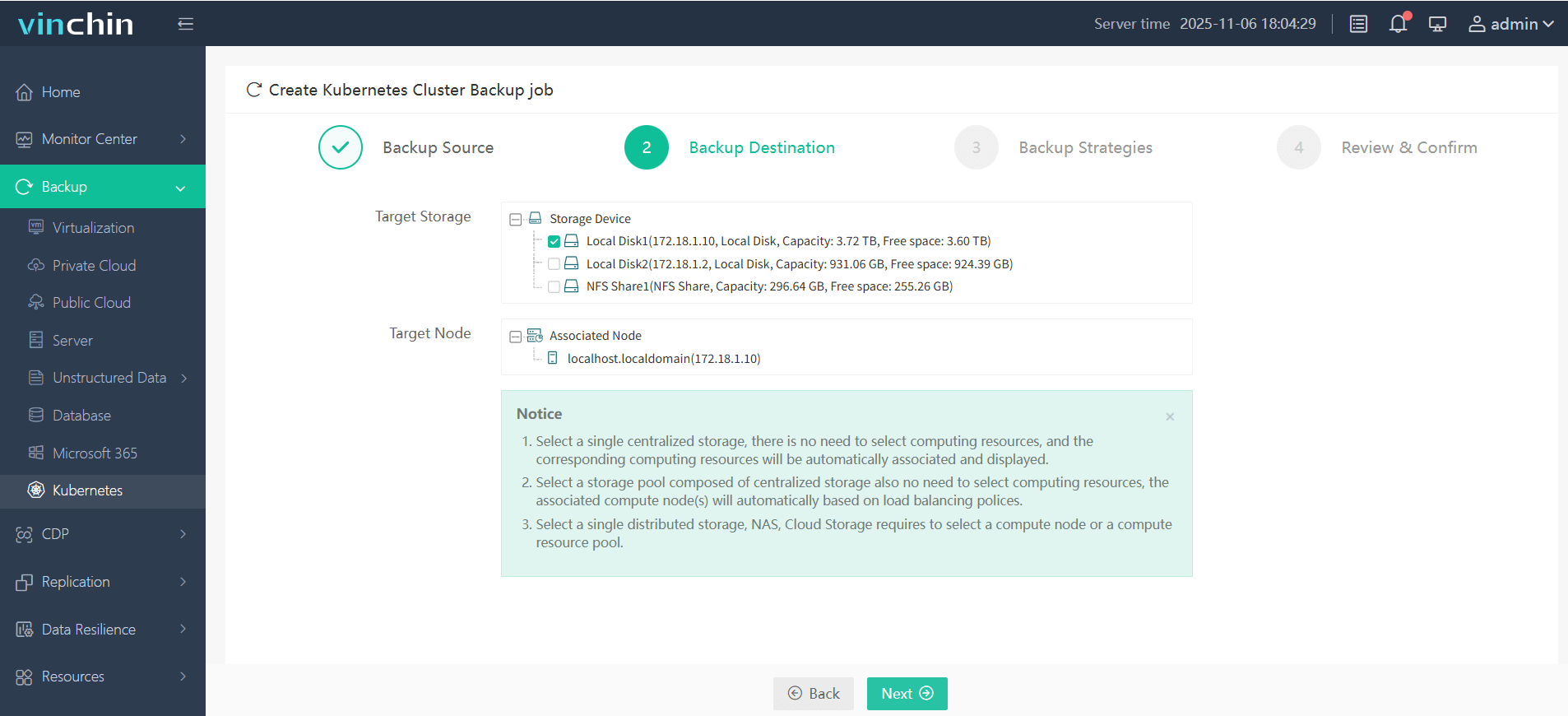
3. Define backup strategy
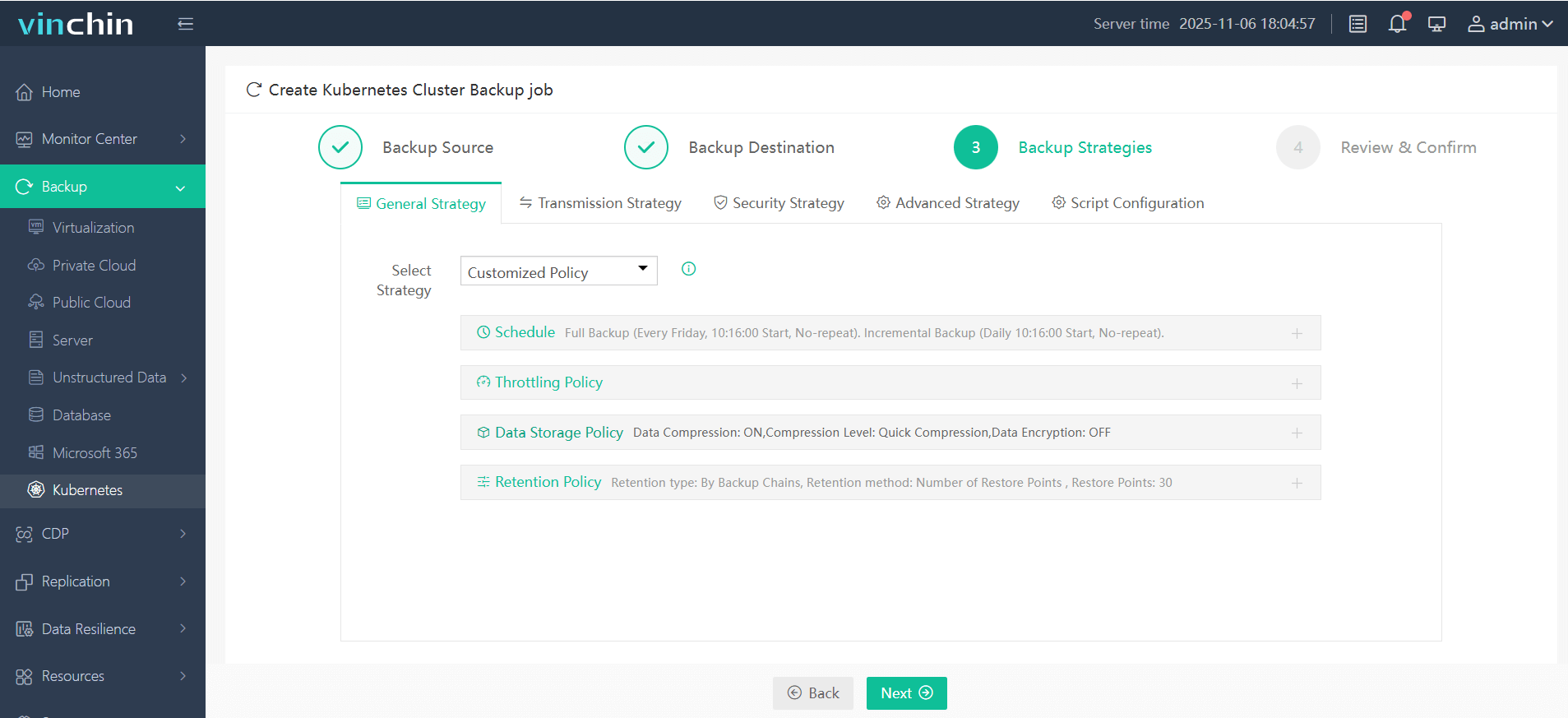
4. Submit the job
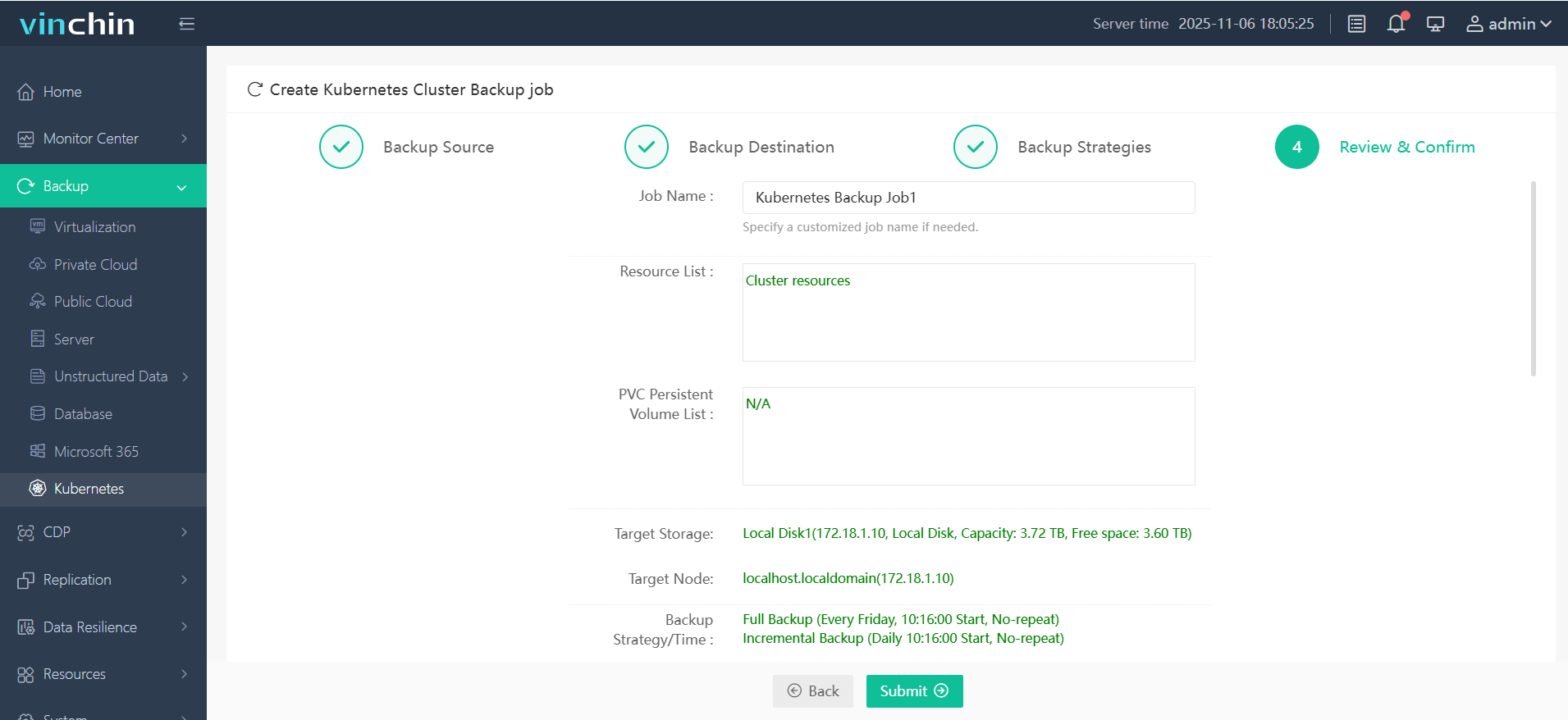
Recognized globally by thousands of customers and top-rated by IT professionals, Vinchin Backup & Recovery offers a 60-day full-featured free trial—experience enterprise-class data protection today!
Hosted Kubernetes FAQs
Q1: Can I move my applications between different hosted kubernetes platforms?
A1: Yes—as long as both platforms are CNCF-certified—you can export manifests/data then import elsewhere after testing compatibility first.
Q2: How do I monitor performance/costs in my hosted kubernetes environment?
A2: Use built-in dashboards provided by most hosts along with open-source tools like Prometheus/Grafana—or connect billing APIs directly into reporting systems.
Q3: What steps should I take before restoring production workloads?
A3: Verify target namespace exists > check user permissions > select correct restore point > click RESTORE
Conclusion
Hosted kubernetes simplifies deploying scalable apps while reducing operational headaches—and robust protection matters more than ever today! With Vinchin's powerful yet user-friendly solution you're covered end-to-end…try our free trial now for peace-of-mind backups that just work.