Are you running out of storage space for your Oracle database backups? Do you want to speed up backup and recovery while saving on storage costs? Oracle backup compression can help. This feature reduces backup file size so you can store more data in less space. It also helps move backups faster across networks or into the cloud. In this article, we’ll explain what Oracle backup compression is, why it matters, how it works in practice, and how to monitor its effectiveness. We’ll cover both native RMAN compression and Data Pump’s built-in options. By the end, you’ll know which method fits your needs best.
What Is Oracle Backup Compression?
Oracle backup compression is a technology that shrinks database backups by removing empty or repeated data blocks before applying binary compression algorithms. This process happens inside Oracle’s own tools—Recovery Manager (RMAN) for physical backups or Data Pump for logical exports. Compressed backups take up less disk space than uncompressed ones. They also transfer faster over slow networks because there’s less data to move.
Oracle offers several levels of compression. Each level balances CPU usage against storage savings. For example, higher levels save more space but use more processor power during backup jobs. The most common methods are RMAN’s compressed backup sets—which work at the block level—and Data Pump’s export file compression—which works at the object level.
Compression does not change your original data or affect how you restore from backup files later on. When restoring from a compressed backup set or dump file, Oracle decompresses it automatically.
Why Use Oracle Backup Compression
Backup compression is about much more than just saving disk space—it helps streamline many aspects of database management. First, smaller backups mean lower storage costs over time since you need fewer disks or cloud resources to keep historical copies safe. Second, compressed files travel faster across networks because there’s less information to send; this speeds up offsite replication or cloud uploads.
Compression also reduces I/O load on your storage systems during both backup and restore operations—a key benefit if your disks are already busy supporting production workloads. With smaller files moving through your infrastructure, bottlenecks are less likely to slow down critical processes.
However, using higher levels of compression increases CPU consumption during both backup creation and restoration tasks. That means it’s important to test different settings in your environment before rolling them out widely—especially if server resources are shared with other applications.
Finally: compressed backups can shorten your overall “backup window”—the period when databases are unavailable due to maintenance—because writing smaller files takes less time than writing larger ones.
Method 1. Native RMAN Compression Options
RMAN (Recovery Manager) is Oracle’s main tool for physical database protection—including full system recovery after disasters or hardware failures. It supports several built-in algorithms for compressing backup sets: BASIC (included with all editions), plus LOW, MEDIUM, and HIGH (which require an Advanced Compression license).
Let’s walk through how you can use these features step by step:
First: remember that RMAN only compresses backup sets, not image copies or archived redo logs stored outside of sets.
To set a default algorithm globally—for all future disk-based backups—connect to RMAN as an administrator:
RMAN> CONFIGURE COMPRESSION ALGORITHM 'BASIC';
This command tells RMAN to use BASIC-level compression every time unless told otherwise. If you have licensed Advanced Compression from Oracle (check with your DBA team), you may choose LOW/MEDIUM/HIGH instead:
RMAN> CONFIGURE COMPRESSION ALGORITHM 'MEDIUM';
Next: configure device type so that all disk-based backups become compressed by default:
RMAN> CONFIGURE DEVICE TYPE DISK BACKUP TYPE TO COMPRESSED BACKUPSET;
This setting ensures every subsequent disk-based job uses compressed sets unless overridden at runtime.
When ready to run a standard full database backup using these defaults:
RMAN> BACKUP DATABASE;
If you want one-off control without changing global settings—for example during ad-hoc jobs—use this syntax instead:
RMAN> BACKUP AS COMPRESSED BACKUPSET DATABASE PLUS ARCHIVELOG;
For even finer control (available in Oracle 12c Release 2/12.2 onward), specify the desired algorithm directly within a single command:
RMAN> BACKUP AS COMPRESSED BACKUPSET DATABASE COMPRESSED FOR MEDIUM;
You may also switch algorithms mid-session if needed:
RMAN> SET COMPRESSION ALGORITHM 'HIGH';
RMAN> BACKUP AS COMPRESSED BACKUPSET DATABASE;
Always remember: higher levels like HIGH provide greater size reduction but demand more CPU cycles per gigabyte processed.
Before deploying changes in production environments:
1) Test each algorithm on representative sample data
2) Measure elapsed time versus resulting file sizes
3) Monitor server CPU utilization throughout
This approach lets you find the right balance between speed/cost/safety based on actual workload patterns—not just vendor recommendations.
Choosing Between RMAN and Data Pump Compression
How do you decide which tool fits best? Let’s compare their strengths side-by-side:
| Feature | RMAN | Data Pump |
|---|
| Type | Physical block-level | Logical object-level |
| Typical Use | Full/incremental DB recovery | Schema/table export/import |
| Granularity | Whole DB/tablespaces | Individual objects/schemas |
| Restore Speed | Fastest for disaster recovery | Best for selective restores |
| Licensing | BASIC free; others licensed | Some options require license |
| CPU Impact | Higher at HIGH/MEDIUM | Lower except ALL/DATA_ONLY |
Choose RMAN when protecting entire databases against outages—or when regulatory compliance requires point-in-time restores from physical media.
Use Data Pump when migrating specific tables/schemas between servers—or archiving subsets of business data long-term.
Method 2. Using Data Pump for Compression
Oracle Data Pump handles logical exports/imports of tablespaces, schemas, users’ objects—and supports multiple ways to shrink output files via built-in parameters.
There are four main choices under its COMPRESSION parameter:
METADATA_ONLY – Only metadata gets compressed; this is default behavior
DATA_ONLY – Compresses table/LOB contents but leaves metadata plain
ALL – Both metadata and table/LOB contents get compressed together
NONE – No compression applied anywhere
It’s important to note that starting from Oracle Database 12c Release 1 (12.1), using COMPRESSION=DATA_ONLY or COMPRESSION=ALL requires an Advanced Compression Option license on the source system.
Here’s how these settings look in practice:
To compress everything during export:
expdp system/password DIRECTORY=backup_dir DUMPFILE=full.dmp COMPRESSION=ALL
For just table data:
expdp system/password DIRECTORY=backup_dir DUMPFILE=full.dmp COMPRESSION=DATA_ONLY
To stick with default metadata-only mode:
expdp system/password DIRECTORY=backup_dir DUMPFILE=full.dmp COMPRESSION=METADATA_ONLY
From version 12c Release 1 onward—you may further tune results using COMPRESSION_ALGORITHM, such as MEDIUM/HIGH/BASIC if licensed:
expdp system/password DIRECTORY=backup_dir DUMPFILE=full.dmp COMPRESSION=ALL COMPRESSION_ALGORITHM=BASIC
During import (impdp), decompression happens automatically behind-the-scenes—no extra steps required from administrators.
Vinchin Backup & Recovery for Enterprise Database Protection
While native tools offer robust options for managing Oracle database backups and compression, organizations seeking streamlined enterprise-grade protection should consider Vinchin Backup & Recovery. As a professional solution designed specifically for modern enterprises, Vinchin Backup & Recovery supports today’s leading databases—including Oracle first and foremost—as well as MySQL, SQL Server, MariaDB, PostgreSQL, PostgresPro, and TiDB platforms.
For Oracle environments especially concerned with efficient storage use and rapid recoverability, Vinchin Backup & Recovery provides advanced source-side compression, incremental backup,batch database protection, multi-level data reduction, and flexible retention policies. These capabilities combine seamlessly, reducing total storage requirements, speeding up routine operations, and ensuring compliance across diverse IT landscapes—all while minimizing administrative effort.
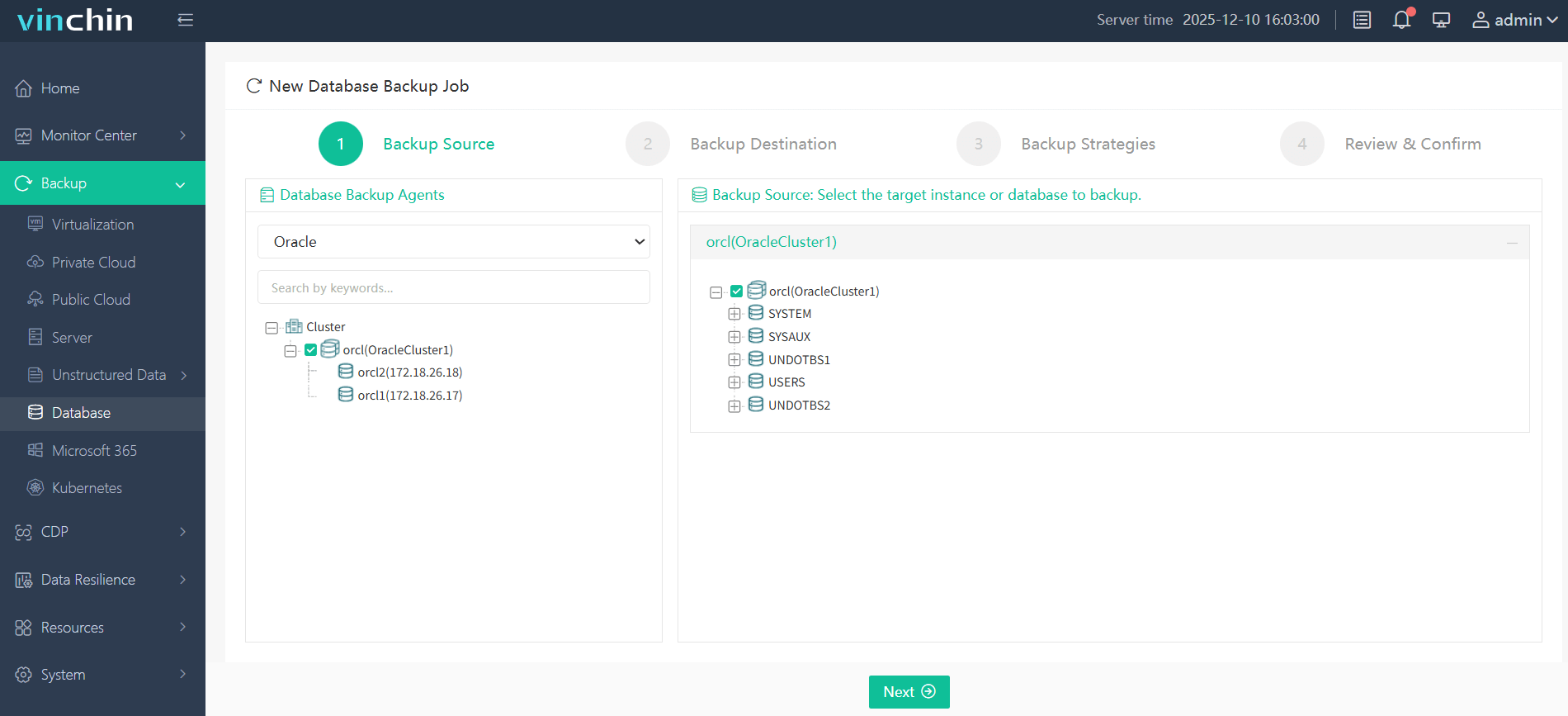
The intuitive web console makes safeguarding your databases remarkably simple.Just follow four clear steps: Step 1. Select the Oracle database to back up.
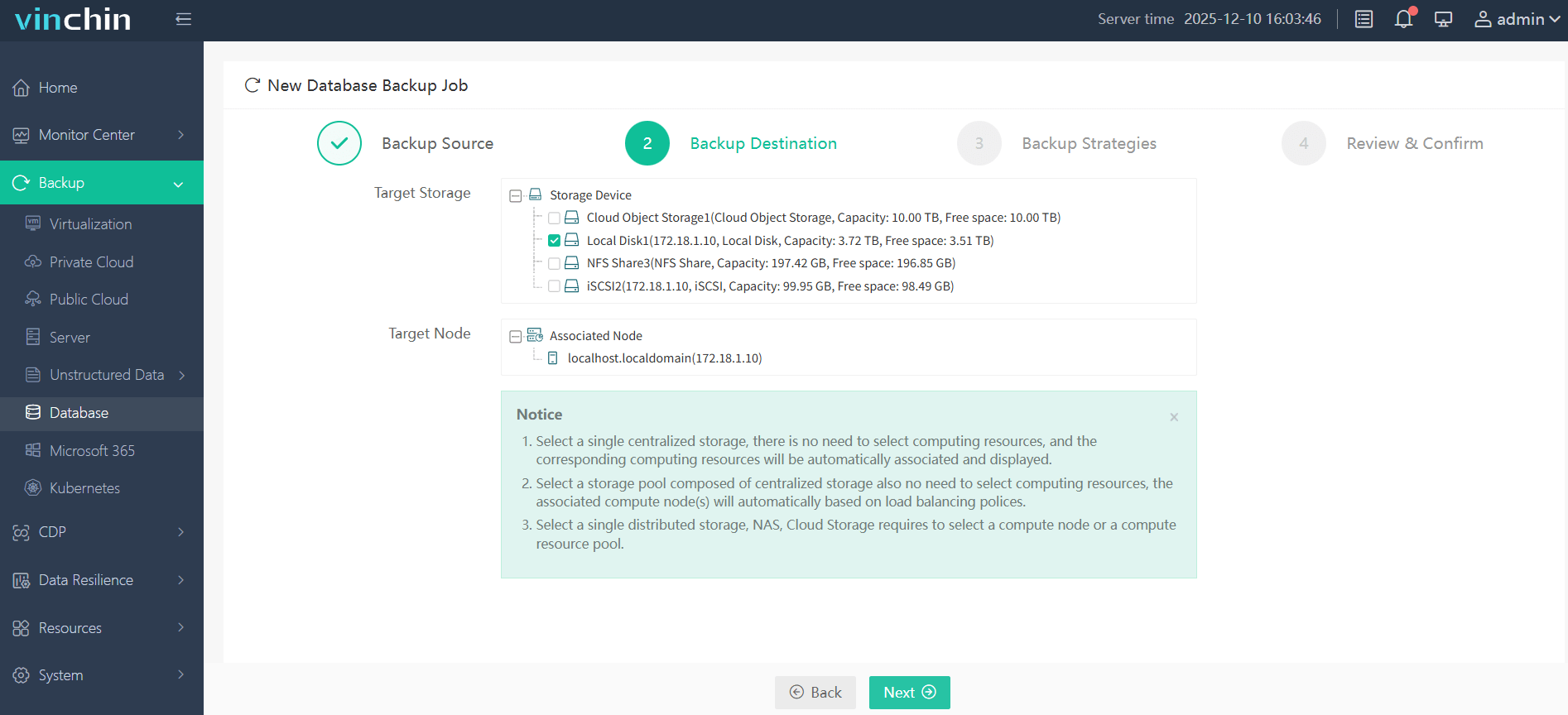
Step 2. Choose the backup storage.
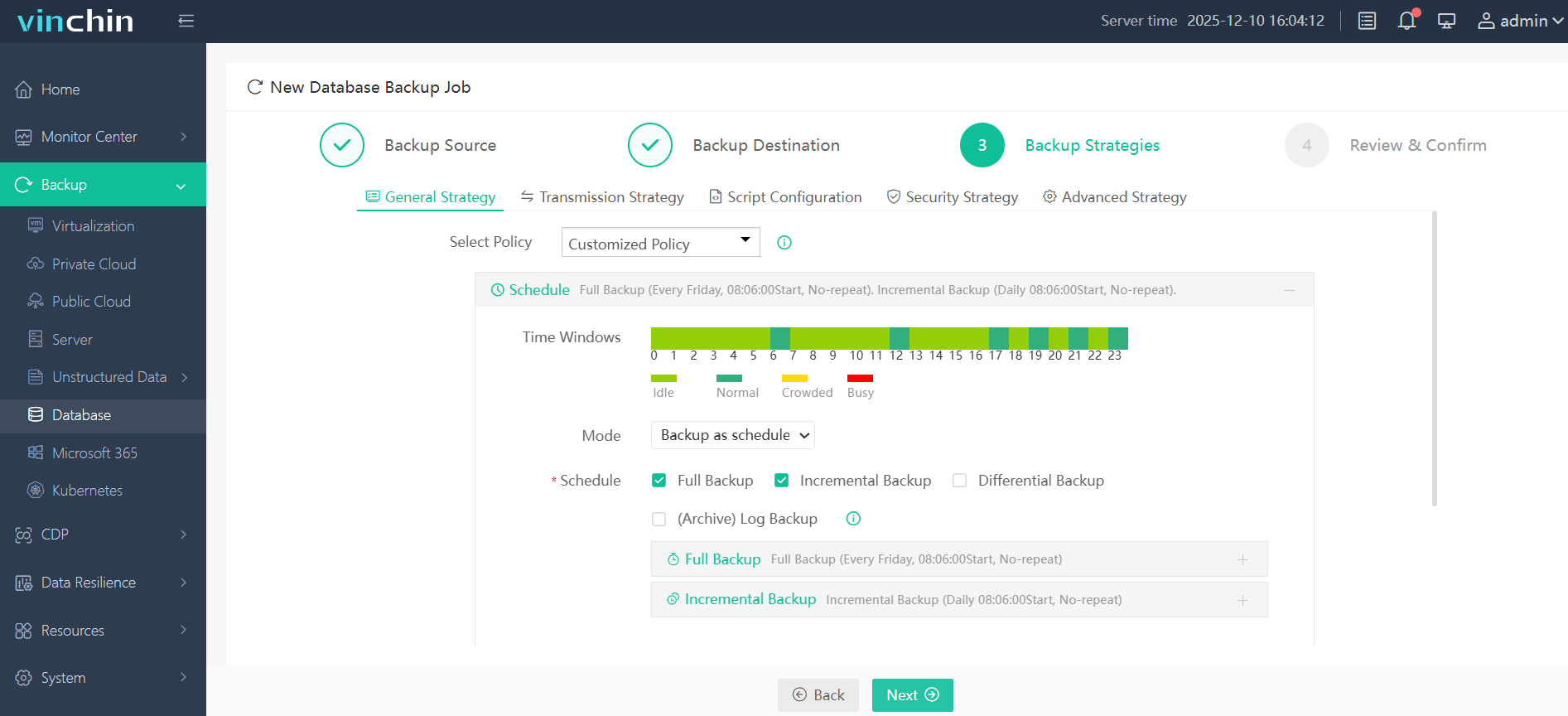
Step 3. Define the backup strategy.
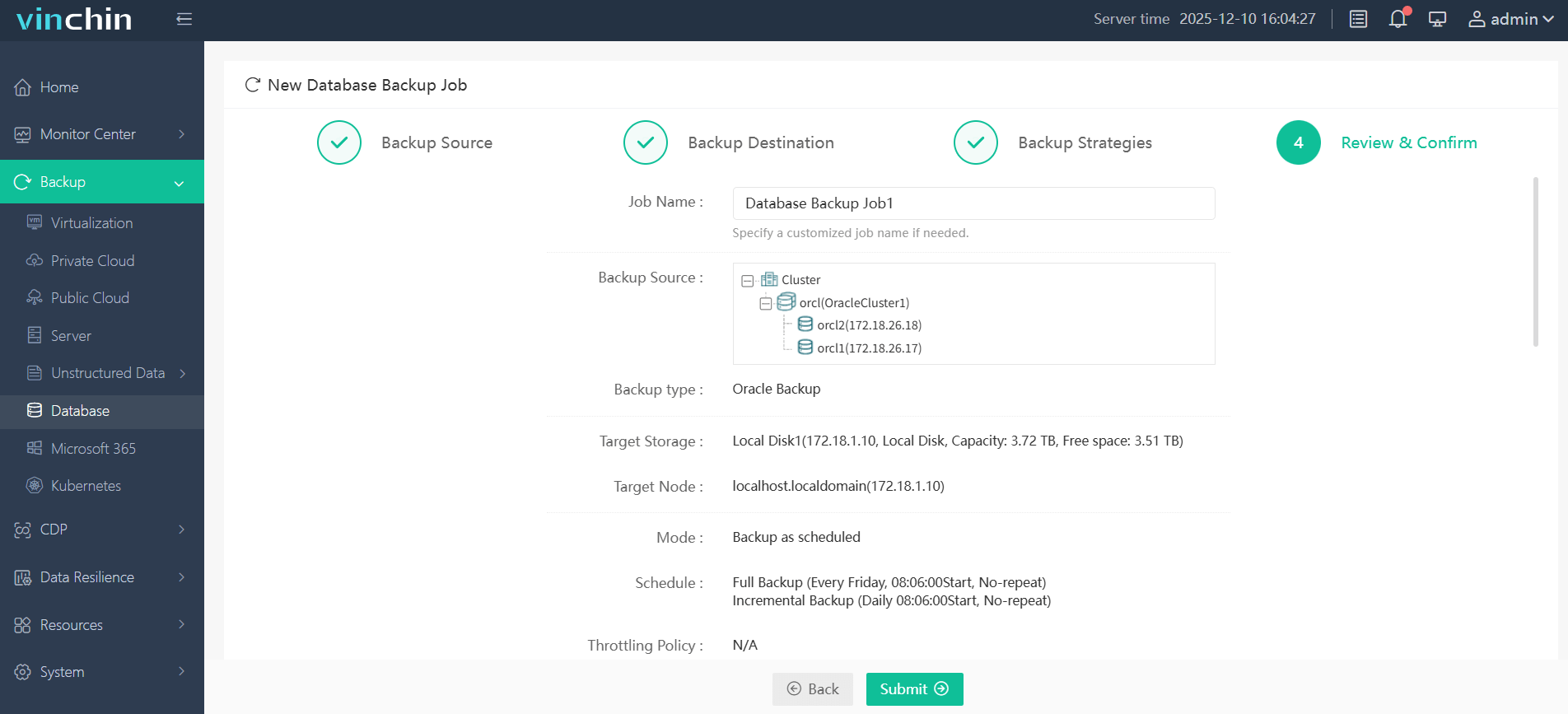
Step 4. Submit the job.
Vinchin Backup & Recovery enjoys global recognition among enterprise customers thanks to its reliability, user-friendly design, and responsive support. Try every feature risk-free for sixty days—click Download now!
Oracle Backup Compression FAQs
Q1: How do I check my current RMAN default compression setting?
Connect via RMAN CLI then run SHOW COMPRESSION ALGORITHM;
Q2: Will enabling high-level RMAN or Data Pump compression impact my ability to restore quickly?
No; decompressing occurs automatically during restore without extra manual steps required.
Q3: Can I mix uncompressed & compressed backups within same retention policy?
Yes; both types coexist safely though mixing may affect deduplication efficiency depending on target storage appliance design.
Conclusion
Oracle backup compression saves space,cuts costs,and accelerates transfers. Whether using native tools or third-party solutions, you gain flexibility balancing speed vs resource use. Vinchin simplifies enterprise-grade protection further—with easy setup, powerful automation, and robust reporting. Try Vinchin today risk-free!