Duplicating an Oracle 19c database using RMAN from backup is a vital skill for operations administrators. This process helps you create test environments, migrate databases, or set up disaster recovery systems without affecting production workloads. In this guide, you’ll learn how to duplicate an Oracle 19c database from backup using RMAN, following Oracle’s best practices and official documentation. We’ll start with basic concepts and move step by step into advanced troubleshooting.
What Is RMAN Duplicate Database?
RMAN (Recovery Manager) is Oracle’s built-in tool for managing backups and restores. The DUPLICATE command in RMAN lets you create a copy of a source database, often called a duplicate or cloned database. This clone is independent of the original and can be used for testing, development work, or as a standby system.
You can duplicate a database either from live data (active duplication) or from existing backups (backup-based duplication). Active duplication copies data directly over the network from the source instance. Backup-based duplication uses pre-existing RMAN backups stored on disk or tape.
In this article, we focus on backup-based duplication because it reduces load on your production environment and supports flexible migration scenarios.
Why Duplicate an Oracle 19c Database?
Database duplication serves many operational needs beyond simple cloning. Common use cases include:
Testing upgrades or patches in a safe environment
Validating backup and recovery procedures
Creating development sandboxes without risking production data
Setting up disaster recovery sites
Meeting compliance requirements by creating air-gapped test environments
By duplicating from backup instead of live data, you avoid putting extra strain on your main system. You also gain flexibility to clone databases across different servers or storage layouts. It is a key advantage when planning migrations or building golden images for DevOps pipelines.
Oracle 19c RMAN Duplicate Database from Backup Steps
Duplicating an Oracle 19c database using RMAN involves several precise steps. Each phase builds upon the last to ensure your new environment is reliable and consistent with your source system.
1. Prepare the Source Database and Take a Backup
Before starting any duplication task, always confirm that you have a recent, valid RMAN backup of your source database, including all datafiles, control files, and archived redo logs.
Begin by connecting to your source instance with RMAN:
rman target /
Then run:
RMAN> BACKUP DATABASE PLUS ARCHIVELOG;
This command creates a full backup along with all necessary archived logs so that no committed transactions are lost during restore.
After taking the backup, it’s good practice to validate its integrity:
RMAN> VALIDATE BACKUPSET <backup_set_number>;
Replace <backup_set_number> with your actual set identifier. Validation ensures there are no corrupt blocks that could cause issues later in the process.
2. Transfer Backups to the Destination Host
If you plan to duplicate onto another server (a common scenario), transfer all relevant backup pieces including control file autobackups to accessible directories on your destination host.
Make sure:
1. The directory structure exists on the destination machine.
2. There’s enough free space for all files.
3. File permissions allow read access by Oracle processes.
Use secure copy tools like scp or rsync if moving files over the network:
scp /u01/app/oracle/backup/* oracle@clonehost:/u01/app/oracle/backup/
Once transferred, double-check file integrity using checksums (md5sum or sha256sum) both before and after transfer to catch any corruption during transit.
3. Prepare the Auxiliary (Duplicate) Instance
On your destination host, the future home of your cloned database, you need to prepare what’s called an auxiliary instance.
First:
1. Copy the password file from source to destination; rename it if needed so it matches your new SID.
2. Create a PFILE (parameter file) for this auxiliary instance by running:
SQL> CREATE PFILE FROM SPFILE;
Edit this PFILE carefully:
Set DB_NAME to match either your original name (if allowed) or choose something unique if required by policy.
Use DB_FILE_NAME_CONVERT and LOG_FILE_NAME_CONVERT parameters so that old paths map correctly onto new ones at your destination location.
Example configuration lines might look like:
*.db_name='CLONE'
*.db_file_name_convert='/oradb/app/oracle/oradata/orcl','/oradb/app/oracle/oradata/clone'
*.log_file_name_convert='/oradb/app/oracle/oradata/orcl','/oradb/app/oracle/oradata/clone'
*.control_files='/oradb/app/oracle/oradata/clone/control01.ctl','/oradb/app/oracle/oradata/clone/control02.ctl'
*.audit_file_dest='/oradb/app/oracle/admin/clone/adump'
Create all required directories referenced above before proceeding. This includes locations for datafiles, control files, redo logs, audit files, etc.
Validating Auxiliary Instance Configuration
Before starting up this auxiliary instance:
1. Check that /etc/oratab lists your new SID correctly.
2. Confirm environment variables like ORACLE_SID, ORACLE_HOME, and PATH point where they should.
3. Review memory settings such as MEMORY_TARGET.these may need adjustment if hardware differs between source and destination hosts.
A common pitfall: If there’s already an existing database with this SID at your destination or if stray control files exist, the startup will fail in NOMOUNT mode. Always clean up old instances first if reusing SIDs.
4. Start the Auxiliary Instance in NOMOUNT Mode
With everything configured:
1. Set environment variables for your new SID (export ORACLE_SID=clone)
2. Launch SQL*Plus as SYSDBA:
sqlplus / as sysdba
SQL> STARTUP NOMOUNT PFILE='$ORACLE_HOME/dbs/initclone.ora';
NOMOUNT mode means only memory structures are initialized. No attempt is made yet to mount any control file, which is exactly what we want at this stage since our goal is restoration via RMAN rather than normal startup.
5. Configure Oracle Net Connectivity
Both source (“target”) and destination (“auxiliary”) hosts must be able to communicate over Oracle Net Services (TNS). This requires correct entries in both listener.ora (for listening endpoints) and tnsnames.ora (for client-side resolution).
Sample tnsnames entry:
ORCL =
  (DESCRIPTION =
    (ADDRESS = (PROTOCOL = TCP)(HOST = orcl.localdomain.com)(PORT = 1521))
    (CONNECT_DATA =
      (SERVER = DEDICATED)
      (SERVICE_NAME = orcl.localdomain.com)
    )
  )

CLONE =
  (DESCRIPTION =
    (ADDRESS = (PROTOCOL = TCP)(HOST = clone.localdomain.com)(PORT = 1521))
    (CONNECT_DATA =
      (SERVER = DEDICATED)
      (SERVICE_NAME = clone.localdomain.com)
    )
  )
Test connectivity using:
tnsping CLONE
tnsping ORCL
If these commands return success messages (“OK”), then TNS setup is correct; otherwise troubleshoot listener status (lsnrctl status) until resolved.
6: Connect to RMAN & Run DUPLICATE Command
Now comes the core operation: launching duplication itself via RMAN.
From your auxiliary host:
Connect only as auxiliary if working purely off backups stored locally
rman auxiliary sys/password@CLONE
Or connect both target/source & auxiliary if needed
rman target sys/password@ORCL auxiliary sys/password@CLONE
For pure backup-based duplication where backups reside on disk at /u01/app/oracle/backup, issue:
RMAN> DUPLICATE DATABASE TO CLONE
      BACKUP LOCATION '/u01/app/oracle/backup'
      NOFILENAMECHECK;
● BACKUP LOCATION must point directly at directory holding all relevant pieces, not just FRA root unless that's where they’re stored.
● Use NOFILENAMECHECK when filenames overlap but physical locations differ between hosts, otherwise omit it.
If you have direct network access between hosts and wish instead to pull latest available backups automatically, you can use:
RMAN> DUPLICATE TARGET DATABASE TO CLONE NOFILENAMECHECK;
This method leverages active connections but does place some load on production systems during transfer.
Interpreting RMAN Duplication Output & Common Errors
During execution you'll see output phases such as “restoring control file,” “datafile restoration,” “media recovery,” “resetting logs.” Watch closely for errors such as:
RMAN-06026: Target not found. It usually means TNS misconfiguration. Check connectivity again.
RMAN-05501: Missing/inaccessible pieces. It means you should verify path correctness & permissions at BACKUP LOCATION.
ORA-01152: File not recovered far enough back. It means that there might be missing archived redo logs. Always include them in initial BACKUP.
7. Post-Duplicate Checks
Once completion message appears (“Finished Duplicate Db...”), verify everything worked properly before allowing access.
Log into SQL*Plus connected as SYSDBA against CLONE instance then run these checks sequentially:
SQL> SELECT name, open_mode FROM v$database;
SQL> SELECT open_mode,database_role FROM v$database;
SQL> SELECT name FROM v$controlfile;
SQL> SELECT file_name,tablespace_name FROM dba_data_files;
Confirm that open_mode reads "READ WRITE" & role shows "PRIMARY" unless intentionally creating standby. Also review alert log (alert_CLONE.log) under $ORACLE_BASE/diag/rdbms/... for warnings/errors missed during automation.
8. Clean Up & Secure Environment
After confirming successful operation:
1. Update DB_UNIQUE_NAME parameter if needed per site naming standards,
2. Adjust archive log destinations/backups scripts so future jobs don’t overwrite originals,
3. Take fresh baseline backup immediately,
4. Remove temporary credentials/files/scripts used during migration,
5. Document changes thoroughly per organizational policy.
Vinchin Backup & Recovery: Enterprise-Level Protection for Your Oracle Databases
For organizations seeking streamlined protection Oracle databases, Vinchin Backup & Recovery delivers robust enterprise-grade capabilities.
It supports Oracle 21c, 19c, 18c, 12c, 11G/11G R2, 10G and Oracle 19c RAC, G R2 RAC, and also other leading platforms such as MySQL, SQL Server, MariaDB, PostgreSQL, PostgresPro, and TiDB.
Vinchin Backup & Recovery offers features highly relevant to database disaster recovery including batch database backup, incremental backup, cloud backup, tape archiving, restoring to new server, integrity check, recovery verification, etc. All designed for reliability while minimizing administrative effort.
The intuitive web console makes safeguarding an Oracle database straightforward:
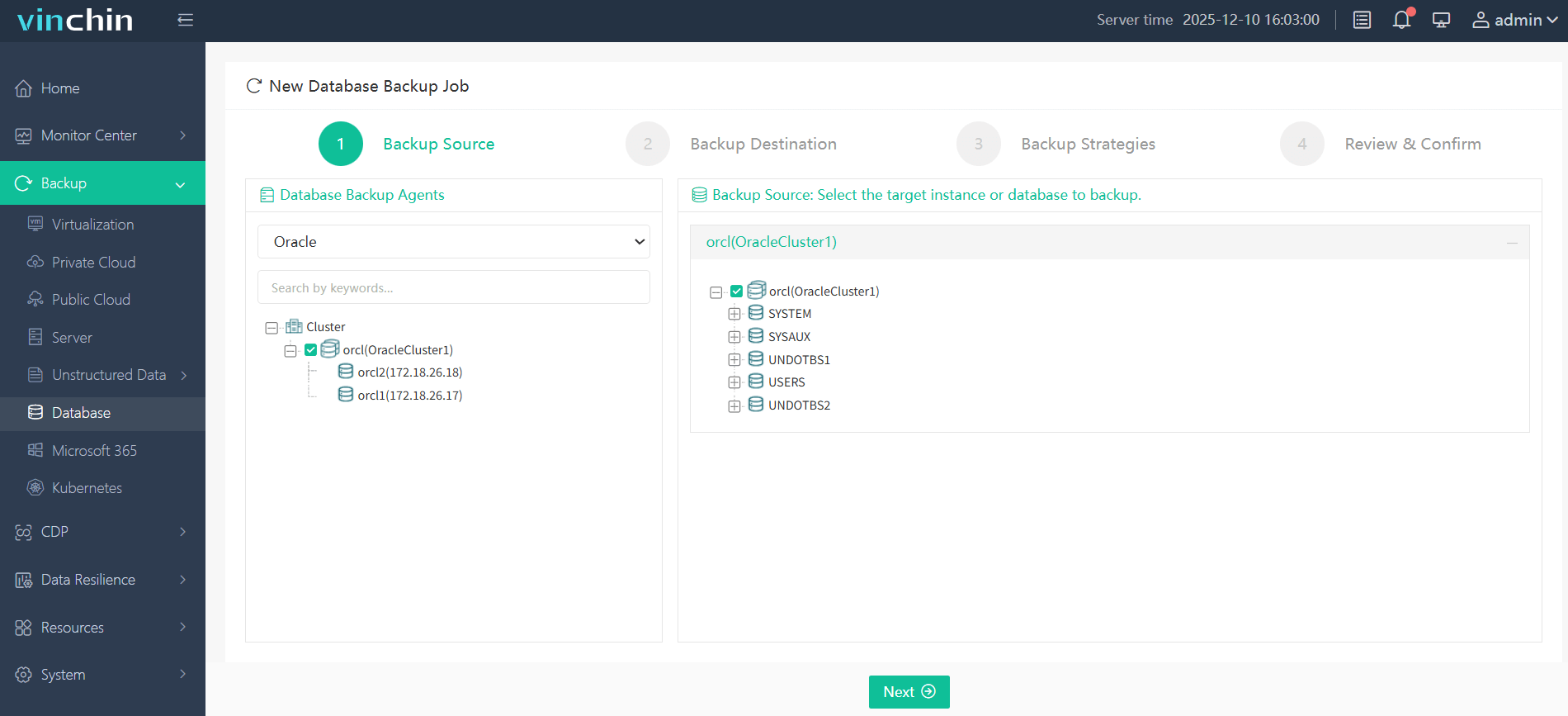
Step 1. Select the Oracle database to backup
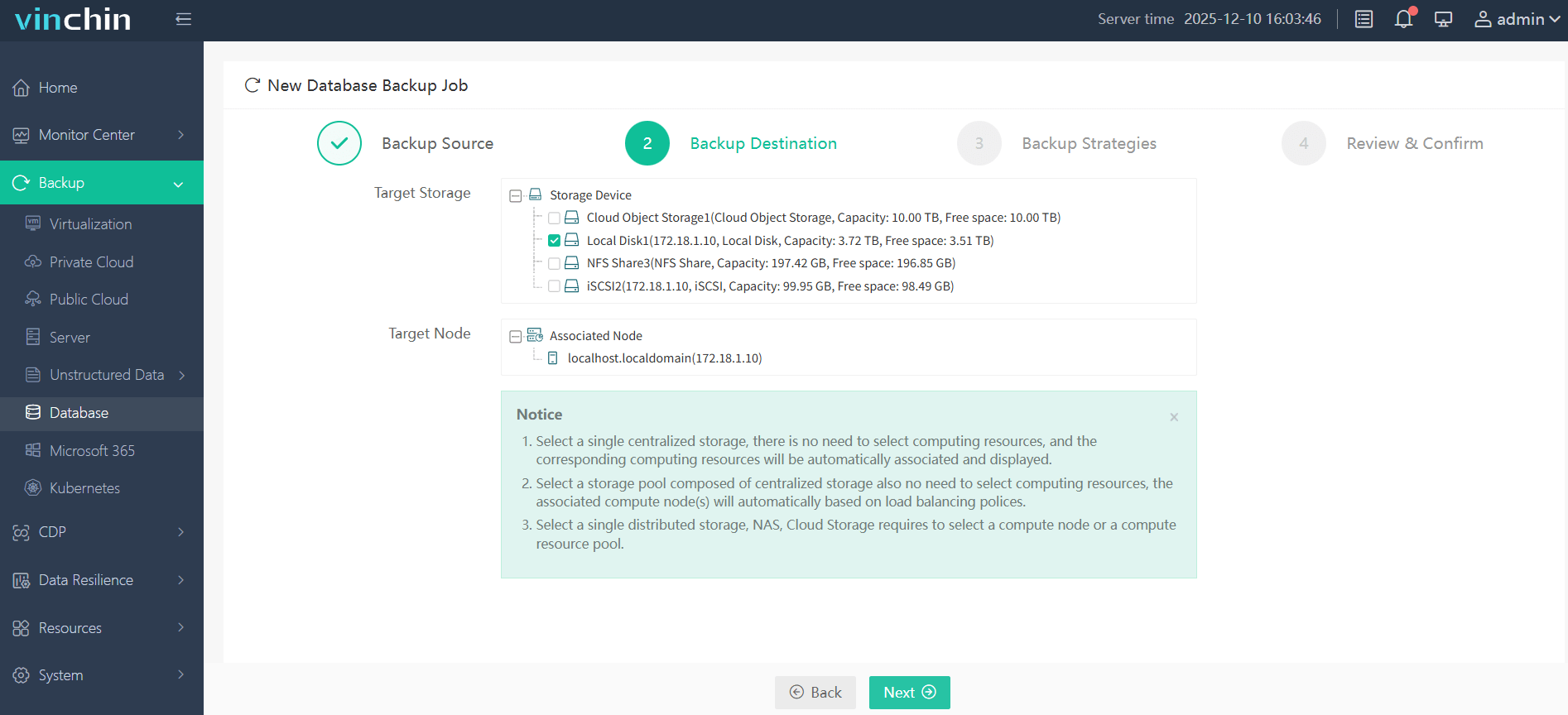
Step 2. Choose desired storage location
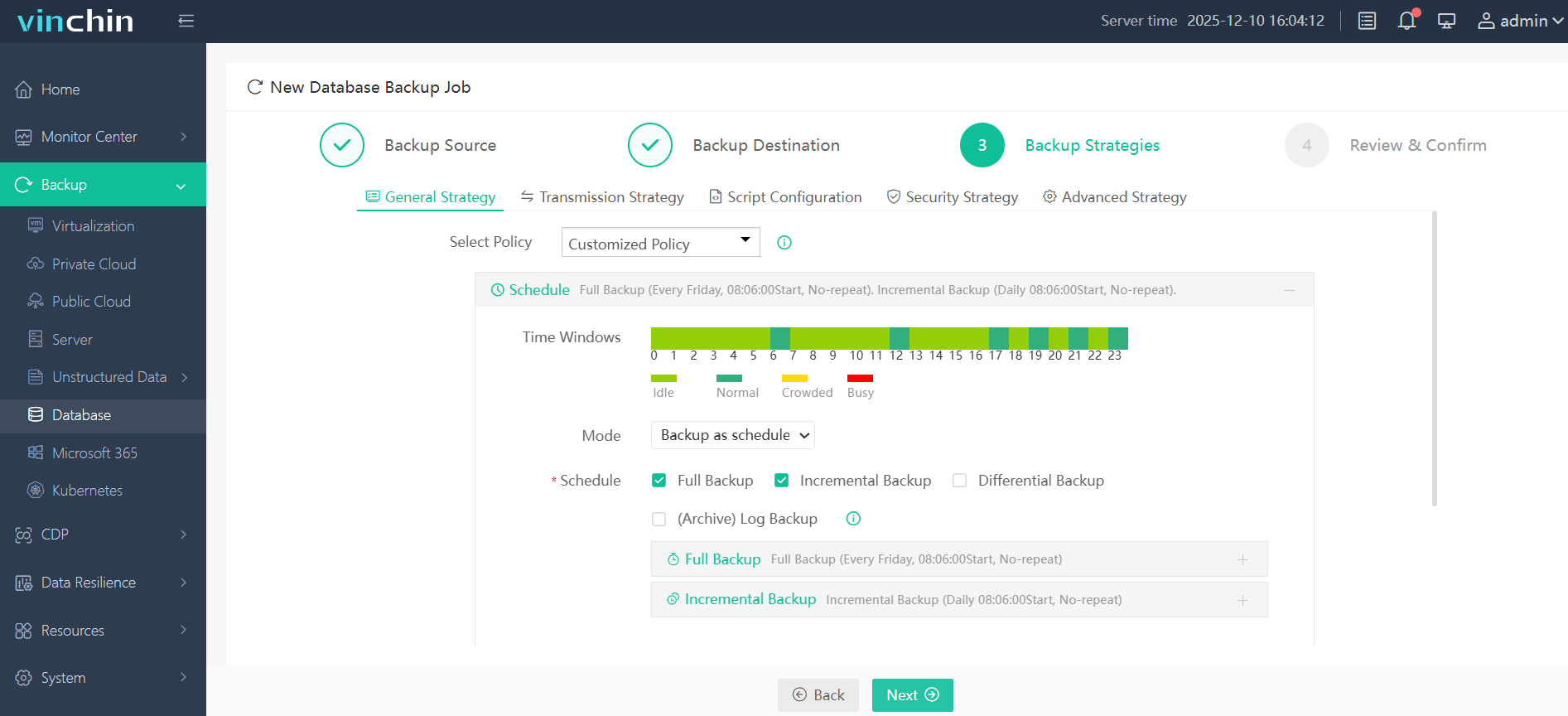
Step 3. Define schedule and other strategies
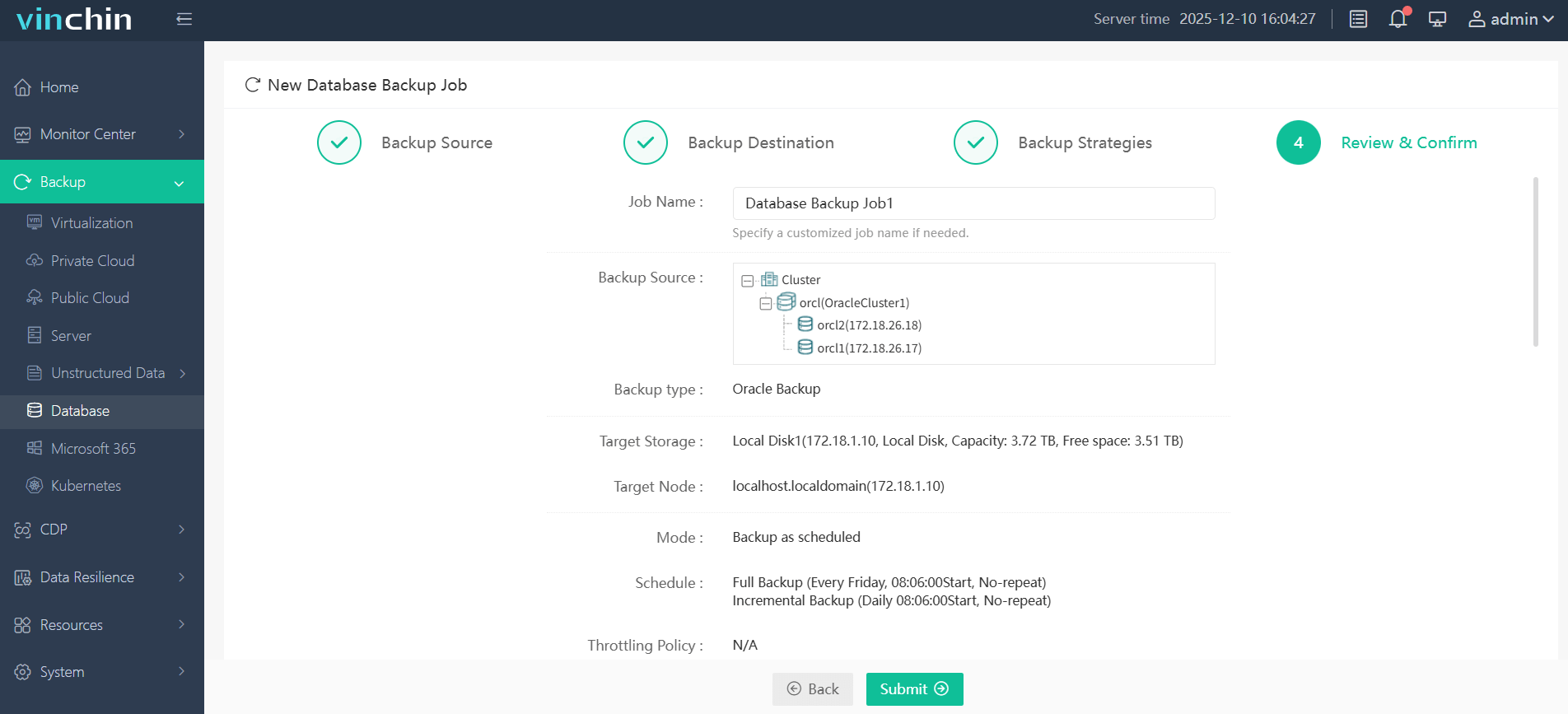
Step 4. Submit job with just one click
Recognized globally among enterprise users with top ratings for reliability, Vinchin Backup & Recovery offers every feature free for 60 days so you can experience seamless protection firsthand by clicking download below.
Oracle 19c RMAN Duplicate Database from Backup FAQs
Q1: Can I duplicate my production Oracle database while users are connected?
A1: Yes. You should include archived redo logs in backupsbut ensure users aren’t making schema changes mid-process for best results.
Q2: What should I do if my duplicated DB won’t open due to missing archive logs?
A2: Restore missing archive log backups into BACKUP LOCATION then rerun DUPLICATE command specifying UNTIL TIME before gap occurred.
Q3: How do I speed up large duplications?
A3: Use SECTION SIZE clause during initial BACKUP DATABASE command enable parallelism increase disk/network throughput exclude non-critical tablespaces via SKIP TABLESPACE option.
Conclusion
Duplicating an Oracle 19c database from backup using RMAN gives operations teams powerful options for testing,migration,and disaster recovery.Success depends on having complete validated backups,a well-configured auxiliary instance,and careful attention throughout.For even easier protection,Vinchin automates complex tasks so you can focus on business priorities instead of manual scripting every time.