Are you searching for a way to back up your Oracle database without adding more infrastructure? Many administrators want to avoid managing an extra recovery catalog database just for backups. Oracle RMAN’s nocatalog mode offers a direct path—simple setup, fewer moving parts—but what does it really mean in practice? And how can you use it safely while avoiding common pitfalls? In this guide, we’ll explore how oracle rman nocatalog works, walk through essential commands, highlight best practices, discuss limitations, and show how to protect your data with confidence.
What Is Oracle RMAN Nocatalog
Oracle RMAN (Recovery Manager) is the built-in tool for backing up and restoring Oracle databases of all sizes. By default, RMAN operates in two modes: catalog and nocatalog. In nocatalog mode, all backup metadata is stored inside the target database’s own control file—not in a separate recovery catalog database.
In nocatalog mode, every detail about your backups—what was backed up, when it happened, where files are stored—is written directly into the control file of the protected database itself. This makes setup quick because there’s no need to create or maintain another database just for backup records.
However, this simplicity comes at a cost: if you lose all copies of your control file or run out of space within it due to too many records or limited retention settings, you risk losing access to critical backup information needed during recovery operations.
Catalog vs Nocatalog Mode
Choosing between catalog and nocatalog mode depends on your environment’s needs and resources available. In catalog mode, you set up a dedicated recovery catalog—a separate Oracle database that stores detailed metadata about all backups across multiple databases over long periods of time. This enables centralized management features like reporting across environments or using stored scripts for automation.
With nocatalog, everything stays local—the control file holds all backup records for its own database only. This approach reduces administrative overhead but introduces some trade-offs:
The size of the control file limits how much history can be retained.
Backup metadata may be overwritten if too many backups occur within a short period.
If every copy of your control file is lost or corrupted before being backed up elsewhere (such as via OS-level snapshots), you could lose track of existing backups entirely.
The retention period is controlled by the parameter CONTROL_FILE_RECORD_KEEP_TIME; however, even if this value is high (for example 30 days), old records may still be purged early if space runs out in the fixed-size control file.
For small environments or when resources are tight—whether that means hardware budgets or staff time—nocatalog mode keeps things simple but requires careful attention to regular maintenance tasks like backing up your control files frequently.
How to Back Up Oracle Database Using RMAN Nocatalog?
Backing up an Oracle database with RMAN in nocatalog mode is straightforward once you know what steps matter most—and which options help ensure recoverability later on.
First make sure you’re logged into your server with correct environment variables set; use either oraenv or coraenv scripts as appropriate:
. oraenv
Next launch Recovery Manager:
rman
At the prompt connect directly to your target instance using operating system authentication:
CONNECT TARGET /
Now issue a robust backup command suitable for production environments:
RUN {
    BACKUP DATABASE FORMAT '/backup_location/full_%d_%T_%U.bkp'
    PLUS ARCHIVELOG FORMAT '/backup_location/arch_%d_%T_%U.bkp';
}
This command creates full backups along with archived redo logs—essential for point-in-time restores—and stores them in an organized directory structure using unique filenames based on date/time (%T) and unique identifiers (%U).
It’s also wise to include explicit commands that back up both current control files and server parameter files (SPFILE):
BACKUP CURRENT CONTROLFILE;
BACKUP SPFILE;
By default unless otherwise specified via FORMAT clauses above backup pieces land in $ORACLE_HOME/dbs—which may not have enough space nor proper protection from accidental deletion—so always specify safe storage paths suited for enterprise requirements.
Why Choose Nocatalog For Backups?
Why would someone pick oracle rman nocatalog instead of setting up a full-blown recovery catalog? Often it's about speed-to-value: smaller shops want minimal setup overhead while larger teams might lack bandwidth/staffing needed justifying another always-on DBMS instance purely dedicated toward tracking historical metadata alone!
Nocatalog shines when:
You manage only one/few databases at once,
Retention policies fit comfortably within what local disk/control-file sizing allows,
Orchestration/integration needs remain modest compared against sprawling multi-site/multi-region architectures found elsewhere,
But remember—the trade-off is responsibility! Without proactive monitoring plus regular exports/copies/disaster drills even small mistakes can snowball rapidly during emergencies.
Vinchin Backup & Recovery: Enterprise Protection for Your Oracle Backups
To further strengthen data protection beyond native tools like oracle rman nocatalog, consider Vinchin Backup & Recovery—a professional enterprise-level solution supporting today’s mainstream databases including Oracle (as well as MySQL, SQL Server, MariaDB, PostgreSQL, PostgresPro, and TiDB). For Oracle users specifically seeking advanced reliability and efficiency at scale, Vinchin Backup & Recovery delivers features such as incremental backup support, log backup capabilities with any-point-in-time recovery options, scheduled automated jobs tailored per policy requirements, robust storage protection against ransomware threats, and comprehensive integrity checks ensuring reliable restores every time—all designed to minimize risks while maximizing operational agility.
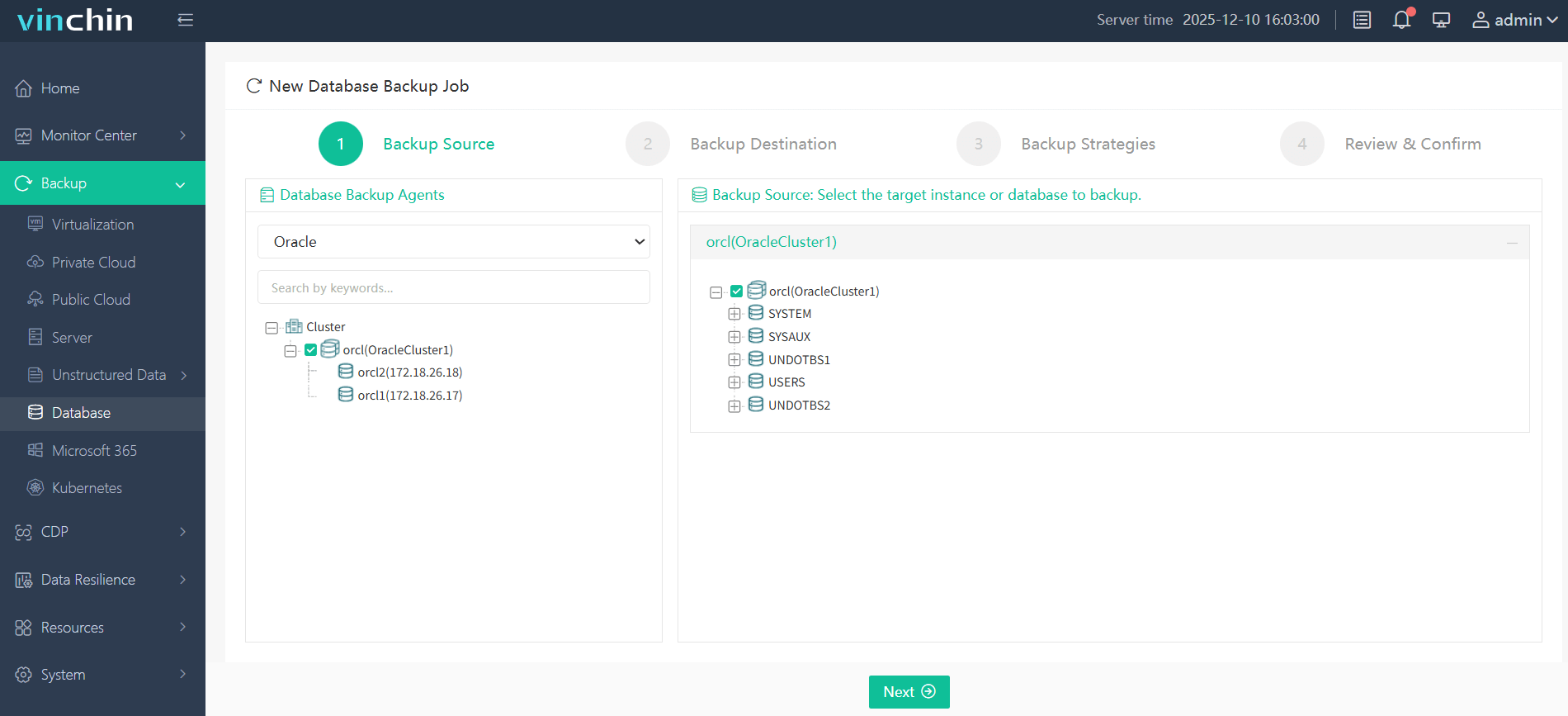
The intuitive web console simplifies every step of protecting your Oracle workloads
Step 1. Select the Oracle database to back up
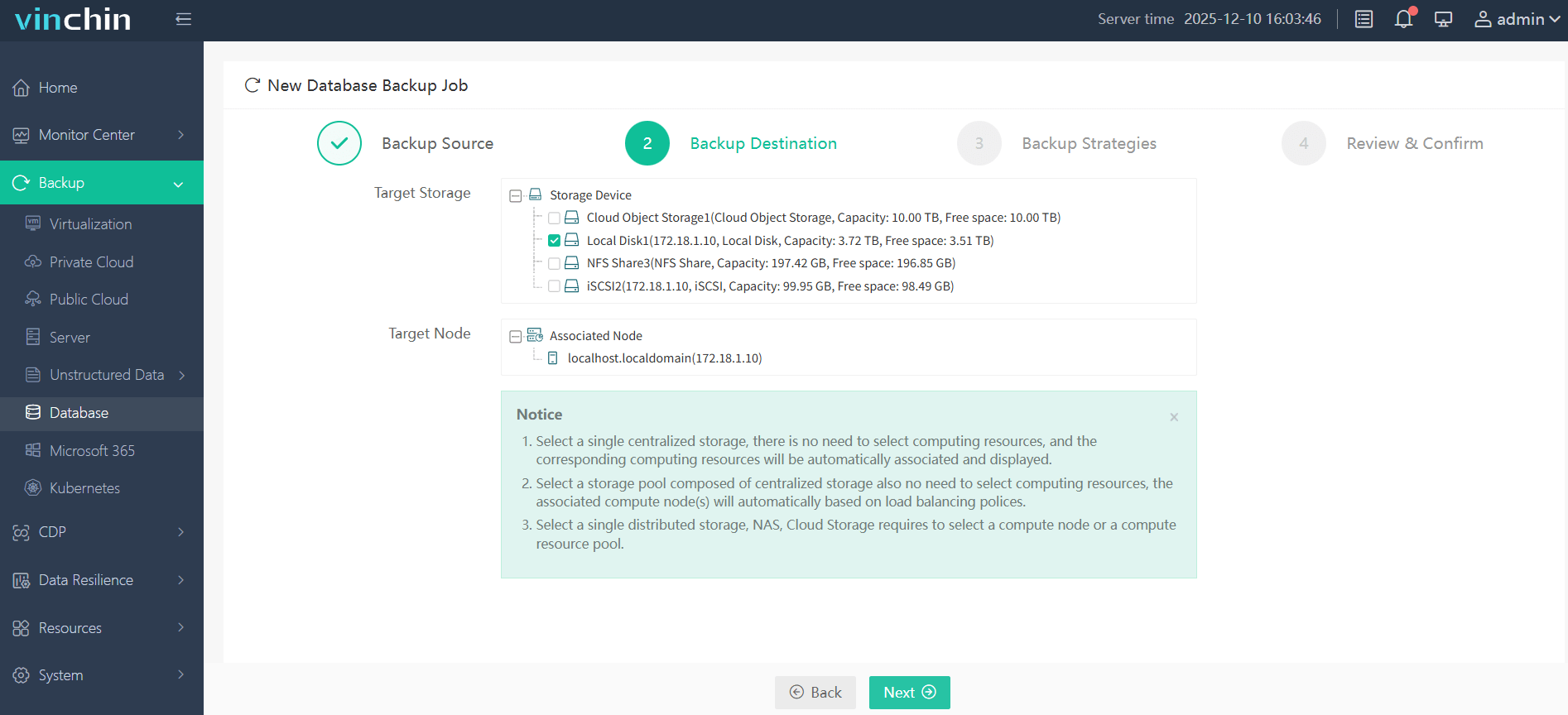
Step 2. Choose the backup storage
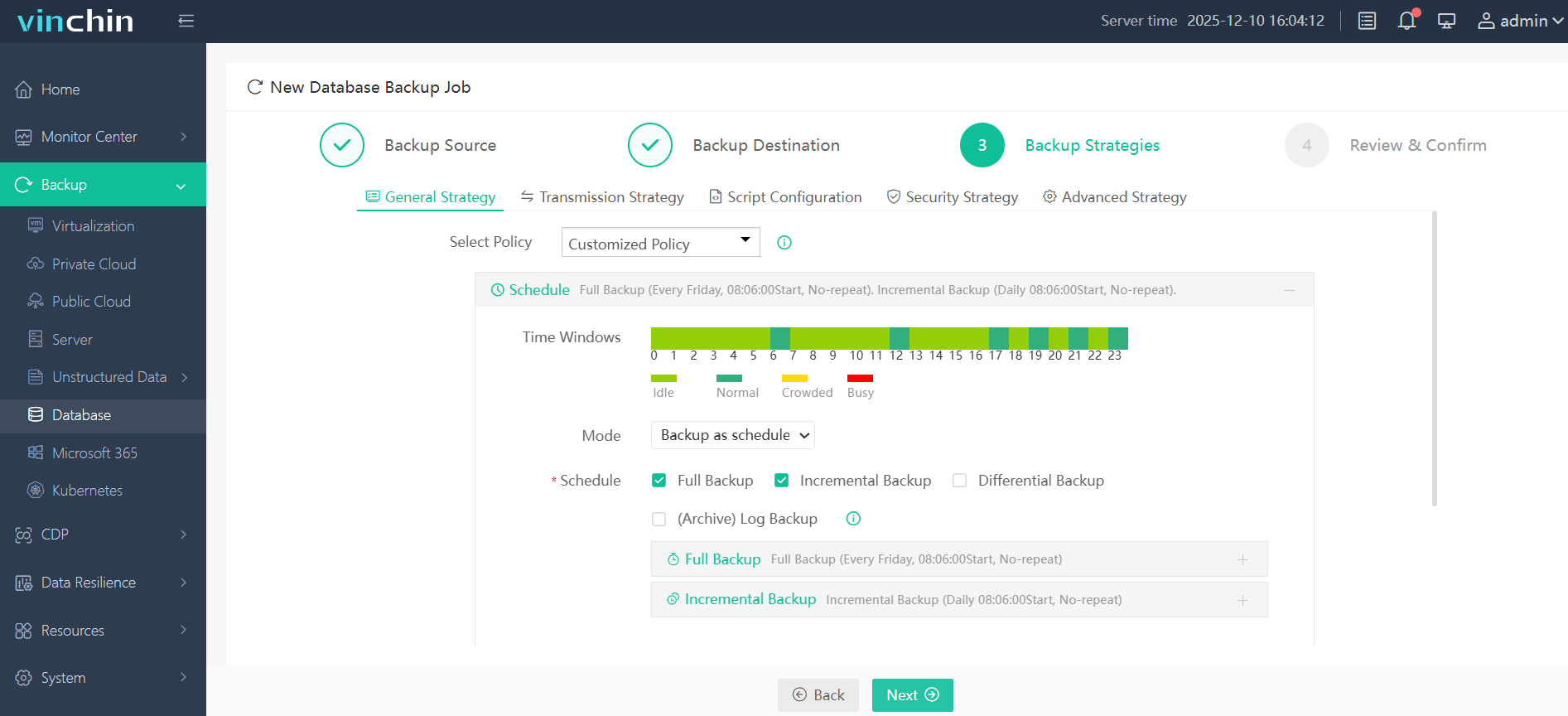
Step 3. Define the backup strategy
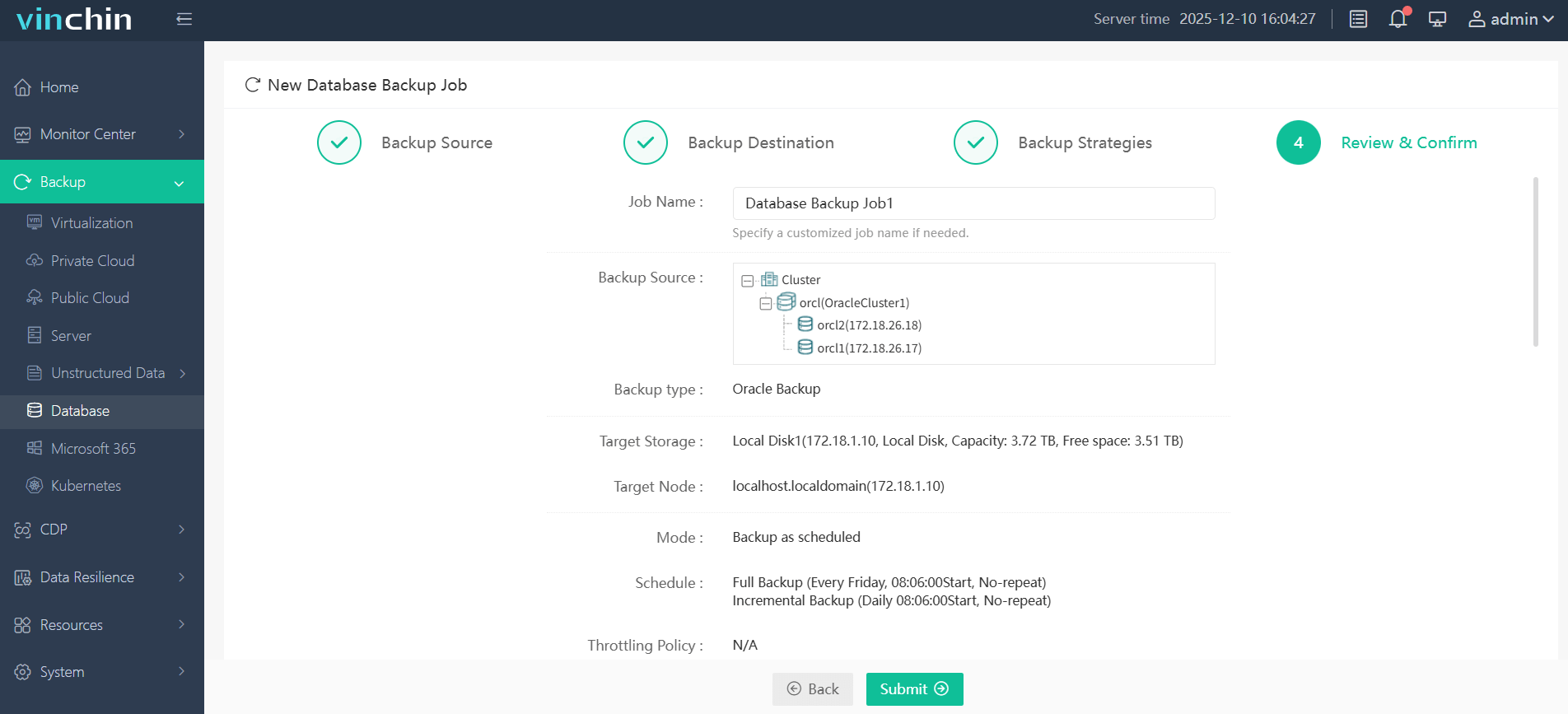
Step 4. Submit the job
Recognized globally by enterprises large and small—with top ratings from industry experts—you can experience Vinchin Backup & Recovery risk-free with a 60-day full-featured trial; click download now and discover why leading organizations trust it for mission-critical data protection.
Oracle RMAN Nocatalog FAQs
Q1: Can I restore my entire database if my only remaining copy is an autobackup made in nocatalog mode?
Yes; start RMAN connected as TARGET only > issue STARTUP NOMOUNT > RESTORE CONTROLFILE FROM AUTOBACKUP > MOUNT DATABASE > restore/recover datafiles normally afterward.
Q2: How do I check how much space my current control file uses storing RMAN records?
Query V$CONTROLFILE_RECORD_SECTION focusing on RECORDS_USED versus RECORDS_TOTAL columns under relevant types such as 'BACKUP SET'.
Q3: Is there any way to extend retention beyond what fits inside my current control file?
No direct method exists except increasing CONTROL_FILE_RECORD_KEEP_TIME parameter—but physical size limits still apply regardless.
Conclusion
Oracle rman nocatalog offers fast setup without extra infrastructure but demands disciplined management around frequent control-file exports plus routine monitoring tasks throughout its lifecycle—for advanced resilience consider solutions like Vinchin which deliver centralized oversight alongside powerful automation capabilities tailored specifically toward modern enterprise needs!