Do you need to keep certain Oracle database backups forever—even when your regular retention policy would delete them? Many administrators face this challenge due to strict compliance rules or business needs. For example, financial regulations may require you to preserve year-end database snapshots for up to seven years. Sometimes legal cases demand that you retain data until a dispute is resolved. Oracle RMAN offers a special feature called Keep Forever that helps you meet these requirements without manual intervention. In this article, we’ll explain what this feature is, how it works at every skill level, common pitfalls to avoid, and why it matters for your backup strategy.
What Is Oracle RMAN Keep Forever
Oracle RMAN (Recovery Manager) is the built-in tool for backing up and restoring Oracle databases. By default, RMAN uses a retention policy—such as redundancy or recovery window—to decide when backups become obsolete so they can be deleted automatically. But sometimes you need a backup that must never expire.
The Keep Forever option in RMAN lets you create an archival backup exempt from normal retention policies. These backups are never marked obsolete by RMAN routines; they remain available until you explicitly remove them. This feature is essential if your organization faces regulatory audits or must prove historical data integrity over many years.
A key requirement: Keep Forever relies on a recovery catalog rather than just the control file. The control file cannot store unlimited metadata about old backups; only a recovery catalog can track archival backups indefinitely. If you try to use Keep Forever without a catalog, your metadata may be lost as records age out of the control file.
Prerequisites and Common Pitfalls for KEEP FOREVER
Before creating an archival backup with Keep Forever, review these important prerequisites:
First, ensure your environment uses a dedicated recovery catalog registered with your target database—not just relying on the control file alone. Only the recovery catalog can store unlimited metadata about long-term backups; otherwise, older entries will eventually disappear as space runs out in the control file.
Second, connect using an account with sufficient privileges—typically SYSDBA or SYSBACKUP. Without these roles, some operations may fail silently or produce incomplete results.
Third, remember that Keep Forever does not work if you specify storage inside Oracle's Fast Recovery Area (FRA). Instead, always set your backup destination outside FRA—such as dedicated disk storage or network shares—to prevent accidental deletion during FRA cleanup cycles.
Fourth—and often overlooked—you cannot apply KEEP FOREVER directly to proxy copies (BACKUP PROXY COPY) or archive log-only jobs (BACKUP ARCHIVELOG). Always back up either full databases or tablespaces when using this feature.
Finally, regularly back up your recovery catalog itself! Losing it means losing all knowledge of which files are protected by KEEP FOREVER, putting compliance at risk.
Common pitfalls include:
Forgetting to monitor storage used by archival backups (since they're never deleted automatically).
Assuming changes made via CHANGE ... KEEP FOREVER update both disk files and metadata instantly—sometimes crosschecking is required.
Not testing restores from old archival sets periodically; compatibility issues may arise after major upgrades or platform changes.
By addressing these points early on, you'll avoid headaches down the road—and ensure true long-term protection of critical data assets.
Steps to Use Oracle RMAN Keep Forever
Once you've prepared your environment according to best practices above, you're ready to create an archival backup that will be kept forever:
1. Connect to Target Database and Recovery Catalog
Start RMAN using credentials with SYSDBA/SYSBACKUP privileges:
rman target sys@yourdb catalog rman/rman@catdb
2. Run Backup Command With KEEP FOREVER
Issue this command—making sure FORMAT points outside FRA:
BACKUP DATABASE FORMAT '/your/backup/location/db_%U.bkp' KEEP FOREVER;
Here %U generates unique filenames per piece so nothing gets overwritten accidentally.
To add clarity later on—which helps during audits—you can assign a tag:
BACKUP DATABASE FORMAT '/your/backup/location/db_%U.bkp' TAG 'YEAR_END' KEEP FOREVER;
3. Verify Your Backup
After completion check status using:
LIST BACKUP SUMMARY;
Look under the "KEEP" column—it should show "YES" next to your new set.
For more detail about specific tags:
LIST BACKUP TAG 'YEAR_END';
4. Restoring From A KEEP Backup
When restoring data months—or even years—later simply run standard restore commands within RMAN; any valid KEEP backup remains eligible regardless of other deletions:
    RESTORE DATABASE FROM TAG 'YEAR_END';
    RECOVER DATABASE;
5. Changing Existing Backups To KEEP FOREVER
If you've already created regular backups but now wish they were permanent use:
CHANGE BACKUP TAG 'YEAR_END' KEEP FOREVER;
6. Reverting A Backup To Normal Retention Policy
If requirements change later run:
CHANGE BACKUP TAG 'YEAR_END' NOKEEP;
Remember: Only those steps performed while connected through both target database and recovery catalog guarantee indefinite retention!
Managing and Monitoring Archival Backups
Creating long-term archives is only half of good governance—the other half is ongoing management:
Start by establishing regular reviews of all existing KEEP sets using commands like
LIST BACKUP OF DATABASE SUMMARY;
and
REPORT NEED BACKUP DAYS n;
to identify gaps since last full archive was taken.
Next schedule quarterly audits where someone verifies both presence and readability of each critical archive set—restoring sample tablespaces into test instances ensures no corruption has crept in unnoticed over time.
Use
CROSSCHECK BACKUP;
to synchronize actual disk contents versus what’s listed in catalogs—especially after hardware migrations or cloud archiving events where paths might change unexpectedly.
If space becomes tight—or business needs shift—you can safely revert any unneeded archive set back into normal rotation via
CHANGE BACKUP ... NOKEEP;
DELETE OBSOLETE;
This way only truly necessary archives consume precious storage resources indefinitely!
Finally document every action taken—including tags used dates locations tested—for future audit trails.
Why Choose Keep Forever for Backups?
Why not just increase your general retention policy instead? The answer lies in flexibility—and peace of mind during audits! With standard policies all old sets eventually expire together; but regulatory demands often require keeping select snapshots much longer than daily operational needs dictate.
Using Oracle's native KEEP FOREVER, admins can:
Preserve specific year-end quarter-end or event-driven images without bloating routine daily/weekly cycles
Prevent accidental loss due either human error ("oops!") or automated scripts running amok
Tag/archive mission-critical milestones separately so they're easy-to-find during urgent investigations
Imagine needing proof-of-data-existence from five years ago while still pruning everything else monthly—that’s exactly what this feature enables!
Achieve Long-Term Oracle Backup Retention with Vinchin Backup & Recovery
For organizations seeking streamlined management beyond native tools like RMAN’s Keep Forever option, Vinchin Backup & Recovery delivers robust enterprise-level protection tailored for today’s leading databases—including Oracle first and foremost alongside MySQL, SQL Server, MariaDB, PostgreSQL, PostgresPro, and TiDB. As an all-in-one solution designed for complex IT environments requiring reliable long-term retention strategies across multiple platforms simultaneously, Vinchin Backup & Recovery stands out through its support for batch database backup operations, flexible data retention policies (including GFS), cloud backup and tape archiving integration options, comprehensive integrity checks via SQL scripts before restoration attempts—even advanced source-side compression specifically optimized for Oracle workloads—all helping ensure compliance while minimizing administrative overhead and risk exposure across diverse infrastructures.
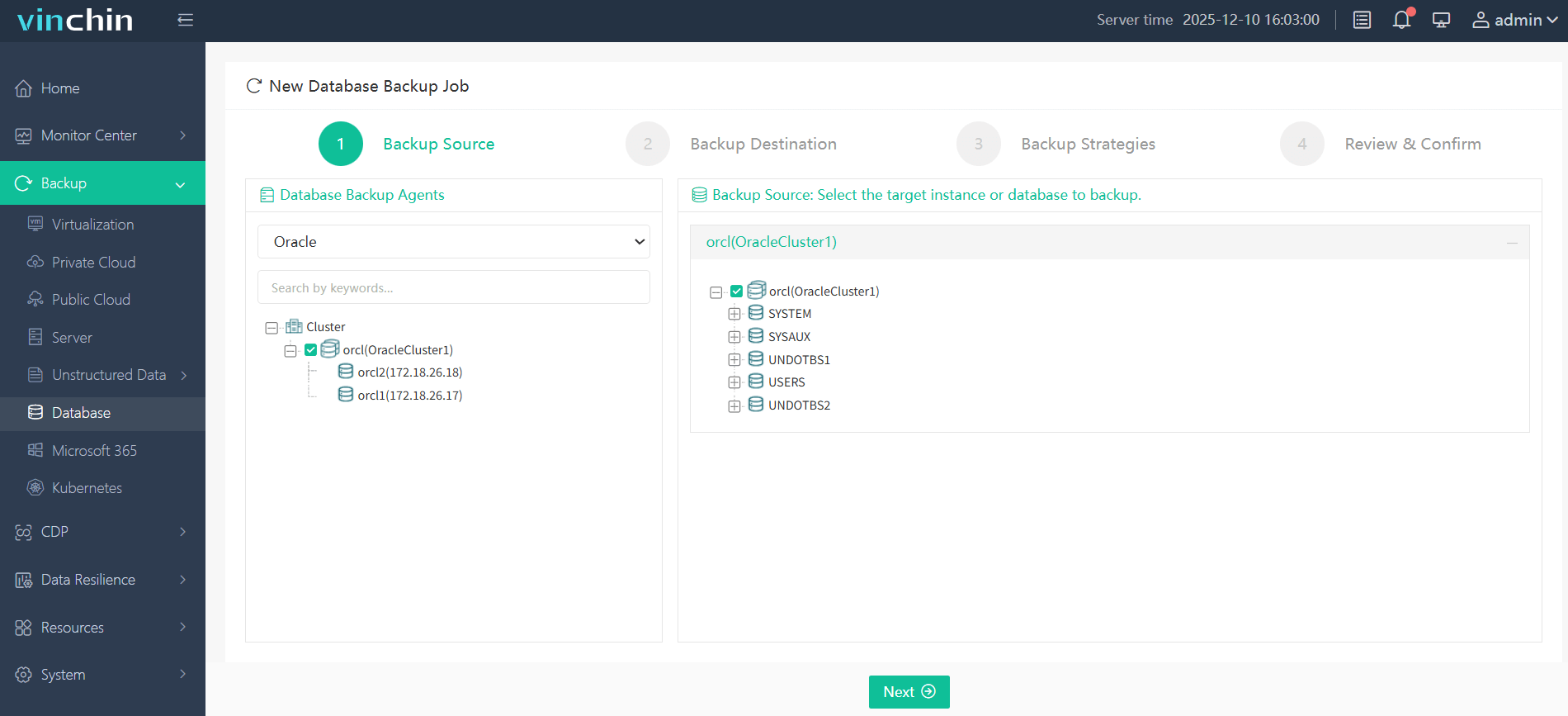
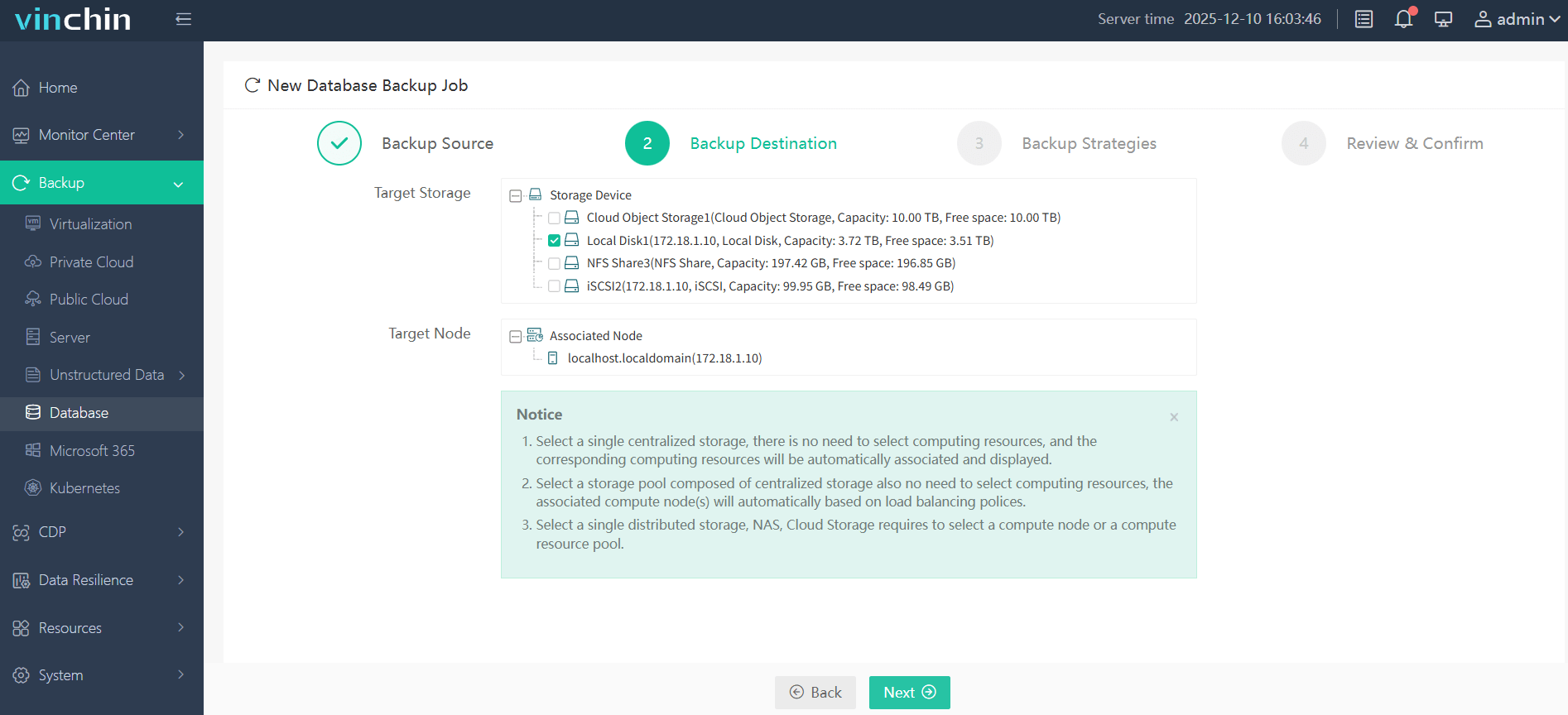
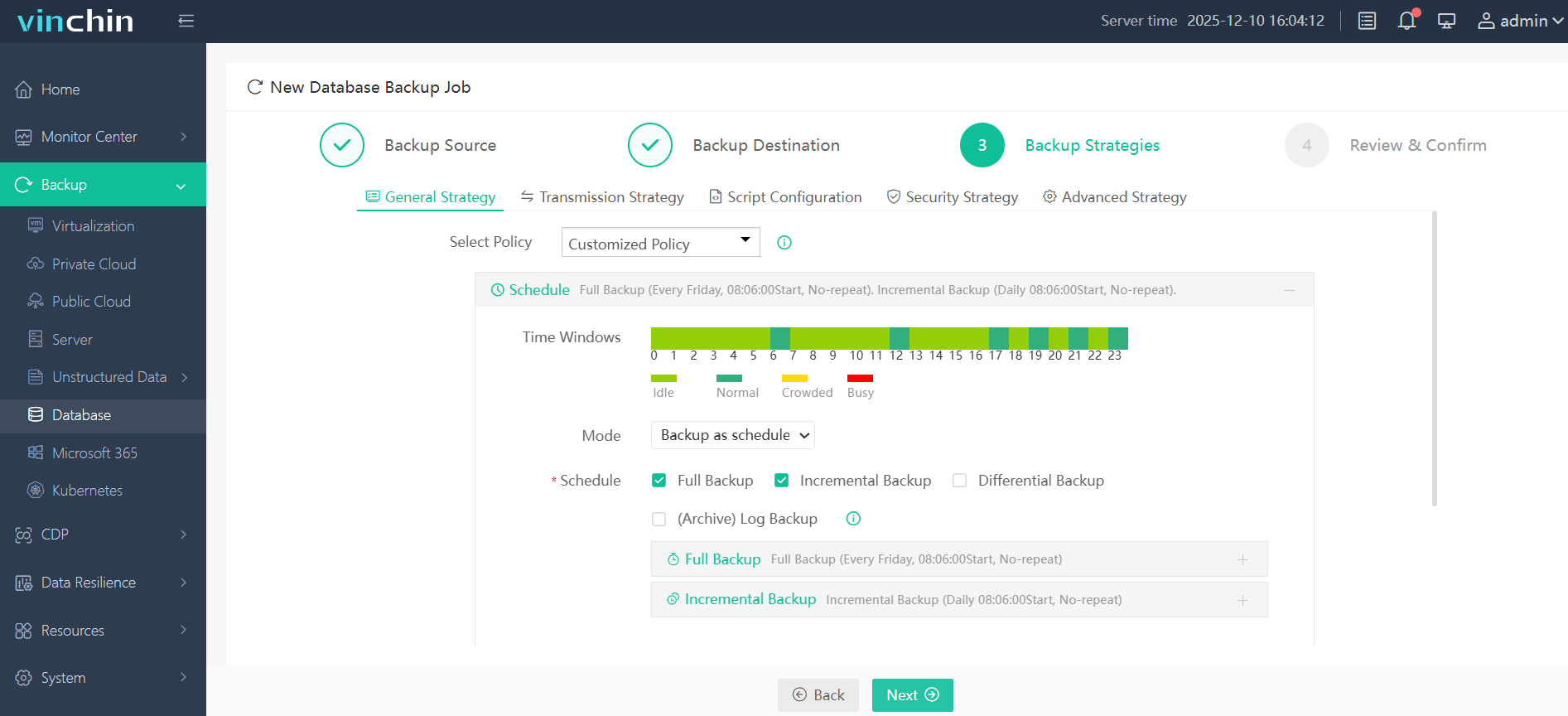
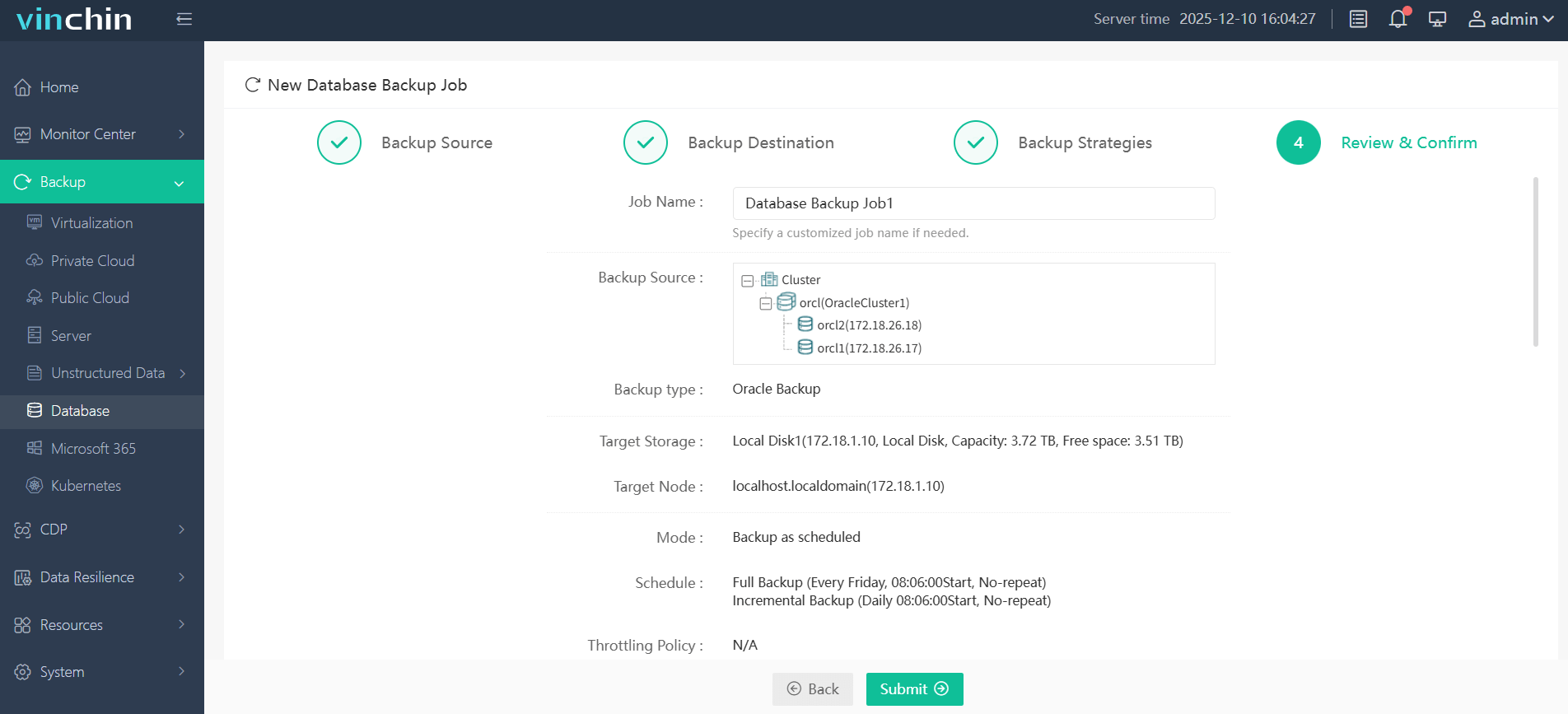
The intuitive web console makes protecting your Oracle database straightforward:
Step 1. Select the Oracle database to back up
Step 2. Choose the backup storage
Step 3. Define the backup strategy
Step 4. Submit the job
Vinchin Backup & Recovery enjoys global recognition among enterprise customers thanks to its reliability and high ratings—try every feature free for 60 days by clicking below and see why it’s trusted worldwide.
Oracle RMAN Keep Forever FAQs
Q1: Can I encrypt my KEEP FOREVER backups?
Yes; add encryption clauses such as ENCRYPTION before specifying format/tag options during creation if TDE/wallets configured beforehand .
Q2: Will creating KEEP FOREVER affect performance compared with normal full/differential jobs?
No ; process speed depends mainly on source size & hardware —the difference lies only in how long output files remain protected afterward .
Q3 : How do I delete an unwanted KEEP FOREVER archive ?
First run : CHANGE BACKUP TAG 'tag_name' NOKEEP ; then DELETE OBSOLETE ; finally CROSSCHECK/BACKUPS again .
Conclusion
Oracle RMAN’s Keep Forever feature gives administrators strong tools for meeting tough compliance demands while protecting vital business records indefinitely.For unified management across multiple platforms,Vinchin delivers automation,simplicity,and peace of mind.Try it free today—and see how effortless true long-term protection can be!