When a server’s disk fails or ransomware encrypts a whole machine, restoring files isn’t enough: you also need the operating system, drivers, applications and settings. Reinstalling everything by hand can take a day or more. Bare metal restore brings the whole machine back in one step.
Quick answer: Bare metal restore (BMR), also called bare metal recovery, restores a complete system image, including the operating system, applications, configuration and data, onto a machine with no operating system installed. You first create a bare metal backup (a full system image), then boot the target machine from recovery media and restore the image to it. On Windows, use a system image (Backup and Restore or wbadmin) with a recovery drive; on Linux, use Relax-and-Recover (ReaR); for many machines or restores to different hardware, use backup software with BMR support.
What Is Bare Metal Restore?
“Bare metal” means a computer with no operating system or software on it. A bare metal restore rebuilds that computer from a bare metal backup: an image-level backup of everything needed to boot and run the system, including:
Boot and system partitions (including the EFI/system reserved partition)
The operating system, drivers and system state (registry, Active Directory on domain controllers, and so on)
Installed applications and their configuration
Data volumes, if included
The process has two parts: boot the target machine from recovery media (a USB drive, ISO or network boot), then restore the image to its disks. When it finishes, the machine boots as it was at the time of the backup.
Bare Metal Restore vs. Other Recovery Methods
| Method | What it restores | Needs a working OS? | Typical use |
|---|
| File-level restore | Selected files and folders | Yes | Accidentally deleted or corrupted files |
| Volume restore | One partition or volume | Yes (usually) | A failed data volume |
| System state restore | OS configuration only | Yes | Repairing Windows configuration |
| Bare metal restore | Entire machine | No | Failed disk, unbootable system, ransomware, hardware replacement |
When Do You Need Bare Metal Restore?
Disk or hardware failure: replace the failed disk or server and restore everything onto it.
Unbootable system: a corrupted OS, failed update or boot problem that can’t be repaired quickly.
Ransomware recovery: wipe the infected machine and restore a clean image from before the attack.
Hardware refresh or migration: move a system to a new server or a different machine (physical-to-physical).
Standard deployment: roll out the same configured system to several machines or a test environment.
Advantages and Limitations
Advantages:
Complete recovery: OS, drivers, applications, settings and data come back together.
Faster than rebuilding: no OS installation, patching or application reconfiguration.
Fewer mistakes: the restored system matches the backup exactly, instead of relying on rebuild notes.
Works when the OS is gone: recovery runs from boot media, not from the damaged system.
Limitations:
Hardware compatibility: restoring to different hardware may need different storage or network drivers; not every tool handles this.
Overwrites the target: a BMR replaces everything on the target disks.
Disk size: the target disks usually need to be at least as large as the used space of the original.
Recovery point: you get the system as of the last backup; later changes are lost.
Licensing and identity: restored Windows systems may need reactivation on new hardware, and duplicate machines need unique names and SIDs.
What You Need Before a Bare Metal Restore
1. A bare metal backup stored somewhere other than the machine itself: an external disk, NAS, network share or backup server.
2. Bootable recovery media that can reach that backup: a Windows recovery drive or installation media, a ReaR ISO for Linux, or your backup software’s boot media.
3. Drivers for the target’s storage and network controllers, if they differ from the original.
4. A target disk at least as large as the original’s used space.
5. A tested process: practice a restore on a spare machine or VM before you need it.
Method 1: Bare Metal Backup and Restore on Windows 10/11
Windows 10 and Windows 11 include the legacy Backup and Restore (Windows 7) tool, which can create a full system image. (Windows 10 reached the end of support on October 14, 2025; the steps are the same on Windows 11.)
Step 1. Create a system image
1. Connect an external disk or make sure a network share is available.
2. Open Control Panel > Backup and Restore (Windows 7). (In Windows 10, you can also go to Settings > Update & Security > Backup > Go to Backup and Restore (Windows 7).)
3. Click Create a system image.
4. Choose where to save the backup (a hard disk, DVDs or a network location) and click Next.
5. Confirm the drives to include (the system and EFI partitions are selected automatically) and click Start backup.
You can also create the image from an administrator Command Prompt:
wbadmin start backup -backupTarget:E: -include:C: -allCritical -quiet
Step 2. Create recovery media
The system image is your data; you also need a way to boot the machine when Windows won’t start:
Search for Create a recovery drive, insert a USB drive (16 GB or more), and follow the wizard, or
Use Windows installation media created with Microsoft’s Media Creation Tool.
A system repair disc or recovery drive contains no backup data; it only boots the machine so you can restore the system image.
Step 3. Perform the bare metal recovery
1. Connect the disk with the system image (or make sure the network share is reachable).
2. Boot the target machine from the recovery drive or installation media.
3. With installation media, choose your language and click Repair your computer.
4. Select Troubleshoot > Advanced options > System Image Recovery.
5. Select the latest available image, or choose a specific image, and click Next.
6. Select Format and repartition disks if the target disk is new or should be wiped, then click Next.
7. Click Finish and confirm to start the restore. The machine restarts when it’s done.
The built-in tool is deprecated and has no scheduling across machines, central management or deduplication, so it’s best for individual PCs.
Method 2: Bare Metal Recovery on Windows Server with wbadmin
On Windows Server, install the Windows Server Backup feature and run:
wbadmin start backup -backupTarget:\\backupserver\bmr -allCritical -systemState -vssFull -quiet
-allCritical includes everything needed for a bare metal recovery. To restore, boot the server from Windows Server installation media, choose Repair your computer > Troubleshoot > System Image Recovery, and select the backup. For full step-by-step instructions with screenshots, see Windows Server bare metal backup and recovery.
Method 3: Bare Metal Restore on Linux with ReaR
Relax-and-Recover (ReaR) is the standard open-source BMR tool for Linux, included in RHEL, SUSE, Debian and Ubuntu repositories.
Step 1. Install and configure ReaR
# RHEL / Rocky / AlmaLinux
sudo dnf install rear genisoimage syslinux
# Debian / Ubuntu
sudo apt install rear
Edit /etc/rear/local.conf, for example to write the rescue ISO and a full backup to an NFS share:
OUTPUT=ISO
BACKUP=NETFS
BACKUP_URL=nfs://192.168.1.50/backups/rear
Step 2. Create the rescue image and backup
This creates a bootable rescue ISO and a tar backup of the system on the NFS share.
Step 3. Restore
1. Boot the target machine from the rescue ISO.
2. Select Recover in the boot menu and log in as root.
3. Run:
ReaR recreates the partitions, file systems and boot loader, restores the files, and makes the system bootable. Reboot when it finishes.
Method 4: Bare Metal Restore with Vinchin Backup & Recovery
Built-in tools work for single machines, but they don’t scale to dozens of servers and PCs. Vinchin Backup & Recovery backs up Windows and Linux servers, workstations and PCs from one web console, with scheduled full and incremental backups, deduplication, compression, encryption and ransomware protection.
From these backups, you can perform file-level restore, partition-level restore, or bare metal restore to the original machine or to new hardware (P2P), and also restore physical systems as virtual machines (P2V).
Back up the machine:
Just select the Windows/Linux server, workstation, or PC > select backup destination to store the backup data > select backup strategies like schedule and incremental backup > submit the job
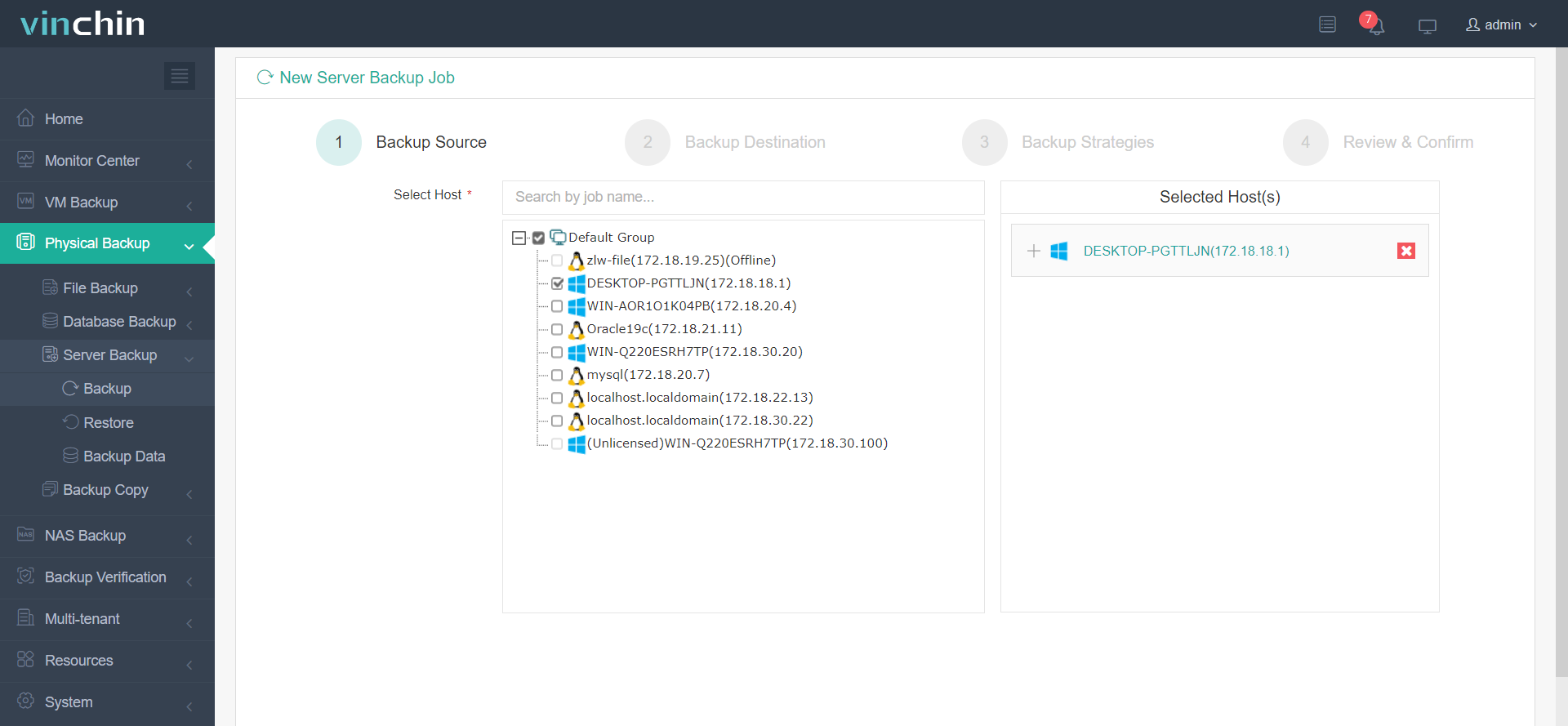
The operating system and applications will be backed up to let you perform a bare metal restore to the original machine or dissimilar hardware later.
Vinchin Backup & Recovery can also help backup other appliances and applications like virtual machine, NAS, database, file, etc. It has been selected by thousands of companies and you can also start a 60-day full-featured free trial here. Also, contact us, leave your requirements, and then you will receive your tailored solution. We have established partnerships with reputable companies all over the world so if you would like to do a local business, you can select a local partner here.
Restoring to Dissimilar Hardware
Restoring to a machine with a different motherboard, storage controller or network card is the hardest part of BMR:
Windows: the restored system may fail to boot (for example with an INACCESSIBLE_BOOT_DEVICE error) if it lacks the new storage controller driver. Use a tool that injects drivers during restore, or add the drivers to the recovery environment.
Linux: ReaR rebuilds the initramfs with the drivers available in the rescue image; include the modules needed for the target hardware, and check network interface names after the restore.
Firmware mode: restore a UEFI system to a machine booting in UEFI mode, and a legacy BIOS system in BIOS mode.
Activation and licenses: Windows and some applications may need reactivation after moving to new hardware.
Always test a restore onto the hardware you’d actually use in a disaster.
Bare Metal Restore FAQs
Q1: What’s the difference between bare metal backup and bare metal restore?
A bare metal backup is the full system image you create in advance. A bare metal restore is the process of booting a blank machine and restoring that image onto it.
Q2: Is a system repair disc or recovery drive a backup?
No. It only boots the computer and gives you recovery tools. You also need a system image or bare metal backup stored elsewhere to restore from.
Q3: Can I restore a bare metal backup to a different computer?
Yes, but it depends on the tool. Windows’ built-in System Image Recovery works best on the same or very similar hardware. Backup software with dissimilar hardware support handles different controllers and drivers more reliably.
Q4: Can I restore to a smaller disk?
Often yes, as long as the target disk is larger than the space actually used on the original volumes, and the tool supports resizing partitions. Windows’ built-in tool requires a disk at least as large as the original.
Q5: How often should I take bare metal backups?
At least before major changes (updates, application installs) and on a regular schedule, with incremental backups in between. For servers, daily backups are common.
Q6: Can bare metal restore help after a ransomware attack?
Yes. Wipe the infected machine and restore an image taken before the infection. Scan the backup before restoring, and keep backups on immutable or offline storage so attackers can’t encrypt them too.
Sum Up
Bare metal restore is the fastest way to bring a failed, infected or replaced machine back to a fully working state. Create regular bare metal backups, keep recovery media ready, test restores, and plan for dissimilar hardware. Built-in tools like Windows system images and ReaR work for individual machines; for many servers and PCs, a centralized backup solution saves time and reduces risk.
Try Vinchin Backup & Recovery free for 60 days.