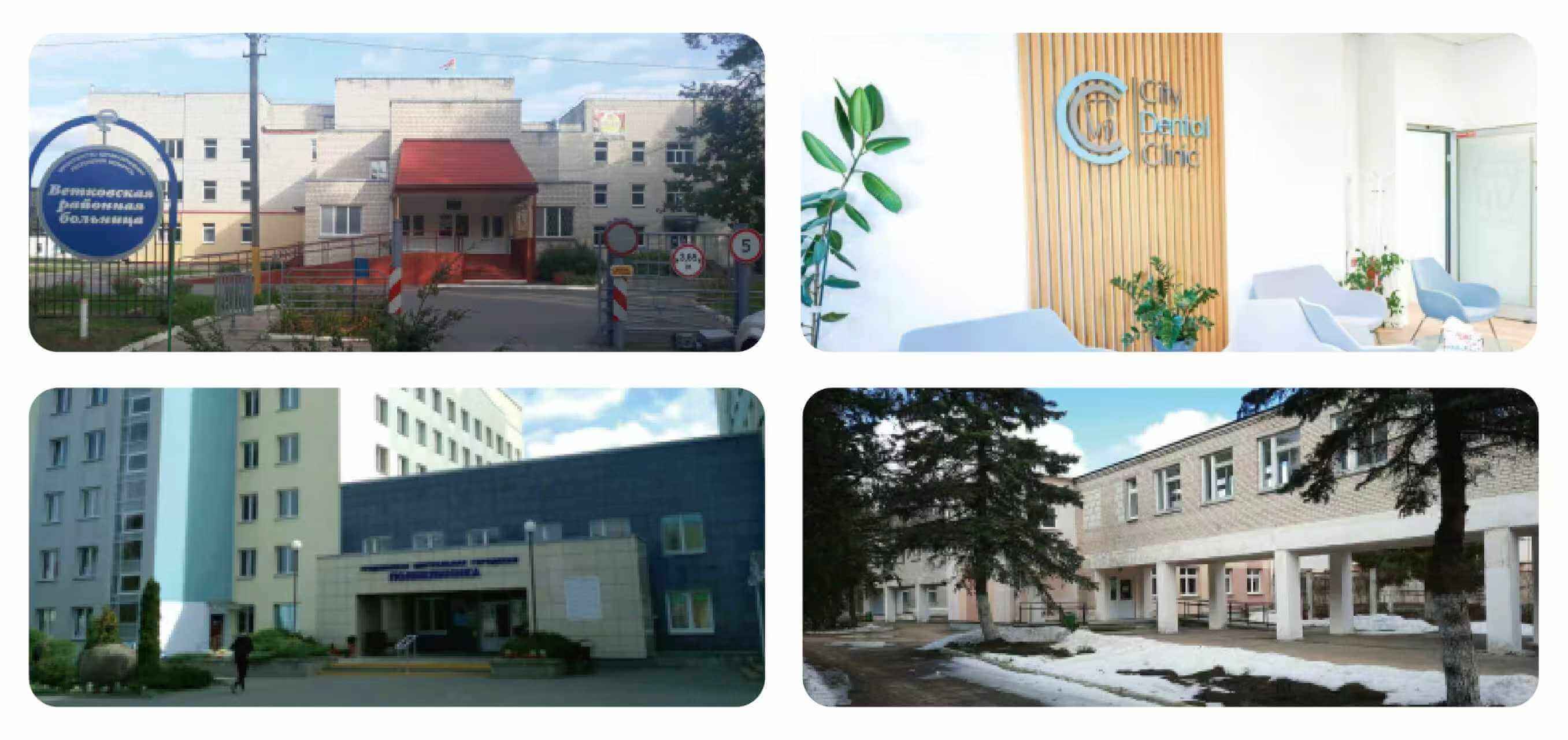
About Belarusian Medical Institutions
This case study covers multiple healthcare institutions in Belarus, including multidisciplinary hospitals, specialized clinics, and district outpatient clinics. These organizations operate different virtualization platforms to support critical healthcare information systems.
Their IT infrastructures support essential applications such as Hospital Information Systems (HIS), Picture Archiving and Communication Systems (PACS), Electronic Medical Records (EMR), and Pharmacy Information Systems (PIS). These systems are essential to daily medical operations, including patient registration, diagnosis, medical imaging, and access to patient records.
With limited IT resources and increasingly complex virtualized environments, these institutions need a reliable, efficient, and easy-to-manage backup solution that can adapt to different platforms while maintaining the availability of critical healthcare services.
Business Challenges
Heterogeneous Virtualization Environments Complicate Backup Management
Different healthcare institutions run their workloads on various virtualization platforms, including VMware vSphere, Microsoft Hyper-V, Proxmox VE, and zVirt. Without a unified data protection strategy, IT teams must manage multiple environments and compatibility requirements, making backup deployment and ongoing management more complex.
24/7 Healthcare Operations Require Minimal Downtime
Critical medical systems must remain available around the clock. Any unplanned downtime can disrupt patient registration, diagnostic services, and access to medical images. Failures involving systems such as HIS and EMR can even affect patient safety, making rapid and reliable recovery essential.
Growing Medical Data Volumes Strain Backup Resources
Medical data comes in different formats and grows at different rates. PACS generates large medical imaging files and continuously increasing data volumes, while EMR records must be retained for extended periods to meet regulatory requirements.
Traditional backup methods can consume substantial time, storage resources, and network bandwidth, potentially affecting production systems and making backup operations increasingly difficult to manage.
Why Choose Vinchin?
After assessing their data protection requirements, these healthcare institutions selected Vinchin Backup & Recovery for its enterprise-grade VM backup capabilities and adaptability to heterogeneous virtualized environments.
Key capabilities included:
Broad virtualization compatibility: Support for VMware vSphere, ESXi, vCenter, Hyper-V, Proxmox VE, XenServer, and zVirt.
Agentless backup: Protect virtual machines without installing backup agents inside individual VMs, simplifying deployment and reducing maintenance overhead.
Efficient backup technologies: Forever incremental backup and CBT help reduce backup time, storage consumption, and production network impact. In VMware vSphere environments, LAN-Free data transfer can further reduce the load on the production network.
Flexible recovery options: Instant VM recovery and file-level recovery help IT teams restore critical workloads and individual files more efficiently.
Vinchin Solution
To address these challenges, the healthcare institutions deployed Vinchin Backup & Recovery to protect their virtualized environments without requiring major changes to their existing IT infrastructures.
The solution combines several core capabilities to support efficient backup operations and reliable recovery across different virtualization platforms.
Agentless Backup for Rapid Deployment Across Virtualization Platforms
Vinchin supports agentless backup for major virtualization platforms, including VMware vSphere, ESXi, vCenter, Microsoft Hyper-V, Proxmox VE, XenServer, and zVirt.
By eliminating the need to install backup agents inside every virtual machine, Vinchin simplifies deployment, reduces resource consumption, and lowers routine maintenance requirements. This allows IT teams to adapt backup protection to different virtualization environments more efficiently.
Efficient Backup Technologies for Large Medical Datasets
Vinchin combines multiple technologies to improve backup efficiency and reduce the impact on production environments.
Forever-Incremental Backup: After the initial full backup, subsequent jobs capture only changed data blocks, reducing backup time and storage consumption.
Changed Block Tracking (CBT): CBT identifies changed blocks so that incremental backups can avoid processing unchanged data. This is particularly useful for PACS environments that generate substantial amounts of new medical imaging data every day.
Optimized Data Transfer: For VMware vSphere environments, LAN-Free data transfer through SAN-based backup and HotAdd transport allows backup data to be sent through dedicated storage paths rather than the primary production LAN, minimizing network congestion and reducing the impact on business applications. For Hyper-V environments, agentless backup combined with forever incremental backup reduces the volume of data transferred over the production network.
Flexible Recovery to Support Business Continuity
Vinchin provides both VM-level and file-level recovery options to help healthcare IT teams respond to different data loss scenarios.
Instant VM Recovery: Where supported by the virtualization platform, administrators can start a failed virtual machine directly from its backup through NFS mounting. The recovered VM can resume serving users while its data is migrated or the original environment is repaired in the background, reducing the recovery time objective (RTO) to seconds.
File-Level Recovery: Administrators can restore individual files or folders from VM backups without recovering the entire virtual machine. This makes it easier to handle accidental deletion or file corruption and improves day-to-day IT operational efficiency.
The Results
Key Benefits
By implementing Vinchin Backup & Recovery, these Belarusian healthcare institutions gained a more flexible and efficient approach to protecting critical virtualized workloads.
Simplified backup deployment: Agentless protection eliminates the need to install agents inside individual VMs.
Broader platform coverage: A single backup solution supports heterogeneous environments running VMware, Hyper-V, Proxmox VE, XenServer, and zVirt.
Reduced backup overhead: Forever incremental backup and CBT reduce unnecessary data processing, while LAN-Free transfer in VMware vSphere environments helps minimize production network impact.
More efficient recovery: Instant VM recovery can reduce RTO to seconds where supported, while file-level recovery allows individual files and folders to be restored without recovering entire VMs.
Improved healthcare service continuity: More flexible backup and recovery capabilities help protect critical systems such as HIS, PACS, and EMR.
Conclusion
The experience of these Belarusian healthcare institutions demonstrates how Vinchin Backup & Recovery can address the data protection challenges of heterogeneous virtualized environments in the healthcare industry.
By combining broad virtualization compatibility, agentless backup, forever incremental technology, CBT, and flexible recovery options, Vinchin provides an adaptable data protection solution for healthcare organizations running critical systems across VMware, Hyper-V, Proxmox VE, and other virtualization platforms.